Press Release 24/07/2023
UNIVERSITY STATISTICS 2022
There were over 70,000 enrolments at Basque universities in the 2021/22 academic year
The gender gap among university teaching staff disappeared
In the 2021/22 academic year, there were 70,503 enrolments at universities with centres located in the Basque Country, 0.8% more than in the previous year, according to Eustat data. This is the fifth consecutive year of growth and the first since the 2004/05 academic year in which the number of enrolments has exceeded 70,000.
Students enrolled at Basque Country universities by study level. 2021/22
| | Total | Men | Women | Public | Private | Variation with respect to the previous course (%) |
| | | | | | | |
| Total | 70.503 | 32.192 | 38.311 | 49.397 | 21.106 | 0,8 |
| | | | | | | |
| Degrees | 58.998 | 26.575 | 32.423 | 41.288 | 17.710 | 0,4 |
| Post-graduate | 11.505 | 5.617 | 5.888 | 8.109 | 3.396 | 2,7 |
| Official Masters | 6.809 | 3.315 | 3.494 | 4.071 | 2.738 | 3,8 |
| Doctorate | 4.696 | 2.302 | 2.394 | 4.038 | 658 | 1,2 |
Date July 24, 2023
Source: Eustat. University statistics
Seven out of ten students opted to study at public universities. This proportion remained the same for undergraduate studies, but it was a different scenario at the higher levels. While 40% of master’s students chose the private system, just 14% chose it for their doctoral thesis.
Women were in the majority in Health and Education studies; men predominated in Engineering
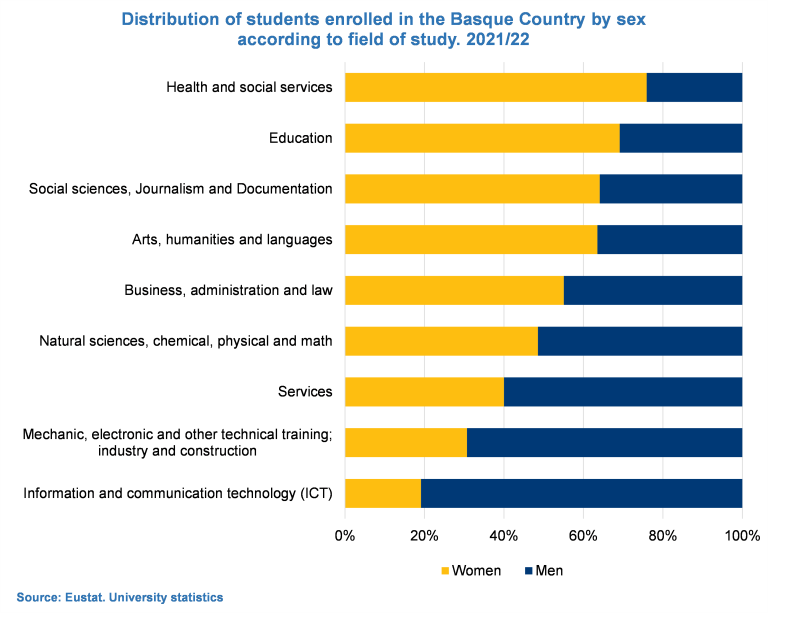
Women represented 54% of university students. However, distribution by gender varied depending on the chosen field of study. More than 70% of students in the fields of Health and Social Services and Education were women. The most female-dominated degrees were Early Childhood Education, Pedagogy and Nursing.
At the other end of the scale, technical fields of study had a higher proportion of men. Women accounted for less than 10% of students enrolled in Marine Engineering, Automotive Engineering, Digital Industry and Mechatronic Engineering degrees.
Degrees in the business and sciences sector saw an even distribution of students.
Public universities gained ground on private universities with regard to dual degrees
Dual degrees are programmes that allow those studying them to simultaneously obtain two qualifications in less time than they would need if they were to study them separately. In the 2021/22 academic year, 3,059 people enrolled in a dual degree, 5% more than in the previous year, thus continuing the upward trend seen in this type of study since its emergence.
The number of places offered on dual degrees was higher at private universities and this was reflected in enrolment data: 7 out of 10 dual degree students chose to study at a private university.
However, the trend in recent years has varied depending on university ownership. While private universities saw four years of very slight, practically constant growth of around 2,100 enrolments, public universities doubled their student population in the same period. In this regard, it is worth nothing that the increase in enrolments observed in the last academic year was attributable to the rise in the number of dual degrees at public universities.
There was a drop in the number of undergraduate degree holders
14,060 people completed their studies at universities with centres located in the Basque Country in the 2021/22 academic year, 2.4% less than in the previous year. This decrease was due to a decline of more than 500 in the number of graduates in undergraduate studies (-5%). However, the rise in both master’s student graduations (4%) and doctoral thesis defences (6%) lessened the overall drop in graduate numbers.
The distribution of graduates by branch of study was similar to that of previous years. Just over half of graduates obtained a qualification in the Social and Legal Sciences branch, 23% graduated in Engineering and Architecture and 13% graduated in Health Sciences. The remaining 14% were distributed between those who graduated with Science degrees and those who completed Arts and Humanities studies.
97.5% of people who sat the university entrance exams passed
97.5% of the 13,075 young people who sat the entrance exams for the University of the Basque Country passed. The average mark obtained after weighting the marks from upper secondary education and the general stage of the exams was 7.4 points. However, women achieved an average of 7.6, two tenths more than men.
Those who opted for the dual degree in Physics and Electronic Engineering as their first choice when registering for the university entrance exams attained the highest average mark (9.1 points), followed by those who chose Medicine, Physics and Biotechnology. There were hardly any differences between men and women in this regard. Among the twelve degrees at the top of this ranking were seven dual degrees, demonstrating the growing interest of prospective university students in this type of joint programme.
There was parity among teaching staff at universities in the Basque Country
There were 6,191 teaching staff at Basque universities, a quarter of whom taught at private universities.
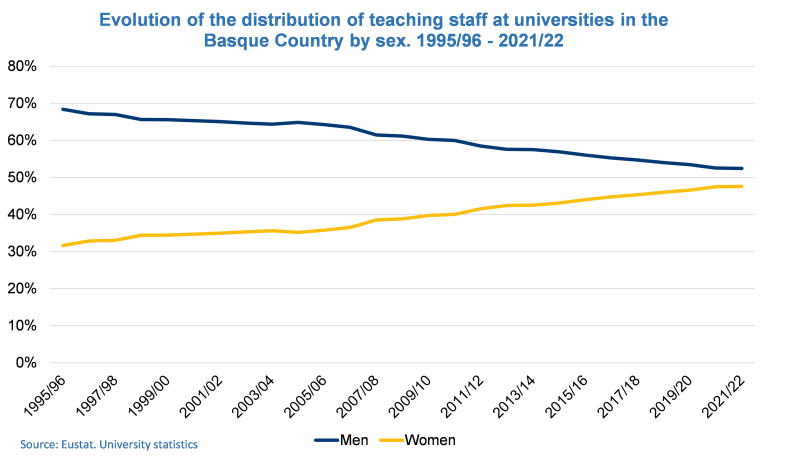
The gender gap among university teaching staff has gradually narrowed in recent years. In the 1995/96 academic year, only 3 in 10 teachers were women. However, this proportion has been levelling out and in the 2021/22 academic year, there was an even distribution by gender. The number of male personnel has remained almost constant over the last 25 years, ranging from 3,000 to 3,500 teachers. Meanwhile, in the same period, the number of female teachers doubled, rising from 1,464 in the 1997/98 academic year to 2,947 in 2021/22, the last academic year analysed.
For further information:
Euskal Estatistika-Erakundea / Basque Statistics Institute
C/ Donostia-San Sebastián, 1 01010 Vitoria-Gasteiz
Press Service: servicioprensa@eustat.eus Tel.: 945 01 75 62