Press Release 11/06/2015
STRUCTURAL INDICATORS. EUROPE 2020
The Basque Country improved in the Europa 2020 indicators for Employment, Climate & Energy and Education
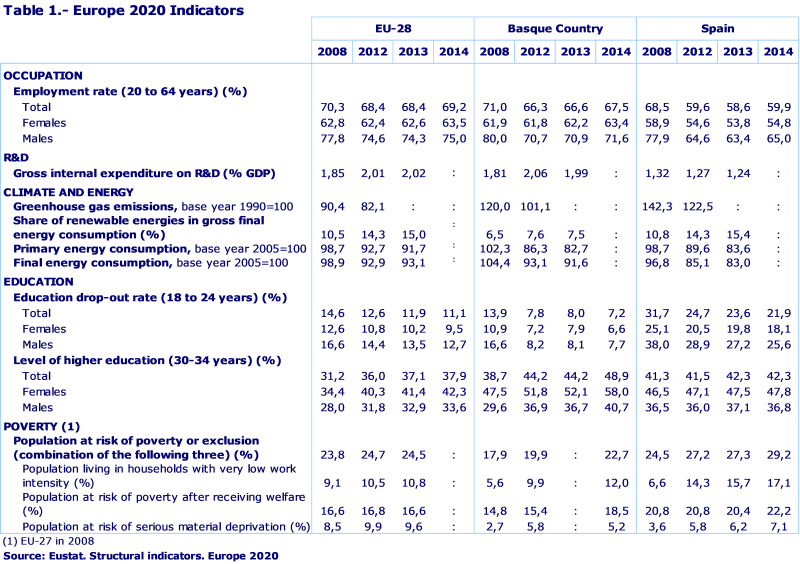
The Basque Country positioned itself above European Union-28 levels in five of the nine indicators selected in the Europe 2020 strategy, according to Eustat data. In some of them, those relating to education, the objective set for 2020 has been reached.
Regarding indicator trends, positive performances have been observed compared to the previous year for the indicators relating to Employment, Climate & Energy and Education, whereas those relating to R&D and Poverty have shown setbacks. As regards objectives, Employment, R&D and Climate & Energy fell far short of the targets set by the European strategy, although in Education they were far exceeded. Poverty indicators suffered setbacks in all areas due to the economic downturn, except for the Population at risk of serious material deprivation which improved by six tenths of a percentage point in 2014 with respect to 2012.
The Europe 2020 Strategy, approved by the European Council in 2010, is the common agenda for the current decade. It prioritises intelligent, sustainable and inclusive growth as a means to overcome structural weaknesses in the European economy, to improve its competitiveness and productivity and to underpin a sustainable social market economy. Its five main objectives are:
1) 75% of the European population between the ages of 20 and 64 should be employed.
2) Internal expenditure on R&D should reach 3% of GDP.
3) The "20-20-20" objective for climate and energy should be achieved: a 20% reduction in greenhouse gas emissions, savings of 20% in energy consumption and promoting the consumption of renewable energies of up to 20%.
4) The school drop-out rate should be lower than 10% and at least 40% of the youngest generation should have completed higher education.
5) The risk of poverty in the EU should threaten 20 million fewer individuals.
The monitoring of these objectives is carried out via several main indicators, which Eustat has created and compiled for the Basque Country.
The Basque Country, compared to the European Union average, posted better results in five of these indicators: Primary Energy Consumption, Final Energy Consumption, Education Drop-out Rate, Higher Education Level and Population at Risk of Poverty or Exclusion.
On the other hand, the values of Employment Rate, Gross Interior Expenditure on R&D, Greenhouse Gas Emissions and of the Renewable Energies Quota were below the European average. As regards the state as a whole, however, all of the indicators except the Renewable Energies Quota and the Final Consumption of Energy produced better figures for our autonomous region than for Spain.
Nevertheless, it must be pointed out that the path towards the set objectives could have ups and downs in the various years analysed, and more in economic situations such as the current one that is already producing setbacks in some indicators compared to the initial values.
Primary energy consumption fell by 3.6 points in the Basque Country in 2013 to stand at 82.7, based on an index of 100 in 2005. This drop has been progressively occurring since 2008, when a maximum of 102.3 was reached. Final Energy Consumption also registered a positive trend towards the target set, with a steady reduction since 2010, to reach 91.6 in 2013, also based on a 2005 index of 100. Nevertheless, the improvements in these two indicators relating to climate and energy, which also occurred in the European Union and Spain overall, may be due to the decreased level of economic activity as a consequence of the financial and economic crisis, rather than to a structural change in the pattern of energy consumption, and it would therefore be advisable to wait and see how they develop in more favourable economic circumstances.
The Education Drop-out Rate of the population between the ages of 18 and 24 and the Higher Education Level of the population between the ages of 30 and 34 did not only show better comparative results, but they exceeded the objectives set by the EU: less than 10% and at least 40%, respectively. Moreover, the values continue to improve year by year, reaching a 7.2% education drop-out rate in 2014, 0.8 percent less than in 2013, and 48.9% of people between the ages of 30 and 34 with higher education, or 58% in the case of women.
The Population at Risk of Poverty or Exclusion indicator is a combination of three indicators:
Population living in households with very low work intensity: Individuals who live in households with a household work intensity under the 20% threshold set.
Population at risk of poverty after receiving welfare: The poverty threshold set for this indicator is 60% of the average national median equivalised disposable income.
Population at risk of serious material deprivation: Individuals who do not have resources at their disposal to confront at least four of nine situations: 1) pay the rent and corresponding bills 2) adequately heat his or her dwelling 3) meet unforeseen expenses 4) regularly eat meat, fish or equivalent proteins (alternate days) 5) spend a week on holiday outside of the home 6) have access to a car 7) have access to a washing machine 8) have access to a colour TV, and 9) have access to a telephone.
Both for the composite indicator and two of the three that make it up, the Basque Country posted more encouraging rates than the European Union average, and almost five points below the average in the case of the aggregate indicator of Risk of Poverty or Exclusion, that affected 22.7% of the Basque population (2014) against 24.5% of Europe as a whole (2013) and 29.2% of the Spanish population in 2014. However, in relation to 2012 (the last comparable year) these indicators registered a decline, with an increase in the population at risk of poverty or exclusion, with the exception of the population at risk of serious material deprivation, which decreased slightly in 2014.
On the less positive side is the Employment Rate of 20 to 64 year-olds in the Basque Country. Although in 2014 (67.5%), the upward trend seen in 2013 was maintained, it was still 7.5 points from the target (75%) as a direct result of the economic crisis. There was a slight increase in the case of women as well as men. With respect to 2008, the drop in the total employment rate was 3.5 percentage points. This same trend was observed both in the European Union overall, and in Spain, with slight improvements in the three rates with respect to 2013.
In 2013, the Gross Interior Expenditure on R&D in terms of GDP was lower in the Autonomous Region (1.99%) than in the EU-28 (2.02%), both of which were still far from the objective of 3% and very much above that of Spain (1.24%). This trend, which was positive until 2013 despite the crisis, suffered a small decline in 2014.
Furthermore, two indicators, both in the climate section, produced worse figures than the EU-28 average: Greenhouse Gas Emissions, with an index of 101.1 against the 82.1 of the EU-28, although an improvement on the 120.0 registered in 2008, and the Quota of Renewable Energies in Gross Final Energy Consumption, which represented 7.5% in the case of the Basque Country, which was a long way not only from the target (20%) but also from the averages for Europe (15%) and Spain (15.4%) which both showed a positive trend.
For further information:
Eustat - Euskal Estatistika Erakundea / Basque Statistics Institute
C/ Donostia-San Sebastián, 1 01010 Vitoria-Gasteiz
Press Service: servicioprensa@eustat.eus Tel: 945 01 75 62
More press releases on europe 2020 Indicators in the Basque Country