Press Release 18/11/2021
INDICATORS OF THE 2030 AGENDA FOR SUSTAINABLE DEVELOPMENT. 2021
Between 2015 and 2020 the percentage of women in business in the Basque Country increased
Eustat continues to include new indicators to report on progress towards the goals and targets of the 2030 Agenda for Sustainable Development
Eustat remains committed to continuously expanding and disaggregating the set of statistical indicators that enable the achievement of the 169 targets and 17 Sustainable Development Goals included in the United Nations 2030 Agenda for Sustainable Development in the Basque Country to be quantified.
On this occasion a total of 42 new statistical indicators were included on Eustat’s platform for the dissemination of indicators of the 2030 Agenda for Sustainable Development in the Basque Country. The majority of these, a total of 38, were prepared with a methodology fully harmonised with the other Autonomous Regions. The other 4 incorporated indicators were specified for the Basque Country following United Nations guidelines, due to their relevance and interest.
With this new incorporation of indicators, it is possible to provide, at least partial, information on three Sustainable Development Goals for which an indicator has still not been obtained for the Basque Country:
Goal 6 Ensure the availability and sustainable management of water and sanitation for all. Includes 3 statistical indicators.
Goal 7 Ensure access to affordable, reliable, sustainable and modern energy for all. Includes 4 statistical indicators.
Goal 15 Protect, restore and promote sustainable use of terrestrial ecosystems, sustainably manage forests, combat desertification, and halt and reverse land degradation and halt biodiversity loss. Includes 3 statistical indicators.
Among the indicators included on the Eustat platform that serve to complete United Nations goals, targets and indicators, is that of Proportion of women in business. This provides additional insights into the information already offered for the United Nations indicator Proportion of women in managerial positions.
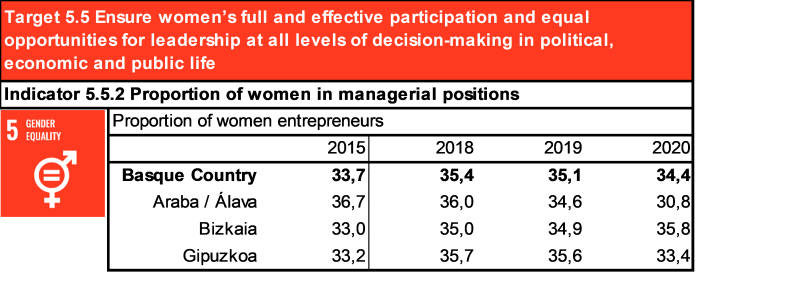
The proportion of women in business in the Basque Country increased by 34.4% in 2020, still a long way from parity. Although lower than in the two previous years, this was a higher percentage than that observed in the reference year 2015, which was 33.7%.
By province the trend was not uniform. Thus, in Álava the proportion of women in business steadily decreased in the period 2015-2020, falling almost six percentage points between 2015 and 2020. In Bizkaia there was an opposite trend, with a rise of almost three percentage points between the year of reference and the last year monitored. In Gipuzkoa, on the other hand, the proportion was similar in 2015 and in 2020, although there was significant decrease in 2020 in respect of 2019, going from 35.6% in 2019 to 33.4% in 2020.
Among the statistical indicators included on the Eustat platform with the aim of providing information on Sustainable Development Goals not quantified to date, is, for example, that of Renewable energy share in the production of electricity, covered by the United Nations indicator Renewable energy share in total final energy consumption, included in Goal 7.
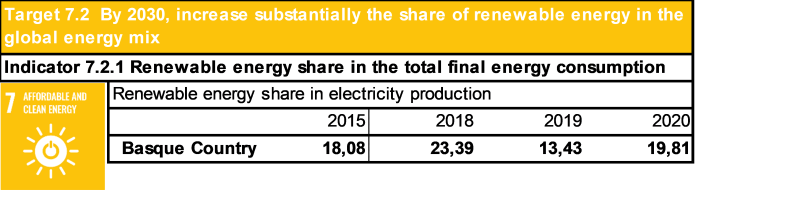
We can see that, although there was a significant decrease in 2019, the renewable energy share in the production of electricity showed a positive trend between 2015 and 2020. In effect, the renewable energy share went from accounting for 18.08% of the total in 2015 to representing 19.81% in 2020.
Another Sustainable Development Goal on which information is provided for the first time with this inclusion of statistical indicators on the Eustat dissemination platform is Goal 15. Three statistical indicators are included in this Goal, among them the Proportion of forest area with sustainable management instruments in place, included in the United Nations Indicator Progress towards sustainable forest management.
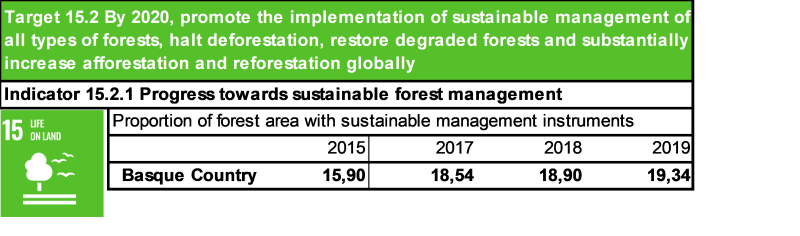
This statistical indicator shows a sustained positive evolution in the period 2015-2019, rising from 15.90% of forest area with sustainable management instruments in place in 2015 to 19.34% in 2019.
Note. Work continues on including new indicators on the platform for the dissemination of indicators of the 2030 Agenda for Sustainable Development in the Basque Country, in order to offer both disaggregated statistical indicators already published and to include new ones that provide information on contents targets not covered to date.
For further information:
Eustat - Euskal Estatistika Erakundea / Basque Statistics Institute
C/ Donostia-San Sebastián, 1 01010 Vitoria-Gasteiz
Press service: servicioprensa@eustat.es Tel.: 945 01 75 62