Press Release 20/04/2022
INDICATORS OF THE 2030 AGENDA FOR SUSTAINABLE DEVELOPMENT. 2022
Women predominate in healthcare institutions, the regional judicial administration and non-university education centres in the Basque Country
However, they continue to be in the minority in the armed forces, state law enforcement agencies and regional police forces
In the Public Administrations in the Basque Country, women held the majority of jobs in healthcare institutions, the regional judicial administration and non-university education centres in 2021, with increases in almost all cases compared to 2015, the reference year for the 2030 Agenda. Their presence in the armed forces, state law enforcement agencies and regional police forces remains at significantly lower levels, despite some progress.
Eustat remains committed to continuously expanding and disaggregating the set of statistical indicators that enable the achievement of the 169 targets and 17 Sustainable Development Goals included in the United Nations 2030 Agenda for Sustainable Development in the Basque Country to be quantified.
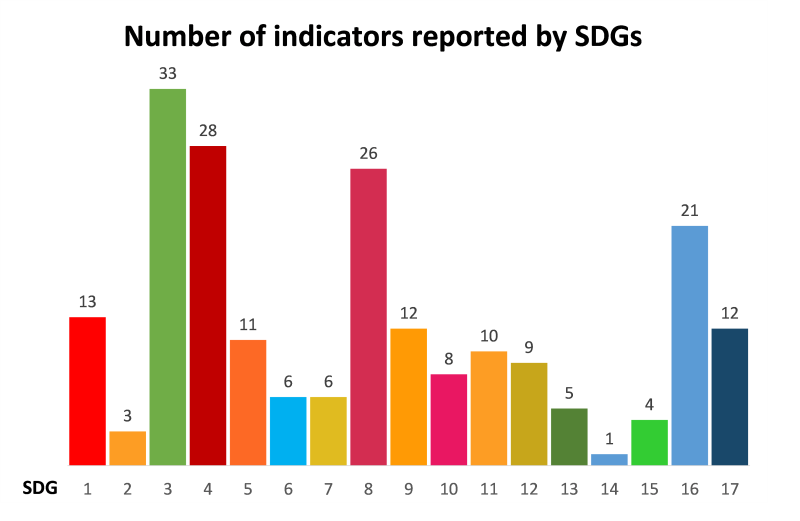
On this occasion a total of 26 new statistical indicators were included on Eustat’s platform for the dissemination of indicators of the 2030 Agenda for Sustainable Development in the Basque Country. All of them have been defined following a methodology harmonised across the Autonomous Regions, thus guaranteeing their full and direct comparability.
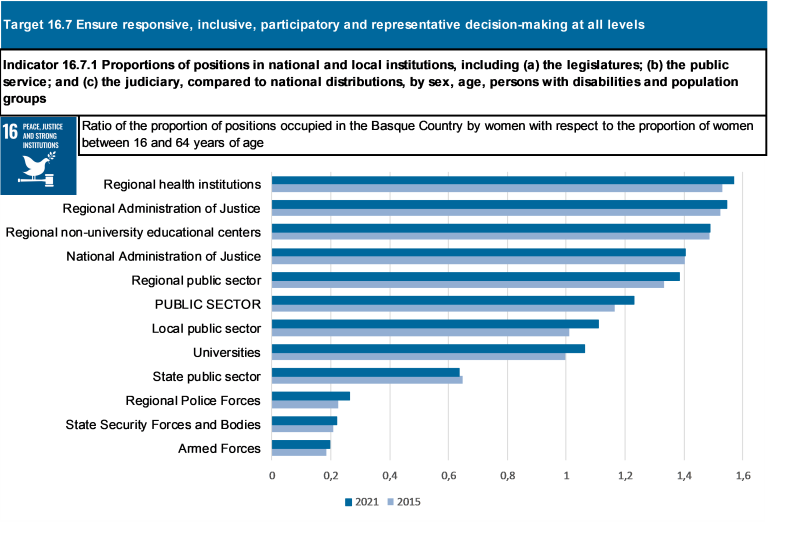
Among the indicators included on the Eustat platform that serve to complete United Nations goals, targets and indicators, are different Ratios of the proportion of posts held by women in the Basque Country compared to the proportion of women aged between 16 and 64 in different bodies in the state, regional, provincial and local public sector. Although there has been progress with regard to the presence of women in the public administration, parity is still far from being achieved in the armed forces, the state law enforcement agencies and the regional police force in the Basque Country. In all of them, the ratio of the proportion of posts held by women in the Basque Country compared to the proportion of women aged between 16 and 64 stood at approximately 0.25 in 2021, following modest progress in respect of 2015. In turn, the presence of women in the state public sector in the Basque Country is also far from the balanced representation that a unit value ratio would imply.
At the other end of the scale, with a high prevalence of women, are regional healthcare institutions, the regional and central judicial administration, as well as non-university education centres and the regional public sector.
Eustat continues to work on including new indicators on the platform for the dissemination of indicators of the 2030 Agenda for Sustainable Development in the Basque Country, in order to offer both disaggregated statistical indicators already published and to include new ones that provide information on targets not covered to date. The inclusion of new indicators of those Sustainable Development Goals with the least information is a priority for Eustat, as is the geographical disaggregation of the indicators available at the Basque Country level.
For further information:
Eustat - Euskal Estatistika Erakundea / Basque Statistics Institute
C/ Donostia-San Sebastián, 1 01010 Vitoria-Gasteiz
Press service: servicioprensa@eustat.es Tel.: 945 01 75 62