Press Release 27/06/2023
MUNICIPAL STATISTICS ON INHABITANTS. 01/07/2022
The population of the Basque Country grew by 5,096 people in the first half of 2022
This rise was based on the increase in the foreign population, which was up by 6,237 people, accounting for 8.8% of the total population
The population of the Basque Country stood at 2,191,613 people on 1 July 2022, representing an increase of 5,096 people compared to January, according to Eustat data. This reverses the trend of the last two years, when the population fell by more than 13,194 people (6,682 in 2021 and 6,512 in 2020).
All three provinces saw their population grow between January and July 2022. The greatest increase in absolute terms occurred in Bizkaia, with a population of 1,141,407 and 2,198 more residents than on 1 January. It was followed by Gipuzkoa, whose population was 718,109 residents, 1,493 more people than in January, while Álava, with a population of 332,097 inhabitants, also saw its population rise by 1,405 people. However, in percentage terms, Álava was the province with the highest growth (0.42%), followed by Gipuzkoa and Bizkaia (0.21% and 0.19%, respectively).
The Basque capitals also saw population numbers recover, especially Vitoria-Gasteiz, with 1,359 more inhabitants than at the beginning of the year, while in Bilbao there were 840 more people and 361 more in Donostia.
Evolution of the population of the Basque Country by territorial area (1). 07/01/2022
| | January 2022 | July 2022 | Increase (num.) | Increase (%) |
| Total | 2.186.517 | 2.191.613 | 5.096 | 0,23 |
| Historic Territories | | | | |
| Araba/Álava | 330.692 | 332.097 | 1.405 | 0,42 |
| Bizkaia | 1.139.209 | 1.141.407 | 2.198 | 0,19 |
| Gipuzkoa | 716.616 | 718.109 | 1.493 | 0,21 |
| Capitals | | | | |
| Bilbao | 340.455 | 341.295 | 840 | 0,25 |
| Donostia / San Sebastian | 181.769 | 182.130 | 361 | 0,20 |
| Vitoria-Gasteiz | 248.106 | 249.465 | 1.359 | 0,55 |
(1)Provisional data
Date June 27, 2023
Source: Eustat. Municipal Inhabitant Statistics
As regards the remaining Basque municipalities, it is worth noting that more than half saw their population grow over the last six months. The greatest absolute increases occurred in Leioa (268), Santurtzi (213) and Derio (177) in Bizkaia, and Tolosa (168) and Errenteria (161) in Gipuzkoa.
At the other end of the scale, Soraluze-Placencia de las Armas in Gipuzkoa and Basauri and Ermua in Bizkaia posted decreases, all below 100 inhabitants.
Looking at the regions, Gran Bilbao recorded the highest absolute rise, with 1,636 more inhabitants, after experiencing the greatest decreases in the last 2 years. There were also significant increases in Llanada Alavesa (1,380 more inhabitants) and Donostialdea (906 more inhabitants).
In the remainder, only 4 of the twenty regions studied (Añana and Montaña Alavesa in Álava, Bajo Deba in Gipuzkoa and Markina-Ondarroa in Bizkaia) saw their population decline, all with decreases well below 1%. The population remained stable in two regions (Arratia-Nervión in Bizkaia and Gorbeialdea/Estribaciones del Gorbea in Álava) and increased in the other 14.
The number of people over 64 years old continued to rise
The average age of the population of the Basque Country stood at 45.7, 0.2 years higher than at the beginning of the year. By sex, the average age for men was 44.1 years old and 47.2 for women, with the difference remaining at around 3 years.
As regards the provinces, Álava continued to have the youngest average age (44.8 years old), Bizkaia the highest (46.2 years old) and Gipuzkoa the age closest to that of the overall population (45.3 years old).
The average age in the provinces reflected their age structure. In July 2022, the population aged 65 or over in the Basque Country was 514,104 people, meaning that it increased by 7,508 people in six months. This group accounted for 23.5% of the population in the provinces as a whole, 22.1% in Álava, 23.3% in Gipuzkoa and 23.9% in Bizkaia.
By region, this percentage ranges from the minimum values of 18.6% of Plentzia-Mungia (Bizkaia), which is the region with the lowest average age along with Tolosaldea and Urola-Costa (Gipuzkoa); or 20.1% of Estribaciones del Gorbea (Álava), and the maximum of 25.1% of Markina-Ondarroa (Bizkaia) or 25.8% of Montaña Alavesa (Álava).
The disparity between municipalities was much greater and the figure varied from 10.6% in Irura to 37.8% in Valle de Arana. On 1 July 2022, there were 11 municipalities where the proportion of the population over 64 years old was below 15%, while on the other hand, there were 6 municipalities with a proportion of over 30%.
The population increase was driven by the rise in the immigrant population
This increase of 5,096 inhabitants in the total population of the Basque Country in the first six months of the year was based on a rise in the number of foreign residents of 6,237 people. Meanwhile, the Spanish population followed the same trend seen in recent years, falling by 1,141 people.
Foreign nationals went from representing 8.5% of the population on 1 January to 8.8% on 1 July. The percentage varied slightly between provinces: Álava had the highest proportion with 10.1% (0.1 percentage points more than in January), followed by Gipuzkoa with 8.9% (0.3 points more) and, lastly, Bizkaia with 8.4% (0.3 points more).
If we look at the continent of nationality, Latin Americans accounted for 42.5% of foreign nationals, an increase of almost two points compared to January. They were followed by those from African countries, at 25.8% (two points less than in January), Europeans, who continued to represent around 23.6%, and, finally, nationals from Asia and Oceania, with around 8%.
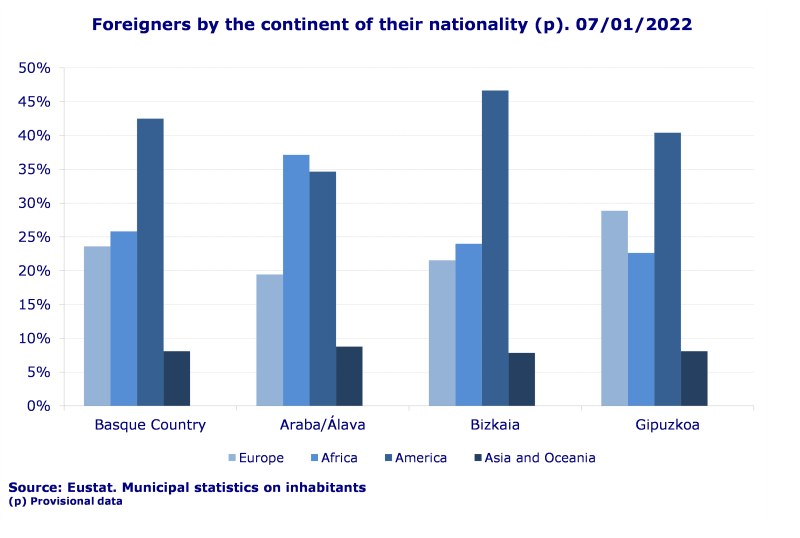
By province, in Álava, African nationals represented the greatest proportion of foreign residents (37.1%), while the second largest group was residents with Latin American nationality, who accounted for 34.6% of the total.
In Bizkaia, Latin American nationals were the majority group (46.6%), followed by people with African (24%) and European nationality (21.5%).
In Gipuzkoa, the distribution of nationalities was closer to that of Bizkaia than Álava, with a higher percentage of residents with Latin American nationality (40.4%), followed by Europeans (28.9%) and Africans (22.6%).
Note:
From now on, Eustat will publish two sets of population figures per year: definitive figures on 1 January and provisional figures on 1 July.
For further information:
Eustat - Euskal Estatistika Erakundea / Basque Statistics Institute
C/ Donostia-San Sebastián, 1 01010 Vitoria-Gasteiz
Press service: servicioprensa@eustat.es Tel.: 945 01 75 62