Press Release 30/01/2023
INDICATORS OF THE 2030 AGENDA FOR SUSTAINABLE DEVELOPMENT. MUNICIPAL DATA
The unemployment rate, an indicator for Goal 8 of the SDGs, fell in 235 of the 251 municipalities in the Basque Country between 2015 and 2021
In half of the regions, the wooded area is stable or increasing, according to the indicator linked to Goal 15 on terrestrial ecosystems
Eustat remains committed to continuously expanding and disaggregating the set of statistical indicators that enable the achievement of the 169 targets and 17 Sustainable Development Goals included in the United Nations 2030 Agenda for Sustainable Development in the Basque Country to be quantified.
On this occasion, for the first time a further step was taken by incorporating data for the 251 municipalities in the Basque Country and for the 20 statistical regions. Based on work coordinated with the General Secretariat for Social Transition and the 2030 Agenda, with the participation of the various institutional levels in the Basque Country - Basque Government, Provincial Councils and Local Councils - it was possible to disaggregate 53 statistical indicators for each of the Basque municipalities to provide information on 20 United Nations targets, divided into 12 sustainable development goals, available on the Eustat Platform for the dissemination of indicators of the 2030 Agenda for Sustainable Development in the Basque Country. For some indicators, there are also series disaggregated by gender.
These include the Unemployment rate indicator (aligned with Goal 8 Promoting sustained, inclusive and sustainable economic growth, full and productive employment and decent work for all), broken down by municipality and gender, which allows the phenomenon to be viewed from various perspectives, not only over time.
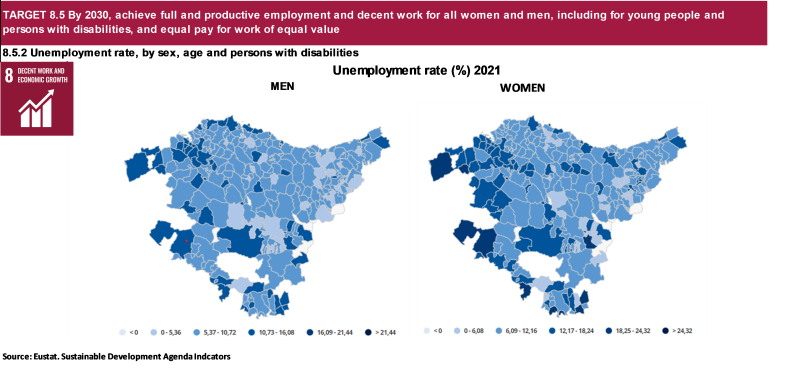
In just over half of the municipalities (140), the 2021 unemployment rate was below the Basque Country average, 9.9%. The rate was higher in the remaining 111 municipalities. In nine municipalities, seven in Gipuzkoa and two in Bizkaia, the goal of full employment has practically been achieved, with unemployment rates below 4%: Aduna, Garai, Orexa, Orendain, Zerain, Izurtza, Abaltzisketa, Gaintza and Errezil, all with fewer than 600 inhabitants. In addition, compared to the year taken as a reference (2015) the unemployment rate has decreased in 235 municipalities, most notably Berantevilla with a fall of 14 percentage points.
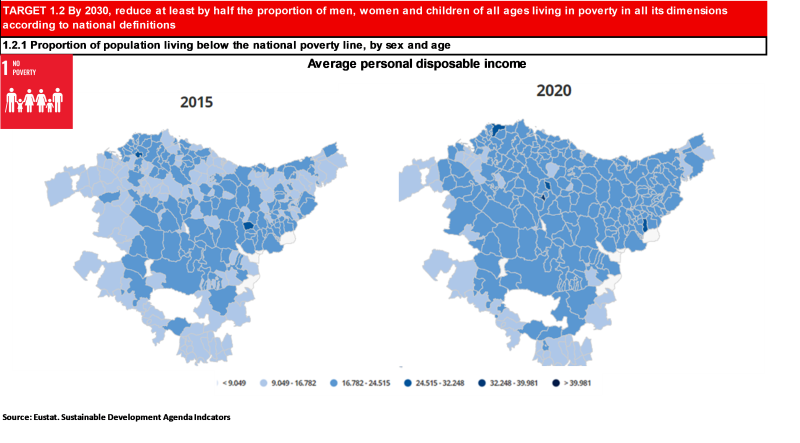
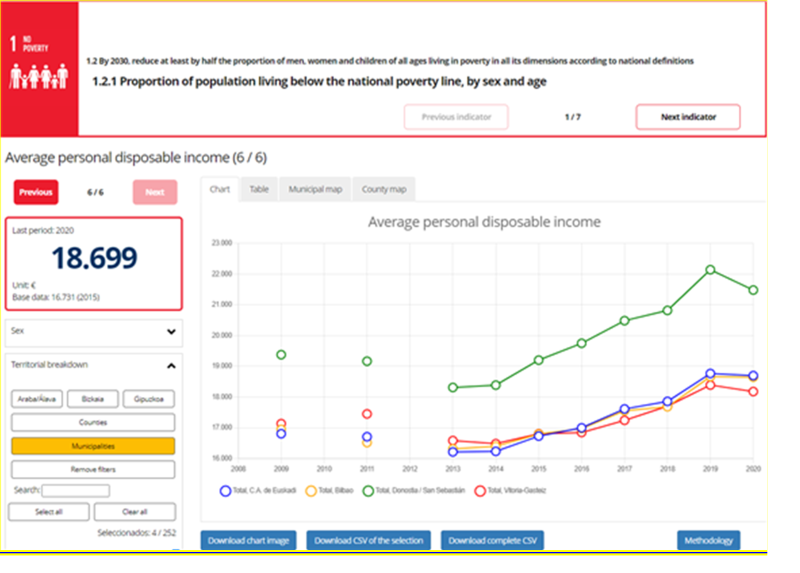
Another of the indicators disaggregated at municipal and regional level is Average disposable personal income, linked to Goal 1, which aims to End poverty in all its forms everywhere. Compared to 2015, average disposable personal income increased in 240 of the 251 municipalities and in 127 of them it rose above the average for the whole of the Basque Country (11.2%). It is worth highlighting Izurtza, where disposable personal income has more than doubled in five years.
The indicator Wooded area in proportion to total area, associated with Goal 15 Protect, restore and promote sustainable use of terrestrial ecosystems, sustainably manage forests, combat desertification, and halt and reverse land degradation and halt biodiversity loss, stood at 54.8% in 2021, significantly higher than the figure for Spain, 36.5% in 2018, and for every single Autonomous Region.
By province, Gipuzkoa was particularly notable as the territory with the highest proportion of wooded area, 61.6%. Bizkaia recorded 59.6% and Álava 46.8%. By municipality, 145 of the 251 municipalities registered figures above the average and 106 below.
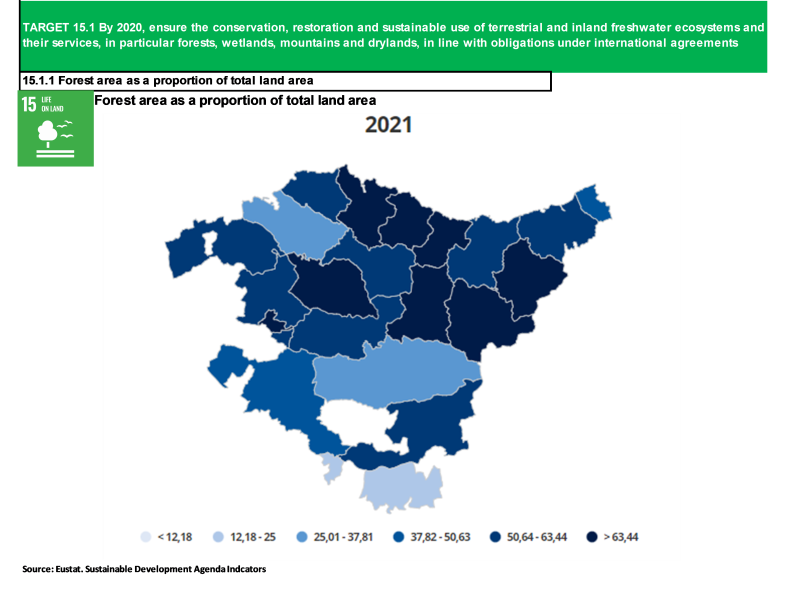
As regards progress towards the target, focusing on the maintenance and conservation of forests, 25 municipalities recorded increases above one percentage point in wooded area over total area between 2016 and 2021, although 64 registered decreases of more than one point. By regions, the situation was balanced: in half of them the area increased or was stable and in the other half it decreased.
All these indicators are available on the Platform for the dissemination of indicators of the 2030 Agenda for Sustainable Development in the Basque Country, , available on the Eustat website. The Eustat platform currently includes 280 statistical indicators providing information on 112 UN global indicators and 85 targets of the 2030 Agenda. Information is at least partially provided for all 17 Agenda goals.
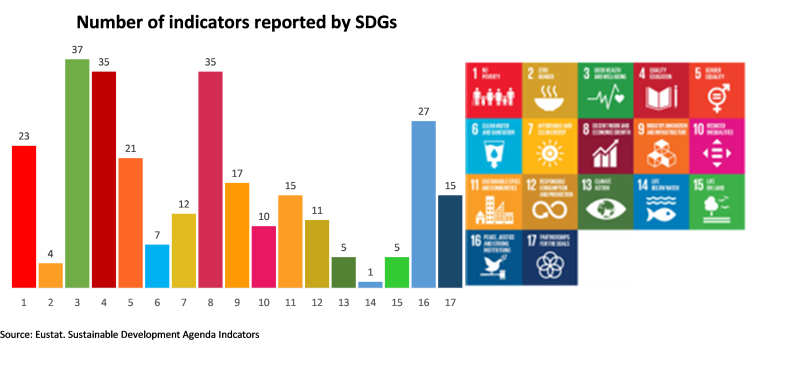
This platform presents the 280 indicators associated with the targets and goals, in grid format. In addition to an arrow marking the trend, there is an icon showing whether the indicator is disseminated at municipal level, along with the latest figure available and that for the reference year.
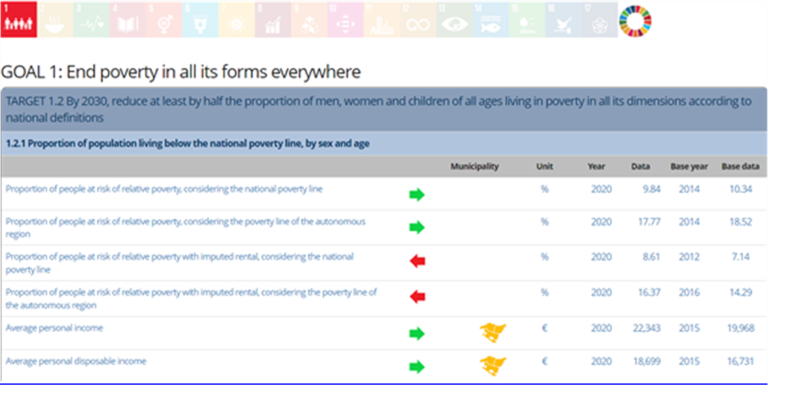
Each indicator links to a screen containing all the information pertaining to it, in both numerical and graphic forms, along with metadata, all within the framework of the UN indicator and the target associated with it. In addition, the other indicators associated with the same target can be accessed, all with the same appearance and graphic form used in the UN indicator framework.
In partnership with several institutions, Eustat continues to work on developing the platform for the dissemination of indicators of the 2030 Agenda for Sustainable Development in the Basque Country, in order to offer both disaggregated statistical indicators already published and to include new ones that provide information on targets not covered to date.
For further information:
Eustat - Euskal Estatistika Erakundea / Basque Statistics Institute
C/ Donostia-San Sebastián, 1 01010 Vitoria-Gasteiz
Press service: servicioprensa@eustat.es Tel.: 945 01 75 62