Press Release 14/06/2023
SURVEY ON THE RECONCILIATION OF WORK, FAMILY AND PERSONAL LIFE. 2022
In the Basque Country in 2022, one in four employed people had significant difficulty balancing work with family obligations
Although the gap is closing, working women spend 1.1 hours more per day looking after their children
28.1% of employed people resident in the Basque Country expressed having great difficulty combining work with looking after minor children, and 28.9% with looking after their dependants, according to Eustat data.
This high degree of difficulty is also perceived by 24% of employed people when it involves balancing work with personal activities. From a gender perspective, it is worth nothing that the greatest difference in terms of the difficulties faced by men and women can be seen when it comes to combining work with looking after children, and while the percentage stood at 30% for women, it was 26.2% for men.
With regards to the amount of time spent looking after children and dependent persons per day, differences were found between men and women. Therefore, women who work outside the home and have children under the age of 15 on average spent 1.1 hours more per day on their care than working men (4.7 and 3.6 hours, respectively). Furthermore, while just over half of women (53.1%) dedicated 5 hours or more per day to looking after their children, in the case of men this percentage stood at 29.8%, with the majority (33.5%) dedicating 2 hours or less to their children’s care.
Furthermore, regarding the time people in work spent looking after dependent persons, on average women spent 0.6 hours more per day on this activity than men (2.3 and 1.7 hours, respectively).
The distribution of domestic tasks amongst working men and working women in the Basque Country was also unequal: almost one in eight men (12.3%) dedicated 3 hours or more to those tasks, whilst in the case of women this percentage is more than double, at 26.7%.
In 2022, differences between men and women in time spent on care and household duties reached their minimum values and decreased to 0.5 hours in household duties (0.3 hours less than 10 years ago): to 1.1 hours in looking after children (0.6 hours less); and 0.6 hours in caring for dependants. The latter is the type care which has decreased the most and as a result, in 2022, the difference obtained is almost an hour less than 10 years ago (0.9 hours less).
This uneven distribution of duties when carrying out domestic tasks causes 14% of working women to be very unsatisfied with the collaboration offered by their spouse or partner. In contrast, a high number of working men were very satisfied with their partner’s participation (76.5%). Despite these evaluations, the percentage of men declaring themselves to be very satisfied with the time they spend on household tasks (53.1%) is similar to that for women (49.5%).
It is worth mentioning that working women expressed greater satisfaction from looking after their children: 56.4% indicated a high satisfaction; and for their dependants, 49.7%; for working men, these percentages dropped to 53.9% and 47.1%, respectively.
As regards general job satisfaction, the overall rating was 7.3 (out of 10), with some differences according to specific aspects. The lowest-rated aspect was promotion in the workplace, with 4.0; followed by flexibility of working hours, with 6.3; breaks during the working day, with 6.5; and salary remuneration, with 6.7. The highest-rated aspects were working hours and holidays and permissions for leave with 7.3 and stability with 7.7.
27.6% of the population in work fear that requesting leave or reduced hours would affect them professionally
16.8% of the population in work regularly had to spend more time at work than established or foreseen, a decrease of 4.6 percentage point with respect to 2021. Another 17.5% sometimes had to extend their working day, 0.4 percentage points less than a year ago.
On the other hand, 16.8% of working men believed that requesting paternity leave would be highly detrimental to them. However, just 9.6% of men believed that paternity could affect them slightly, compared to 26.1% of working women who believed that maternity could create promotion inequalities. The fear that requesting leave or reduced hours for family reasons would affect their professional career was greater amongst women than men (31.3% and 24.2% respectively).
To a greater or lesser extent, 17.8% of employed people work from home, 9 tenths lower than in 2021
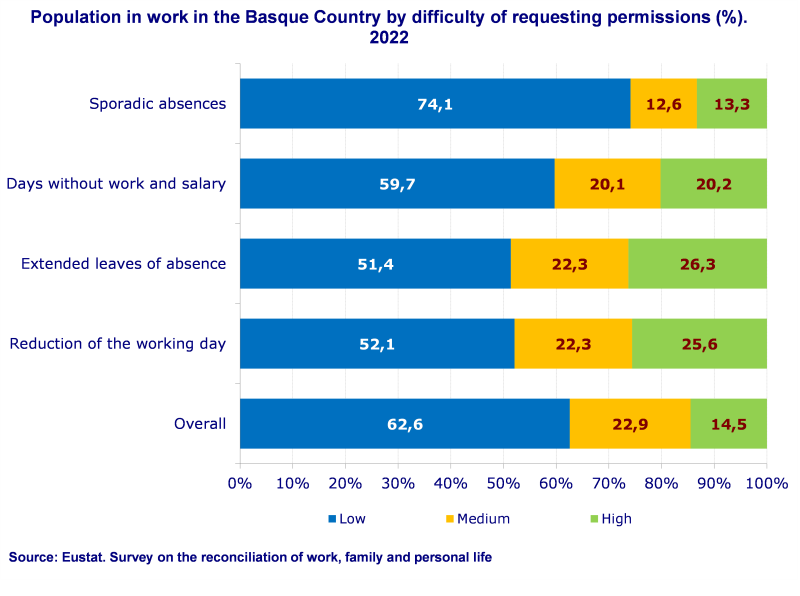
Amongst the various methods that might facilitate the reconciliation of work, family and personal life, short-term leave is within reach of the majority of the working population, followed by the possibility of requesting leave in the form of unpaid days off. Furthermore, almost half the working population stated that they experienced little difficulty in obtaining extended leaves of absence or a reduction in working hours.
Regarding flexible finish time and in respect of 2021, there was an increase of 5.5 points in the percentage of individuals who benefit from this measure facilitating work-life balance: if in 2021 this percentage was 47.1%, it has risen to 52.6% in 2022. From the gender perspective, men benefited the most, as 57.4% had a flexible timetable compared to 47.6% of women.
As for working from home, the percentage of individuals working in this way (to a greater or lesser extent) is 17.8%, 9 tenths less than in 2021. Furthermore, the proportion of those who work at least half of the days was 6.7%, 1.7 percentage points less than in 2021 and 4.1 percentage points less than in 2020, when it reached its highest percentage (10.8%). When working from home is carried out occasionally, this percentage reaches 11.1%, the highest percentage since the survey began, experiencing an increase of 0.8 percentage points compared to 2021, and 3.8 compared to 2020.
With respect to the different types of working day, a steady decrease was seen in the percentage of people who had a split working day. While in 2012, 39.6% of people worked morning and afternoon shifts only, in 2022 this was 28.2%, hence there was an increase in the percentage of people who had a continuous working day (50.6% in 2012 to 57.3% in 2022) or a mixed working day (from 9.8% in 2012 to 14.5% in 2022).
In households where both partners worked, looking after children during parents’ working hours corresponded, in 92.5% of cases, to schools, on 3.3% of occasions to family members or people who were not paid, and in 2.8% of cases to both parents.
In these same households, the sporadic care of children when, during working hours, they have to be taken to the doctor, are ill or do not have school, was provided in most cases by both parents (62.9%), and less frequently by family members or people who were not paid (17.9%), by the mother (14.1%) or the father (4.5%).
Finally, in relation to work preferences, the working population opted for the condition of salaried worker (83.7%) against that of self-employed worker (16.3%) and for working in the public sector (60.3%) as opposed to the private sector (39.7%), while this preference is more balanced between large companies (55.9%) and small companies (44.1%).
Children under the age of 15 of the employed population in the Basque Country by daily care (when both spouses work). 2022
| | 2021 | 2022 |
| Total (thousand) | 181,0 | 181,3 |
| Daily care during the working day of the employed person (%) | | |
| Both | 4,7 | 2,8 |
| Relatives or individuals without earnings | 3,7 | 3,3 |
| Other individual with earnings | 0,6 | 0,5 |
| Nurseries | 1,1 | 0,9 |
| Education centres | 89,8 | 92,5 |
| Sporadic care during the working day of the employed person (%) | | |
| Mother | 11,5 | 14,1 |
| Father | 4,1 | 4,5 |
| Both | 64,4 | 62,9 |
| Relatives or individuals without earnings | 17,5 | 17,9 |
| Other individual with earnings | 0,3 | 0,0 |
| Selfemployed (Left alone) | 2,1 | 0,6 |
Date June 14, 2023
Source: Eustat. Survey on the reconciliation of work, family and personal life
For further information:
Eustat - Euskal Estatistika Erakundea / Basque Statistics Institute
C/ Donostia-San Sebastián, 1 01010 Vitoria-Gasteiz
Press service: servicioprensa@eustat.es Tel.: 945 01 75 62