Press Release 17/03/2023
SCHOOL ACTIVITY STATISTICS. 2022
In the 2021/22 academic year, the total amount of grants and financial aid for studying increased by 23% in the Basque Country
The number of students in Vocational Training exceeded 40,000, but Early Childhood and Primary Education continued to see a decline in pupil numbers
In the 2021/22 academic year, 407,941 people enrolled in formal non-university education in the Basque Country, 1% less than in the previous academic year, according to Eustat data.
Early Childhood and Primary Education levels each saw student numbers fall by more than 2,200 pupils. In the case of Early Childhood Education, this is the ninth consecutive year of decline, which translates into a cumulative decrease of over 20,000 enrolments since the 2012/13 academic year. In contrast, the number of students in Intermediate and Advanced Level Vocational Training saw six years of growth and stood above 40,000 for the first time since records began.
The drop in enrolments at Official Language Schools marked the overall negative trend in Specialised Education. However, both Visual Arts and Design and Sports Education increased their student population by more than 10% compared to the previous academic year.
Students enrolled in non-university education in the Basque Country by study level, according to province. 2021/22


| | Total | Araba/Álava | Bizkaia | Gipuzkoa | Variation with respect to the previous course (%) |
| TOTAL | 407.941 | 66.988 | 203.913 | 137.040 | -1,0 |
| General teaching | 379.625 | 62.157 | 187.462 | 130.006 | -0,9 |
| Infant education | 76.387 | 12.586 | 37.903 | 25.898 | -2,8 |
| Primary education | 125.889 | 20.864 | 63.151 | 41.874 | -1,7 |
| Obligatory secondary education | 87.091 | 13.591 | 43.290 | 30.210 | -0,1 |
| Basic vocational training | 4.746 | 665 | 2.858 | 1.223 | -1,5 |
| Baccalaureate | 32.640 | 5.061 | 16.407 | 11.172 | 0,4 |
| Professional Training middle grade | 16.289 | 2.593 | 7.411 | 6.285 | 3,4 |
| Intermediate vocational training courses | 33 | 15 | 7 | 11 | . |
| Professional Training higher grade | 23.749 | 3.295 | 10.728 | 9.726 | 3,0 |
| Higher degree FP specialization courses | 110 | 16 | 25 | 69 | . |
| Special education | 1.623 | 298 | 849 | 476 | 4,4 |
| Adult education | 11.068 | 3.173 | 4.833 | 3.062 | -4,1 |
| Special teaching | 28.316 | 4.831 | 16.451 | 7.034 | -2,3 |
| Language studies | 23.742 | 3.799 | 13.736 | 6.207 | -3,1 |
| Artistic studies - music | 2.497 | 497 | 1.243 | 757 | -4,0 |
| Artistic studies - dance | 138 | 108 | 30 | . | 0,7 |
| Plastic arts and design teachings | 728 | 427 | 241 | 60 | 13,9 |
| Sports studies | 1.151 | . | 1.141 | 10 | 10,2 |
| Arts Education in dramatic art | 60 | . | 60 | . | 13,2 |
Date March 17, 2023
Source: Eustat. School activity statistics
Low proportion of women in Vocational Training courses in the field of science and technology
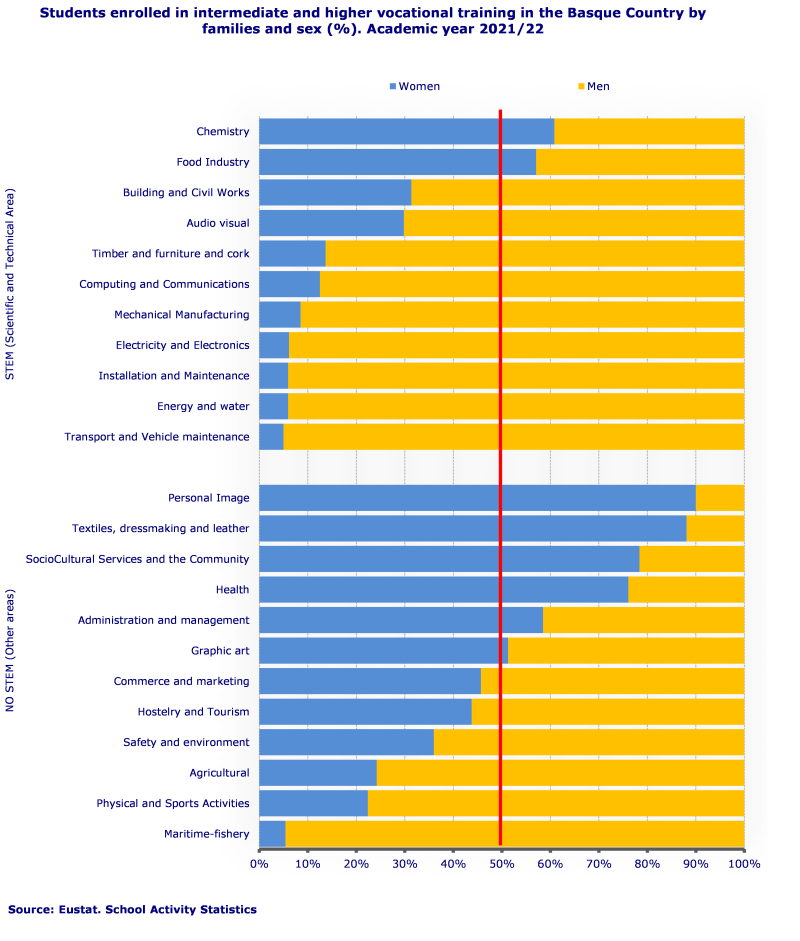
Only a third of students enrolled in Intermediate or Advanced Level Vocational Training were women. However, the gender gap was even wider in training courses belonging to occupational families linked to STEM professions, i.e. in the science and technology field (Science, Technology, Engineering and Mathematics). Just over half of enrolments in Vocational Training were in studies of this type, but the proportion of women barely exceeded 11%. In contrast, six out of every ten students in courses not linked to STEM professions, including those related to care and personal image, were women.
In Upper Secondary Education, the science pathway continued to be the most popular, as it was chosen by 54% of students. It was also at gender parity. At the other end of the scale was the arts pathway, with only 1,384 students enrolled, 4% of the total, of which more than 75% were women.
The average amount received by each student awarded grants and financial aid for studying increased
In the 2021/22 academic year, the Public Administration allocated 63.7 million euros to grants and financial aid for non-university level studies, 12 million more than in the previous academic year, an increase of 23%.
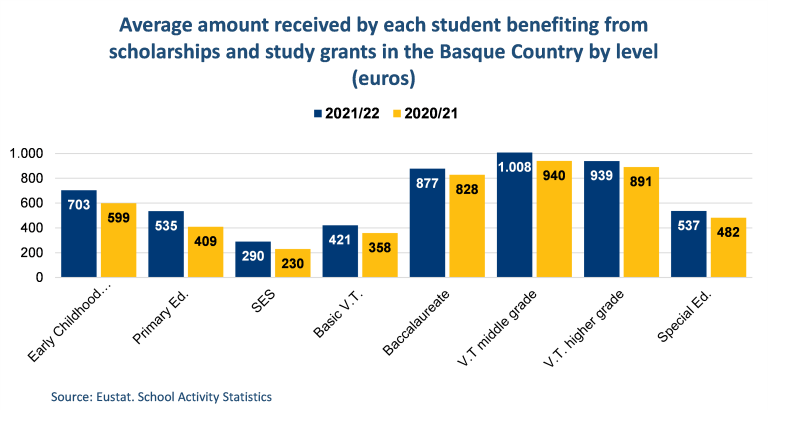
115,441 people benefited from these grants and financial aid, a very similar figure to that for the 2020/21 academic year. Likewise, there were no notable changes in the distribution by level of the amount awarded or the distribution of students receiving grants compared to the previous academic year. Therefore, the increase in the total budget resulted in a rise in the amount received by each grant recipient. Overall, the average amount stood at 552 euros per student, although there were differences between levels. Compulsory Secondary Education was the level with the lowest average amount per capita (290 euros), while the amount received by grant recipients in Intermediate Level Vocational Training was, on average, more than 1,000 euros.
Slight recovery in use of the school meals service
45% of students enrolled in General Education used the school canteen, 3 percentage points up on the 2020/21 academic year, but below pre-pandemic levels, when half of students used this service.
In this regard, the same provincial differences were observed as in previous academic years. 55% of students in Bizkaia had lunch at their place of study, while the proportion stood at 37% and 32% in Gipuzkoa and Álava, respectively.
Nearly 51,700 people travelled to their education centres by school transport. This resource was most frequently used at privately owned centres, 17% compared to 10% at public centres.
For further information:
Euskal Estatistika-Erakundea / Basque Statistics Institute
C/ Donostia-San Sebastián, 1 01010 Vitoria-Gasteiz
Press Service: servicioprensa@eustat.es Tel.: 945 01 75 62