Press release 10/11/2022
HUMAN DEVELOPMENT INDEX. 2022
The Basque Country occupied 14th place in the global HDI ranking 2022
The HDI showed a global decline in welfare as a result of the COVID-19 pandemic
The Basque Country, with a Human Development Index (HDI) of 0.936, was at the level of 14th place in the ranking of countries, according to Eustat data applying the methodology of the United Nations Development Programme (UNDP) published in its latest report for 2021/2022, with data from 2021.
This report, published by the UNDP in September 2022, established a global ranking of 194 countries by living conditions. The study allocated an HDI to each country (on a scale of 0 to 1) according to life expectancy at birth, expected years of schooling for children at school age, mean years of schooling for adults aged 25 or above, and Gross National Income per capita.
For the first time in the 32 years that the UNDP has been compiling the Human Development Index, there was a global decline in welfare for two consecutive years caused by the COVID-19 pandemic. Human Development regressed to 2016 levels, reversing much of the progress made in achieving the Sustainable Development Goals.
The decline was practically universal, given that more than 90% of countries saw their HDI levels deteriorate in 2020 or 2021, and over 40% registered a drop in both years, demonstrating that the crisis continues to worsen for many countries.
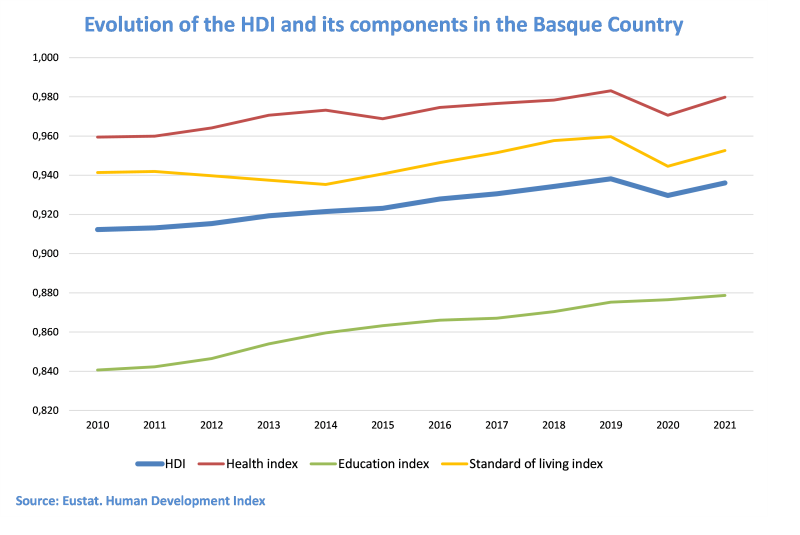
Following the same trend, the HDI of the Basque Country fell in 2020, going from 0.938 in 2019 to 0.930. This decline was caused by the decreases in both life expectancy (83.9 years in 2019 compared to 83.1 in 2020) and gross income per capita, which, measured in US dollars (from 2017), was down from 57,438 in 2019 to 51,954 in 2020. On a positive note, it should be pointed out that there was no decline in education indicators.
In contrast, the HDI of the Basque Country improved in 2021, standing at 0.936, thanks to the recovery in life expectancy, which rose to 83.7 years, and the increase in gross income per capita ($54,791), although, respectively, these figures did not reach the values recorded in 2019, the year before the pandemic.
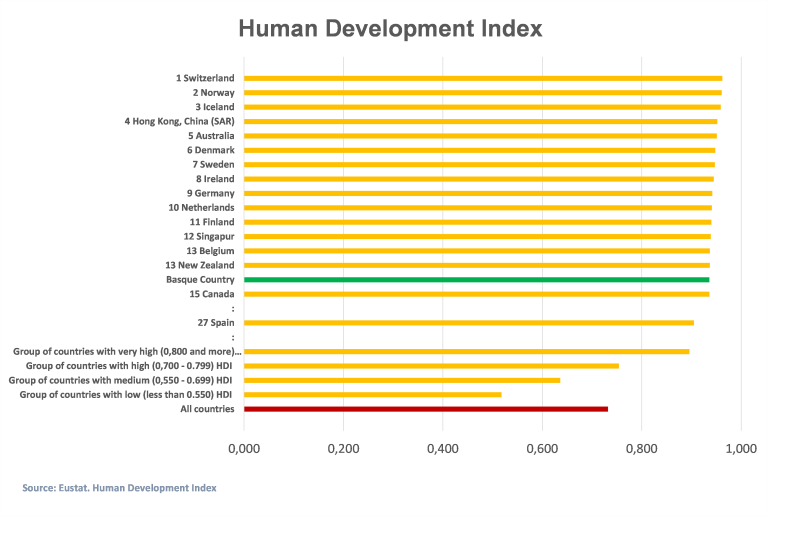
Using data from 2021, the HDI placed Basque society amongst the most developed in the world, on par with Canada and only behind Switzerland, Norway, Iceland, Hong Kong, Australia, Denmark, Sweden, Ireland, Germany, the Netherlands, Finland, Singapore, Belgium and New Zealand. Spain came 27th in the UNDP report, with an HDI of 0.905. South Sudan was last in the ranking with an HDI of 0.385.
In the period 2010-2021, all the components of the HDI improved in the Basque Country. Life expectancy went from 82.4 to 83.7 years, with the Basque Country occupying seventh place in the ranking, which was topped by Hong Kong with 85.5 years.
The situation was the same with regard to the expected years of schooling indicator, which went from 18.1 to 18.5 years and also placed the Basque Country amongst the top positions, specifically in twelfth place. In this case, the country with the best indicator (21.1 years) was Australia.
With regard to the mean years of schooling, although this also increased in the aforementioned period, from 10.2 to 11.4 years, the Basque Country was overtaken by 48 countries, led by Germany (14.1 years on average).
Between 2010 and 2021, the Gross National Income per capita in the Basque Country rose from 50,877 to 54,791 US dollars (from 2017), as measured in terms of purchasing power parity, putting it a long way behind Switzerland (66,933) and Liechtenstein (146,830), the country with the highest income per person in the world, but ahead of countries such as Australia, Sweden, Germany, Finland, Belgium and New Zealand, all of which had a higher HDI than the Basque Country.
Human Development Index. Structural Indicators
Methodological information:
Human Development Index. Methodological note
For further information:
Eustat - Euskal Estatistika Erakundea / Basque Statistics Institute
C/ Donostia-San Sebastián, 1 01010 Vitoria-Gasteiz
Press Service: servicioprensa@eustat.es Tel.: 945 01 75 62