Press Release 24/10/2022
PERSONAL AND FAMILY INCOME STATISTICS 2020
The average income of the population of the Basque Country decreased by 0.9% in 2020
During the year of the COVID-19 pandemic, transfer income rose by 14.2%
Basque Country residents aged 18 and over obtained an average personal income of 22,343 euros in 2020, which was a decrease of 0.9% (down 205 euros) compared to the previous year, according to Eustat data.
Regarding distribution by province, Gipuzkoa recorded the highest average personal income (with €23,512), followed by Bizkaia with €21,853 and Álava with €21,516. Compared to 2019, Bizkaia experienced a smaller reduction (-0.5%) than Gipuzkoa and Álava (-1% and -2.2% respectively).
Average personal income of the Basque Country by type of income, according to historical territory and sex (euros). 2020
| | Basque Country | Araba/Álava | Bizkaia | Gipuzkoa |
| | Total | Men | Women | Total | Men | Women | Total | Men | Women | Total | Men | Women |
| Total Income | 22.343 | 27.422 | 17.667 | 21.516 | 26.236 | 17.050 | 21.853 | 26.978 | 17.217 | 23.512 | 28.672 | 18.687 |
| Income from work | 12.806 | 15.823 | 10.028 | 12.591 | 15.304 | 10.024 | 12.731 | 15.738 | 10.010 | 13.025 | 16.197 | 10.059 |
| Capital revenue | 1.659 | 1.946 | 1.394 | 1.412 | 1.688 | 1.151 | 1.549 | 1.820 | 1.302 | 1.951 | 2.265 | 1.657 |
| Income from activities | 989 | 1.356 | 651 | 876 | 1.189 | 580 | 986 | 1.365 | 644 | 1.046 | 1.420 | 696 |
| Transfers | 6.889 | 8.296 | 5.593 | 6.637 | 8.055 | 5.296 | 6.588 | 8.055 | 5.261 | 7.490 | 8.790 | 6.275 |
| Disposable income | 18.699 | 22.751 | 14.969 | 17.969 | 21.647 | 14.490 | 18.345 | 22.495 | 14.590 | 19.606 | 23.666 | 15.810 |
Date October 24, 2022
Source: Eustat. Statistics on personal and family income
With regard to the provincial capitals, the aforementioned differences were more pronounced, given that the average income of people residing in San Sebastián (€26,395) exceeded the Basque average by 4,052 euros, compared to the populations of Bilbao (€22,464) and residents of Vitoria-Gasteiz (€21,818), which saw incomes closer to the Basque average.
The disposable income, calculated as total income less income tax and social security contributions by the workers, of the population resident in the Basque Country in 2020 stood at €18,699, a figure equivalent to 83.7% of total income. Once again, Gipuzkoa (€19,606) achieved a higher disposable income than that obtained in Bizkaia (€18,345) and Álava (€17,969).
In terms of the composition of total personal income received by residents of the Basque Country during the 2020 financial year, 57.3% of it came from work, with an average of €12,806 (€757 less than the previous year), while the rest was distributed among 30.8% from transfers or social provisions (€6,889), 4.4% as income from economic activities (€989) and 7.4% from capital gains, both moveable and immoveable (€1,659).
During the year of the COVID-19 pandemic, total income decreased by 0.9%, which extended to all components except transfer income, which increased by 14.2%.
Regarding the distribution of income amongst the population, more than 1.5 million individuals aged 18 and over received some type of income, that is, 85.4%, whilst 14.6% of the population in these age groups did not receive any type of income during 2020. Furthermore, more than 59.5% of individuals received an income below the Basque Country average, including those who did not receive any income; whereas 10% had an income that more than doubled the average, incomes over €44,958 to be precise.
The median, the indicator that establishes the income that divides the population in two equal parts, stood at €17,811, that is, half of the adult population of the Basque Country had an average annual personal income over €17,811 in 2020; while the other half received an income below this figure.
The distribution of income between men and women was uneven. Men in the Basque Country received an average income of €27,422, whereas women received an average income of €17,667. In other words, men earned €9,755 more than women. The greatest difference was recorded in the 70-74 age group, where the average income for men exceeded that of women by more than €16,000. Despite the significant differences being maintained, they were €395 lower in 2020 in respect of the previous year. In this period, income from employment decreased to a greater extent for men (-€1,053) than for women (-€482).
Half of families in the Basque Country received an average yearly family income above € 36,312 in 2020
Average family income in the Basque Country stood at €45,266 in 2020. The total family income is obtained as an aggregation of the personal incomes of all adult members of the family. The average income for families overall in the Basque Country stood at almost double the average personal income.
Once again, Gipuzkoa, with €47,734, was the province with the highest family income, followed by Bizkaia with €44,578 and Álava with €42,365. San Sebastián, with €53,599, was the capital with the highest family income, followed by Bilbao (€45,095) and Vitoria-Gasteiz (€42,617).
As regards regional distribution, there were also differences between the twenty regions of the Basque Country, which remained unchanged compared to 2019 in terms of the regions with the highest and lowest figures. Eight regions received family income higher than the average, in particular Plentzia-Mungia (€53,615) in Bizkaia; Estribaciones del Gorbea (€52,137) in Álava; and Urola Costa (€50,702) in Gipuzkoa. In contrast, the eleven remaining regions had family incomes lower than the average, and the lowest figures of the classification were found in Bajo Bidasoa (€43,837) in Gipuzkoa; Encartaciones (€38,984) in Bizkaia; and Rioja Alavesa (€33,699) in Álava was the region with the lowest family income in the Basque Country.
There were inequalities regarding family income depending on the gender of the main earner. Where the main earner was a man, families had an average income of €49,868, with the majority of families being concentrated in the intermediate and high strata, whereas if the main earner was a woman the average income stood at €38,576 euros and was concentrated in the lowest income strata; 8% of these families were in the €9,001 to €12,000 stratum.
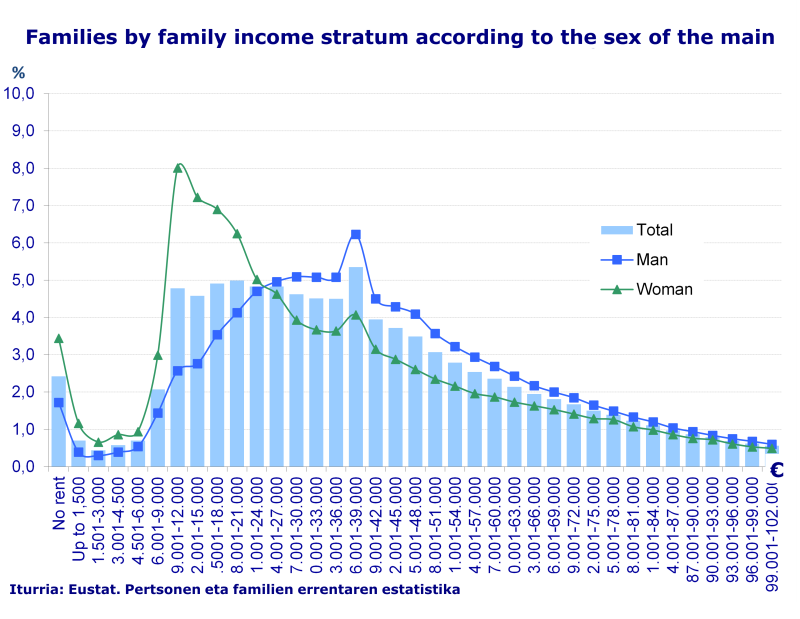
Around 63% of families received an income below the Basque Country average (€45,266) or received no income at all. 2.4% of families were in the latter situation and did not have any income in 2020. On the other hand, 10% of families received incomes approximately double the average (>€85,263).
Family income increased progressively as the person who contributed most income to the household got older until the 55 to 59 age group was reached, the age at which a maximum average income of €57,542 was attained. This maximum was also seen for men (€61,377) and women (€51,585). Families with an income above the Basque Country average were those where the main earner was aged between 40 and 69.
Personal and family income: main results for the Basque Country. 2020


| | YEAR 2020 | Variation on the year 2019 |
| | Euros | % | Euros | P.P. (*) |
| PERSONAL INCOME | 22.343 | 100 | -205 | -0,9 |
| type of rent | | | | |
| Income from Employment | 12.806 | 57,3 | -757 | -5,6 |
| Capital Income | 1.659 | 7,4 | -238 | -12,5 |
| Income from activities | 989 | 4,4 | -67 | -6,3 |
| Transfers | 6.889 | 30,8 | 856 | 14,2 |
| Disposable income | 18.699 | 83,7 | -69 | -0,4 |
| Province | | | | |
| Araba / Álava | 21.516 | 96,3 | -478 | -2,2 |
| Bizkaia | 21.853 | 97,8 | -106 | -0,5 |
| Gipuzkoa | 23.512 | 105,2 | -244 | -1,0 |
| Capitals | | | | |
| Bilbao | 22.464 | 100,5 | -195 | -0,9 |
| Donostia / San Sebastian | 26.395 | 118,1 | -902 | -3,3 |
| Vitoria-Gasteiz | 21.818 | 97,7 | -293 | -1,3 |
| Sex | | | | |
| Men | 27.422 | 122,7 | -409 | -1,5 |
| Women | 17.667 | 79,1 | -14 | -0,1 |
| Age | | | | |
| 18-34 years | 11.893 | 53,2 | -511 | -4,1 |
| 35-49 years | 25.661 | 114,9 | 11 | 0,0 |
| aged 50-64 | 28.228 | 126,3 | -415 | -1,4 |
| 65-79 years | 22.017 | 98,5 | -86 | -0,4 |
| 80 and more years | 17.650 | 79,0 | 5 | 0,0 |
| Percentiles | | | | |
| 25 | 6.120 | 27,4 | 41 | 0,7 |
| 50 | 17.811 | 79,7 | -77 | -0,4 |
| 75 | 31.846 | 142,5 | 150 | 0,5 |
| 95 | 56.338 | 252,2 | -861 | -1,5 |
| | | | | |
| FAMILY INCOME | 45.266 | 100,0 | -633 | -1,4 |
| Province | | | | |
| Araba / Álava | 42.365 | 93,6 | -1.131 | -2,6 |
| Bizkaia | 44.578 | 98,5 | -486 | -1,1 |
| Gipuzkoa | 47.734 | 105,5 | -634 | -1,3 |
| Capitals | | | | |
| Bilbao | 45.095 | 99,6 | -745 | -1,6 |
| Donostia / San Sebastian | 53.599 | 118,4 | -2.007 | -3,6 |
| Vitoria-Gasteiz | 42.617 | 94,1 | -822 | -1,9 |
| Sex of the main recipient | | | | |
| Men | 49.868 | 110,2 | -325 | -0,6 |
| Women | 38.576 | 85,2 | -1.985 | -4,9 |
| Family Size | | | | |
| 1 person | 25.593 | 56,5 | -299 | -1,2 |
| 2 persons | 48.634 | 107,4 | -360 | -0,7 |
| 3-5 persons | 65.624 | 145,0 | -1.150 | -1,7 |
| 6-9 persons | 80.156 | 177,1 | -3.466 | -4,1 |
| 10 and more persons | 110.356 | 243,8 | -17.109 | -13,4 |
| Percentiles | | | | |
| 25 | 20.245 | 44,7 | -200 | -1,0 |
| 50 | 36.312 | 80,2 | -323 | -0,9 |
| 75 | 57.691 | 127,4 | -506 | -0,9 |
| 95 | 107.853 | 238,3 | -1.466 | -1,3 |
(*)p.p = Difference in percentage points
Date October 24, 2022
Source: Eustat. Statistics on personal and family income
For further information:
Eustat - Euskal Estatistika Erakundea / Basque Statistics Institute
C/ Donostia-San Sebastián, 1 01010 Vitoria-Gasteiz
Press Service: servicioprensa@eustat.eus Tel.: 945 01 75 62