Press Release 07/11/2022
EUROPEAN INNOVATION SCOREBOARD (EIS) 2022
The Basque Country was in the group of ‘strong innovator’ countries in 2022 and exceeded the EU27 average by 10%
‘Framework conditions’ and ‘Investments’ were the innovation blocks in which the Basque Country stood out
The European Innovation Scoreboard (EIS) 2022 stood at 0.597 in the Basque Country, a rating higher than the EU27 average of 0.542, according to Eustat data.
This figure places the Basque Country at the level of the group of strong innovator countries, obtaining an average of between 100% and 125% of that registered by the EU27, specifically 110.1%. For its part, Spain was amongst the moderate innovator countries, with a value of 0.481.
The EIS 2022 European Innovation Scoreboard attempts to measure the extent to which countries' economies have the capacity to develop innovation activities. The EU27 countries are grouped into four categories, according to the rating scored and their position in relation to the European average.
The EIS scoreboard is continuously revised. Each year there are variations in terms of both its component indicators and its calculation formula. These changes mean that comparisons cannot be made with EIS scoreboards published in previous years. Each EIS provides data for an eight-year period, 2015-2022 in the case of EIS 2022, using the latest available data.
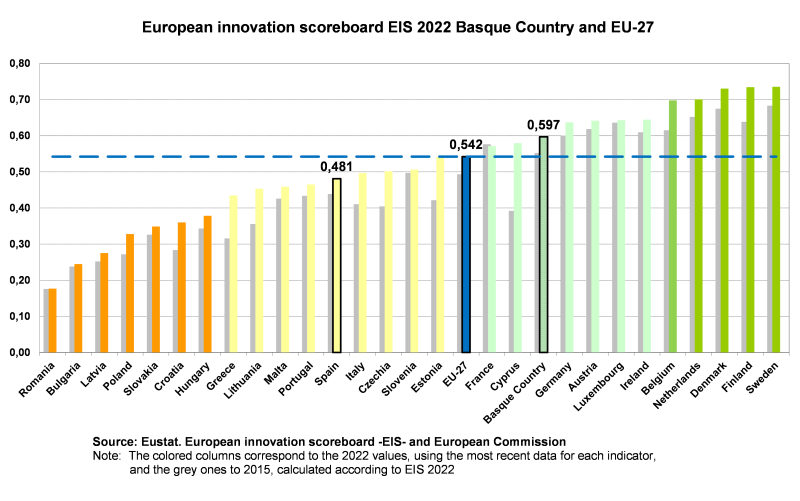
In the first category, innovation leader countries, were those countries that scored a rating more than 125% of the European Union average. They were: Sweden (0.735), Finland (0.735), Denmark (0.731), the Netherlands (0.701) and Belgium (0.698), although the country that was at the forefront of innovation in Europe was Switzerland (0.772).
In the second group, strong innovator countries, were those that achieved a rating of between 100% and 125% of the average. In this case, in descending order, were Ireland (0.645), Luxembourg (0.643), Austria (0.641), Germany (0.637), Cyprus (0.579) and France (0.571). The Basque Country, with a rating of 0.597, would be placed in this group, between Germany and Cyprus, reaching 110.1% of the EU27 average.
Following these, the third group, moderate innovator countries (between 70% and 100% of the average), included Estonia, Slovenia, Czech Republic, Italy, Spain, Portugal, Malta, Lithuania and Greece, with ratings between 0.542 for Estonia and 0.435 for Greece.
Lastly, in the fourth group, emerging innovator countries (under 70% of the average), were, in descending order, Hungary, Croatia, Slovakia, Poland, Lithuania, Bulgaria and Romania, obtaining ratings between 0.378 for the first country in the list and 0.177 points for the last.
EIS European Innovation Indicators Panel (4 Blocks and 12 Dimensions). Composite indices. 2022
| | EU-27 | BASQUE COUNTRY | SPAIN |
| Innovation Indicators Panel -EIS 2022- | 0,54 | 0,60 | 0,48 |
| | | | |
| FRAMEWORK CONDITIONS | 0,46 | 0,66 | 0,57 |
| Human Resources | 0,42 | 0,61 | 0,54 |
| Attractive research systems | 0,42 | 0,60 | 0,41 |
| Digitalization | 0,58 | 0,82 | 0,86 |
| | | | |
| INVESTMENT | 0,59 | 0,66 | 0,43 |
| Finance and Support | 0,66 | 0,64 | 0,49 |
| Investment by companies | 0,62 | 0,71 | 0,39 |
| Use of information technologies | 0,45 | 0,61 | 0,41 |
| | | | |
| INNOVATION ACTIVITIES | 0,50 | 0,46 | 0,36 |
| Innovators | 0,60 | 0,45 | 0,30 |
| Collaborations | 0,37 | 0,65 | 0,33 |
| Knowledge assets | 0,56 | 0,35 | 0,43 |
| | | | |
| IMPACTS | 0,62 | 0,59 | 0,56 |
| Employment impacts | 0,52 | 0,45 | 0,31 |
| Sales impacts | 0,69 | 0,57 | 0,67 |
| Environmental sustainability | 0,61 | 0,76 | 0,62 |
Date November 7, 2022
Source: Eustat. European Innovation Scoreboard (EIS) and European Commission
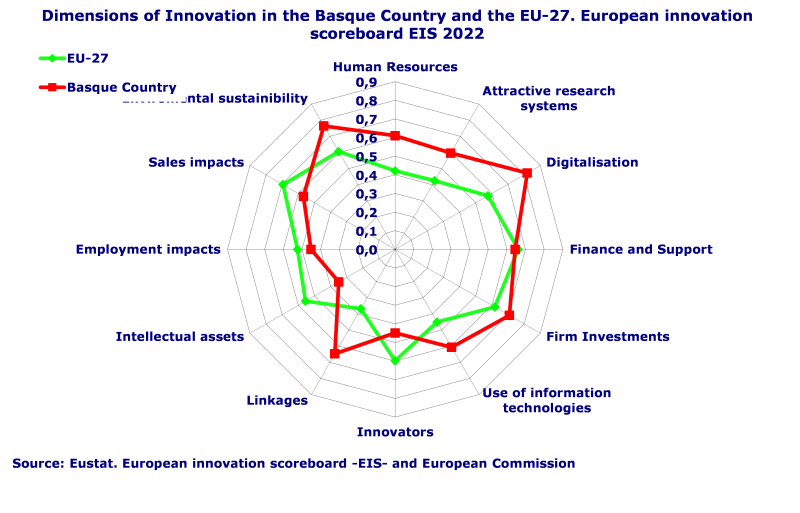
It should be pointed out that the EIS 2022 European Innovation Scoreboard is divided into four blocks, which include 12 innovation dimensions, for a total of 32 indicators.
In this regard, the Basque Country stood out in two blocks when compared with the European average: ‘FRAMEWORK CONDITIONS’ and ‘INVESTMENTS’.
In the first block, ‘FRAMEWORK CONDITIONS’ (which measure the main drivers of innovation performance external to the firm), the Basque Country scored a rating of 0.66 compared to 0.46 in the EU; moreover, the Basque Country attained a better rating than the European average in all three dimensions comprising this block: ‘Human resources’, ‘Attractive research systems’ and ‘Digitalisation’.
In ‘Human resources’, a dimension that measures the availability of a highly qualified and trained workforce as a key element of innovation, in the Basque Country all three indicators stood out with respect to the European average: the ‘New doctorate graduates in science and technology aged 25-34’ indicator stood at 1.05 per thousand in the Basque Country, while in the EU27 it was 0.70 per thousand; the ‘Percentage of the population aged 25-34 having completed tertiary education’ stood at 50.4%, with the community average standing at 41.2%; and in the third indicator of this dimension, ‘Percentage of the population aged 25-64 participating in lifelong learning’, the value obtained in the Basque Country, 12.7%, once again exceeded that for the EU27, 10.8%.
‘Attractive research systems’, a dimension that measures the international competitiveness of the scientific framework, is comprised of three indicators. The Basque Country stood out compared to the EU27 in all three. Thus, the number of ‘International scientific co-publications per million inhabitants’ stood at 1,957 in the Basque Country compared to 1,181 in Europe. In the percentage of ‘Scientific publications among the top 10% most cited internationally’ (excellent), the value for the Basque Country was 10.40% and 9.79% for the EU27 and, lastly, ‘Foreign doctorate students as a percentage of all doctorate students’ stood at 29.15% for the Basque Country compared to 17.81% for the EU27.
The third dimension of this first block under analysis is ‘Digitalisation’, which measures the level of digital technology. It includes two indicators and the Basque Country stood out in both. In ‘Broadband penetration’, it scored a rating of 66.3% compared to 52.0% in the EU27. It also stood out in ‘Individuals with above basic overall digital skills’; the Basque Country, with 37.0%, surpassed the European Union, which obtained a value of 26.0%.
In the second block, ‘INVESTMENTS’ (which measures public and private investment in research and innovation), the Basque Country, with 0.66, once again scored a better rating than the European average, which was 0.59. Three dimensions are examined in this block and in two of them, ‘Firm investments’ and ‘Use of information technologies’, the Basque Country ranked higher than the EU, while in the other, ‘Finance and support’, it was Europe that achieved a higher rating.
‘Firm investments’. This dimension includes three indicators of both R&D and non-R&D investments that firms make to generate innovations. In two of them, ‘R&D expenditure in the business sector as a percentage of GDP’ and ‘Innovation expenditures per employee in innovative enterprises’, the Basque Country surpassed Europe, with 1.59% compared to 1.53% and €11,004 compared to €7,484, respectively. However, in ‘Non-R&D innovation expenditures (% of turnover)’, the European Union, with 0.80%, was ahead of the Basque Country, with 0.69%.
‘Use of information technologies’. This dimension captures the use of information technologies through two indicators. In the first, ‘Enterprises providing ICT training’, the Basque Country ranked higher than the EU with 37.9 compared to 20.0, while in the second, ‘Employed ICT specialists’, it was the EU, with a rating of 4.5, that outperformed the Basque Country, which scored 3.4.
Lastly, the ‘Finance and support’ dimension, which measures the availability of finance for innovation projects and the support of governments for research and innovation activities, includes three indicators. One of them, ‘Direct government funding and government tax support for business R&D’, had a better rating in the Basque Country (0.34) than in the EU (0.17). However, in the other two indicators, ‘R&D expenditure in the public sector (% of GDP)’ and ‘Venture capital expenditures (% of GDP)’, it was the EU that surpassed the Basque Country, with 0.78% compared to 0.48% and 0.19% compared to 0.11%, respectively.
As regards the third and fourth blocks comprising the EIS, ‘INNOVATION ACTIVITIES’ (which shows innovation efforts at firm level) and ‘IMPACTS’ (which covers the effects of firms’ innovation activities), the Basque Country obtained a rating below the European average, 0.46 compared to 0.50 and 0.59 compared to 0.62, respectively. Even so, it is worth noting that there were several indicators in which the Basque Country outperformed the EU.
In ‘Linkages’, a dimension that measures the collaborative efforts between innovative enterprises and also with the public sector, the Basque Country achieved a better rating (0.65) than the EU27 (0.37) due to two indicators, ‘Innovative SMEs collaborating with others’ and ‘Public-private co-publications per million inhabitants’, with ratings of 18.12 and 405.18 for the Basque Country and 11.68 and 133.83 for the EU27, respectively.
Finally, in the ‘Environmental sustainability’ dimension, which covers improvements to reduce the negative impact on the environment, the Basque Country, with 0.76 points, once again ranked higher than the EU27, which scored 0.61. The Basque Country obtained this better position by outperforming the EU27 in the ‘Resource productivity’ indicator, with a figure of 2.95 compared to 2.23, and equalling the EU27 in the ‘Air emissions by fine particulate matter’ indicator, with a figure of 0.07 for the two areas analysed.
In the remaining dimensions: ‘Innovators’, which measures the proportion of SMEs that have introduced innovations into the market or within their organisations, considering both product and business process innovations; ‘Intellectual assets’, which captures the different forms of Intellectual Property Rights generated as returns on innovation processes; ‘Employment impacts’, which records the economic success of innovation on employment; and ‘Sales impacts’, which evaluates the economic success in sales as a result of innovation activities, it was the European Union that surpassed the Basque Country by achieving a higher score.
European Innovation Scoreboard, EIS 2022
European Innovation Scoreboard, EIS 2022.Basque Country
For further information:
Eustat - Euskal Estatistika Erakundea / Basque Statistics Institute
C/ Donostia-San Sebastián, 1 01010 Vitoria-Gasteiz
Press Service: servicioprensa@eustat.eus Tel.: 945 01 75 62