Press Release 20/07/2022
UNIVERSITY STATISTICS. 2021
The number of enrolments at Basque universities rose by 2.5% in the 2020/21 academic year, the greatest increase in more than 20 years
Enrolments in dual degrees were up 8%, with dual degrees combined with Business Management and Administration predominating
In the 2020/21 academic year, universities with centres located in the Basque Country increased their student population for the fourth consecutive year. There were nearly 70,000 enrolments, a rise of 2.5% on the previous year, according to Eustat data. This is the greatest increase in enrolments in more than 20 years.
Students enrolled at Basque Country universities by study level. 2020/21
| | Total | Men | Women | Public | Private | Variation with respect to the previous course (%) |
| | | | | | | |
| Total | 69.933 | 32.033 | 37.900 | 49.735 | 20.198 | 2,5 |
| | | | | | | |
| Degrees | 58.734 | 26.488 | 32.246 | 41.700 | 17.034 | 2,1 |
| Post-graduate | 11.199 | 5.545 | 5.654 | 8.035 | 3.164 | 4,6 |
| Official Masters | 6.558 | 3.220 | 3.338 | 4.043 | 2.515 | 5,3 |
| Doctorate | 4.641 | 2.325 | 2.316 | 3.992 | 649 | 3,8 |
Date July 20, 2022
Source: Eustat. University statistics
Seven out of ten students chose to pursue their studies at public university, although there were differences between the levels of education. While the proportion of undergraduate students remained the same, public centres accounted for a smaller share of enrolments in masters degrees (62%). On the other hand, the public system, with 86%, was clearly the most popular choice for students pursuing a doctorate.
Gender stereotypes continued to affect the choice of university studies
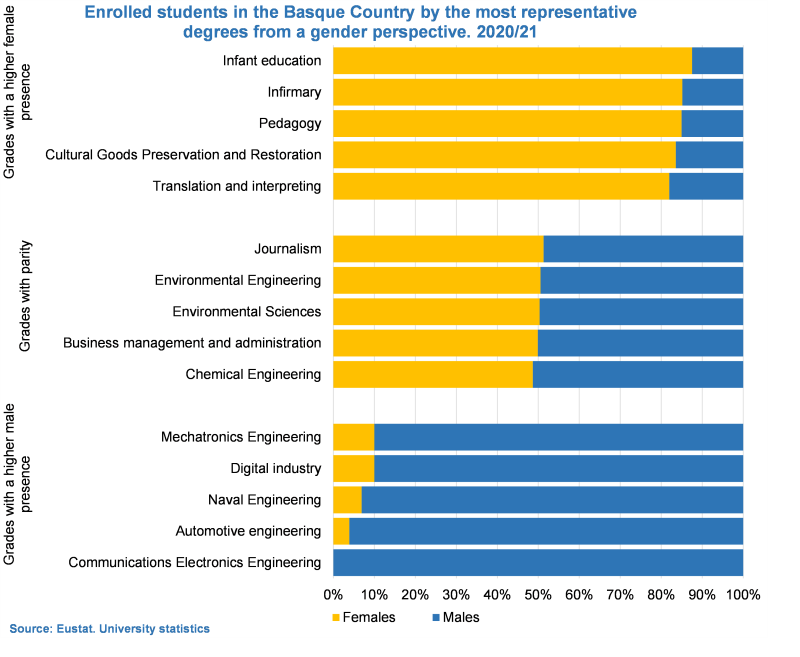
As in previous academic years, the gender distribution of undergraduate students was still far from equal in the majority of degrees. Only in a quarter of degrees were both sexes equally represented, i.e. the proportion of both men and women was at least 40%.
The degrees with the greatest imbalance in favour of women were Early Childhood Education, Nursing and Pedagogy, as men represented no more than 15% of enrolled students in any of these cases. In contrast, there were twenty degrees where the proportion of women stood below 25%, all of them in the branch of engineering.
Business Management and Administration prevailed among dual degrees
In the 2020/21 academic year, 2,903 people enrolled in a dual degree, 8% more than in the previous year. Dual degrees are joint programmes in which the sequencing of subjects is organised and the timetable of two different degrees is coordinated in order to allow students to simultaneously obtain two university qualifications in a shorter period of time than they would need if they were to study them separately.
The dual degree with the highest number of enrolments was the one combining Business Management and Administration with Law, followed by Physical Activity and Sports Sciences with Primary Education.
The transversal nature of the Business Management and Administration degree made it the most frequently included course in these joint programmes and meant that it could be accompanied by a wide variety of other degrees, from Law to Mechanical Engineering. Almost 40% of dual degree students were enrolled in a programme with Business Management and Administration as one of its components.
Arts predominated in undergraduate degrees and Sciences prevailed in doctorates
In the 2020/21 academic year, 14,404 people finished their university studies. Of particular note was the rise in people who successfully completed their doctoral theses, 548 compared to 435 in the 2019/20 academic year, an increase of 26%. Furthermore, 3,639 students obtained an official masters degree, 6% more than in the previous academic year. The number of students who received an undergraduate degree, however, saw hardly any change.
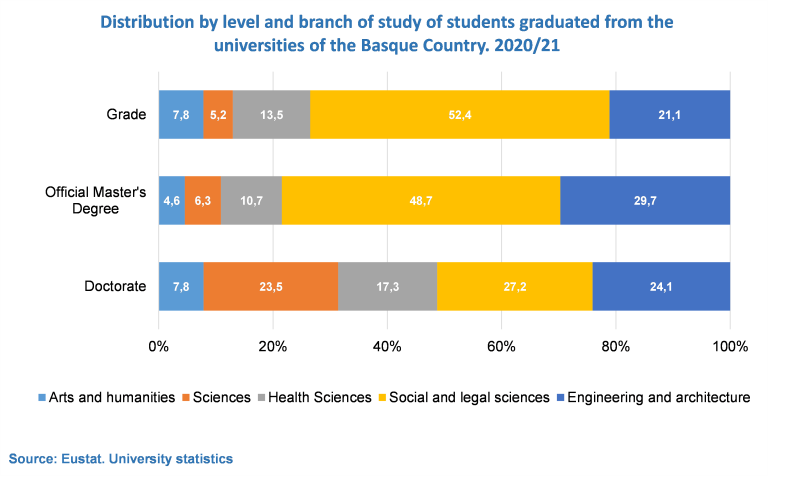
The distribution of graduates by branch of study differed between levels of education. Generally speaking, the higher the level of education, the larger the proportion of people who graduated in scientific studies (Engineering and Architecture, Sciences or Health Sciences): 40% in undergraduate degrees, 47% in masters and 65% in doctorates. Evidently, the opposite occurred in the case of arts subjects (Social and Legal Sciences or Arts and Humanities), whose graduates accounted for 60%, 53% and 35% in undergraduate degrees, masters and doctorates, respectively.
It is particularly worth noting the cases of the Social and Legal Sciences and Sciences branches. While over half of those who completed undergraduate degrees obtained a qualification in the Social and Legal Sciences branch, only one in four doctorates completed were in this field. The very opposite was true for the Sciences branch, which represented just 5% and 6% of undergraduate and masters degree holders, respectively, but more than 23% of new doctors.
98.3% of people who sat the university entrance exams passed
12,882 people sat the entrance exams for the University of the Basque Country. 98.3% of them achieved a pass, resulting in the highest pass rate since data have been available. The average mark for the general stage of the exam, i.e. the common section taken by all candidates, reached 7.2 points. However, different results were observed depending on the upper secondary education pathway taken. In this regard, there was a one-point difference between those who opted for the Arts route and those who chose Science and Technology. The average mark obtained by students on these two pathways stood at 6.5 and 7.5 points, respectively. Those who took the Humanities and Social Sciences route achieved 6.7 points on average.
For further information:
Euskal Estatistika-Erakundea / Basque Statistics Institute
C/ Donostia-San Sebastián, 1 01010 Vitoria-Gasteiz
Press Service: servicioprensa@eustat.eus Tel.: 945 01 75 62