Press Release 30/06/2022
POPULATION AND HOUSING CENSUS 2021
In 2021, six out of ten family dwellings were occupied by one or two people, 5 percentage points more than in 2011
Eight out of ten buildings had piped gas and three in four had a lift
In 2021, the percentage of family dwellings occupied by one or two people grew significantly in respect of 2011, rising by 5 percentage points to stand at 59.5%, six out of every ten, according to Eustat data.
The housing stock in the Basque Country comprised 1,075,076 dwellings on 1 January 2021, 5.4% more than in 2011, 5,494 more dwellings, and an increase of 0.7% compared to 2020. Over half of the dwellings were located in Bizkaia (51.8%), Gipuzkoa accounted for 32.6%, whilst the remaining 15.6% corresponded to Álava.
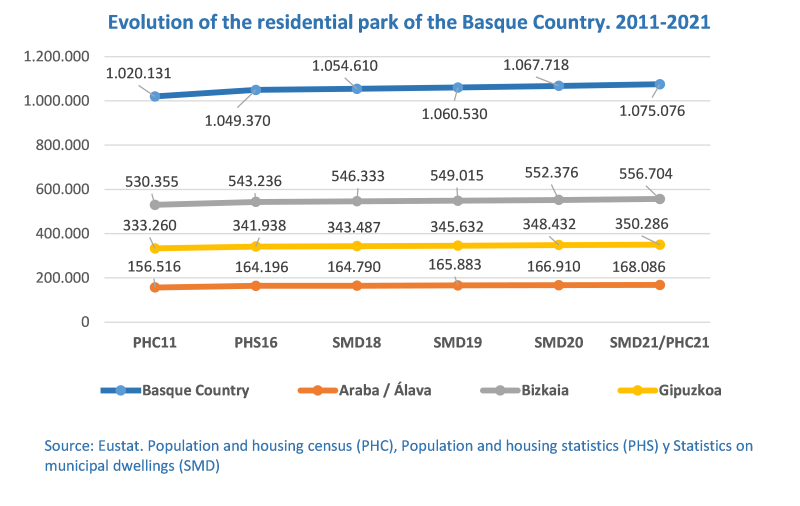
In the period between the 2011 Census and the most recent 2021 Census, the residential housing stock in the Basque Country grew by 54,945 units. This represents an increase of 5.4% between these two dates. At provincial level, some differences were observed; while Álava saw a rise of 7.4% in the ten years between the two dates, Gipuzkoa and Bizkaia recorded slower growth at very similar rates: 5.1% in the former and 5% in the latter.
If we focus on the short term and the comparison is made with 2020, i.e. the previous year, it can be seen that the residential housing stock increased by 0.8% in Bizkaia, 0.7% in Álava and 0.5% in Gipuzkoa between 2020 and 2021.
The number of primary dwellings with a lift and piped gas in the building rose compared to 2011
In 2021, 82.5% of primary dwellings in the Basque Country had piped gas in the building. In addition, 73.4% of all primary homes had a lift. These results represent an increase of 6 and 5 percentage points, respectively, in relation to the presence of these facilities in 2011.
Furthermore, in 2021, family housing stock in the Autonomous Region as a whole had an average age of 47.1 years. Álava was the province with the youngest housing stock, with an average age of 40.9 years. In Gipuzkoa and Bizkaia, this average was significantly higher, around 7 years more in both cases, standing at 47.5 in Gipuzkoa and 48.8 in Bizkaia.
Another distinguishing feature of dwellings in Álava was that they had more usable space. In 2021, the average size of dwellings in this province was 92.6 m2, which together with the figures for Gipuzkoa (87 m2) and Bizkaia (86 m2), brought the average for the Basque Country as a whole to 87.3 m2.
In terms of the number of rooms, it is worth noting that three quarters of Basque dwellings had 4 or 5 rooms, that is, 2 or 3 bedrooms, a living room and a kitchen. On average, they had 1.4 bathrooms and practically all homes had at least one bathroom (99.7%).
More than eight out of ten dwellings were used as primary residences
Regarding use, 85% of family dwellings were used for habitual residence, whilst 15% were used as second homes or were empty. Compared to 2011, it can be observed that the ratio remained virtually unchanged: in the case of primary residences, the proportion rose by 0.6 percentage points.
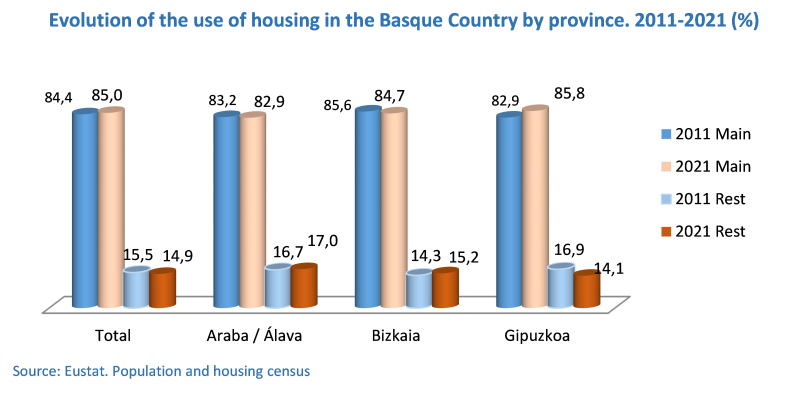
However, although there was little variation in the Basque Country as a whole, the differences were more significant at provincial level. Between 2011 and 2021, Gipuzkoa saw an increase of nearly three points in the percentage of primary residences, whilst the opposite occurred in both Álava and Bizkaia, where this type of use fell by three and nine tenths, respectively.
In terms of dwellings that are not habitually occupied, Álava was the province with the highest proportion, with 17%, while in the case of Bizkaia it stood at just 15%, and in Gipuzkoa it was even lower, at 14.1%.
The number of primary residences grew in all the regions both in the intercensal period and in relation to the previous year, albeit to varying degrees
At the regional level, although all of them recorded increases, in absolute values, in primary housing stock, there were notable comparative differences.
Standing out among those with the highest growth in Bizkaia were Plentzia-Mungia, with a rise of 13.3%, and Duranguesado, with 8.1% more dwellings; of particular relevance in Gipuzkoa were Urola Costa, which saw an increase of 10.7%, Tolosa, 9.7%, and Bajo Bidasola, with 8.2% more homes. In Álava, there was considerable growth in Estribaciones del Gorbea (7.6%) and Llanada Alavesa (7.5%), although the regions with the least growth were also in this province: Montaña Alavesa (2.5%) and Rioja Alavesa (2.7%).
However, looking at the most recent data, the year-on-year increase recorded between 2020 and 2021, the highest rises were seen in regions in Álava. These were Montaña Alavesa and Añana, with growth of 4.9% and 3.6%, respectively.
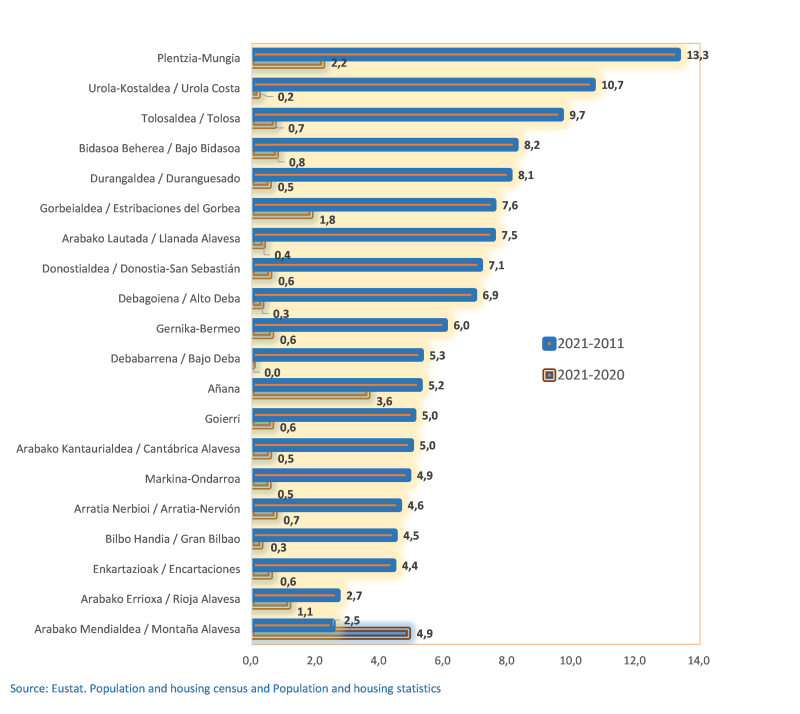
More moderate increases were recorded in the region of Bajo Deba, which did not see any significant variation that year, as well as in Urola-Costa, Alto Deba and Gran Bilbao, with rises of between 2 and 3 tenths of a point.
Uneven growth in the provincial capitals
Over the last ten years, of the three Basque capitals, Vitoria-Gasteiz has registered the largest growth in its residential housing stock, with an additional 7,946 dwellings, an increase of 7.1%. Compared to 2020, the rise stood at 456 units, or 0.4%.
In the case of San Sebastián, there was a total of 5,288 additional dwellings, up 5.9% in ten years. In respect of 2020, the variation was positive, at 0.8%, 787 more units.
The capital with the least growth in the intercensal period was Bilbao, as its 5,402 extra dwellings represented an increase of 3.4%. Between 2020 and 2021, the variation was of little significance: 159 more dwellings, a rise of 0.1%.
At the municipal level, it can be observed that 210 municipalities increased their primary housing stock, figures remained the same in 6 municipalities and 35 saw a drop in the number of this type of dwelling between 2011 and 2021.
The municipalities whose residential housing stock grew the most over the ten years were Astigarraga, Urduliz, Arakaldo, Ereño, Derio, Nabarniz and Lemoiz, all with rises of above 20%.
From 2011 to 2021, the proportion of dwellings occupied by one or two people increased by 5 points
In 2021, six out of ten family dwellings were occupied by one or two people, 59.5%, five points more than in 2011. Conversely, with regard to the same period, the percentage of dwellings with five or more residents fell from 6.1% to 5.5%.
By province, Álava stood out in terms of the number of single member households, with 31.1%. In Bizkaia, two or three people resided in over half of homes (50.9%); lastly, in Gipuzkoa, of particular note was the group of dwellings occupied by 4 or 5 people (20.8%).
For further information:
Eustat - Euskal Estatistika Erakundea / Basque Statistics Institute
C/ Donostia-San Sebastián, 1 01010 Vitoria-Gasteiz
Press Service: servicioprensa@eustat.eus Tel.: 945 01 75 62