Press Release 31/05/2022
CONSTRUCTION SURVEY. 2020
Employment in the construction sector in the Basque Country fell by 5.1% and turnover was down 18.5% in 2020
Renovation of residential buildings and construction of new residential buildings generated 44% of the sector’s turnover
In 2020, the year when the COVID-19 pandemic began and the most restrictive measures were imposed on activity, employment in companies in the construction sector of the Basque Country dropped by 5.1%, according to Eustat data.
In absolute figures, this is a loss of just over 3,200 net jobs compared to the previous year, reaching a figure of 59,963 jobs in the construction sector of the Basque Country in 2020.
At provincial level, all three provinces followed the same trend, albeit to varying degrees. The greatest relative losses were recorded in Álava, where employment dropped by 6.3%, followed by Bizkaia, down 5.4%, and in Gipuzkoa the year-on-year decrease was slightly smaller, standing at 4.0%.
As a result of these variations, Bizkaia accounted for 52.4% of employment in the sector, Gipuzkoa 33.9% and Álava 13.7%.
In keeping with employment figures, the number of hours worked fell by 8.8% in the Autonomous Region as a whole; this percentage was slightly higher in Álava (-10.0%) and Bizkaia (-9.2%) than in Gipuzkoa (-7.6%).
Main Construction Variables. Basque Country. Current prices (thousands euros). 2019-2020
| | 2020 | 2019 | Increase (%) |
| Personnel employed NU | 59.963 | 63.173 | -5,1 |
| Net amount of the turnover | 7.873.599 | 9.655.684 | -18,5 |
| Supplies | 4.156.818 | 5.419.595 | -23,3 |
| Exterior services | 921.932 | 1.126.623 | -18,2 |
| Expenditures on personnel | 1.917.325 | 2.080.364 | -7,8 |
| Funds for depreciation | 148.024 | 138.273 | 7,1 |
| Result before tax | 805.266 | 1.118.040 | -28,0 |
| Profit or loss for the financial year from continuous operations | 720.646 | 1.000.396 | -28,0 |
| Investment made | 168.037 | 235.469 | -28,6 |
Date May 31, 2022
Source: Eustat. Construction Survey
In terms of size, the three main subsectors were: Electrical Installations, Plumbing and Other Installations, with 18,561 jobs; Finishing Works, with 15,388 jobs; and Building Construction, with 11,139 people in work. Between them, they accounted for just over 75% of the total number of people employed in construction. In 2020, all three subsectors posted a negative trend: employment was down 4.5% in the Installations subsector, it fell by 2.9% in Finishing Works and there was a decrease of 6.1% in Building Construction.
A fairly similar drop in employment was seen across all strata. The greatest loss in relative terms occurred in the stratum with the highest employment, that of more than 20 people, which decreased in size by 6.5%. This employment stratum, with 15,268 people, accounted for 25.5% of total employment in construction. The stratum of 1 to 19 people also fell significantly, albeit to a lesser degree, by 4.5%, employing almost half of the total, 49.2%. Lastly, the sector without salaried workers, self-employed people, which represented 25.3% of the total, registered a drop of 4.7%.
Source: Eustat. Construction survey
Period availables
It is worth noting that, in 2020, 10.1% of people employed in the construction sector were women. This is just over one percentage point more than in 2019 (8.8%) and 3.1 percentage points less than in 2010, when the highest proportion of working women was recorded, at 13.2%.
Turnover fell by 18.5% in the Basque Country: it decreased by 18.9% in Bizkaia, 18.4% in Álava and 17.9% in Gipuzkoa
COVID-19 also had a dramatic impact on turnover. Thus, in 2020, the net turnover figure for this sector registered a drop of 18.5% compared to 2019, standing at 7,874 million euros in the Basque Country as a whole. Following the recovery seen in 2018 and 2019, this figure placed the construction sector at lower levels than those observed in 2017, a year which marked the culmination of years of continuous declines.
Broken down by province, companies in Bizkaia, which turned over 3,912 million euros (49.7% of the total value in the Basque Country), recorded the largest decrease of the three provinces, at 18.9%. It was closely followed by Álava, with a turnover of 1,090 million euros (13.8% of the total), which saw a fall of 18.4%. The smallest annual decrease occurred in Gipuzkoa (17.9%), with a turnover of 2,872 million euros, representing 36.5% of the Basque Country total.
This 18.5% drop in total sales was reflected in the negative performance seen to varying degrees across the different employment strata. In effect, the highest stratum, that of 20 or more employees, was by far the least affected and experienced a decline of just 9.9%. In contrast, the stratum without salaried workers saw turnover fall by more than a quarter compared to 2019, specifically 26.4%. Following closely behind was the stratum of 1 to 19 employees, where turnover dropped by 22.1%. With these variations, the stratum of 1 to 19 employees accounted for 56.9% of total turnover in 2020, the stratum of 20 employees or more accounted for 36.0% and the stratum without salaried workers took up the remaining 7.1%.
Personnel costs decreased by 7.8% in the Basque Country, and by 3.7% in Gipuzkoa, 9.6% in Bizkaia and 11.1% in Álava.
Source: Eustat. Construction survey
Period availables
Value added in the construction sector was down 10.9% in 2020, reaching 2,867 million euros, after falling by 13.3% in Álava, 11.2% in Bizkaia and 9.5% in Gipuzkoa. It is worth noting that the stratum of establishments with 20 or more employees was hardly affected, as its value added only shrank by 0.6%, while in the case of establishments with one to twenty employees it was down 10.2% and it decreased by as much as 32.5% in the stratum without salaried workers.
Property Development only represented 3.8% of total employment in 2020, but generated 13.6% of the total gross value added for the construction sector
Considering the different activity groups within construction and the generation of value added at factor cost, Electrical Installations, Plumbing and Other Installations activities stood out, accounting for 31.0% of jobs and generating 27.2% of total value added. If we add to this the figures for employment in Building Construction (18.6% of the total) and the value added generated (19.1%), this accounts for almost half of the value added at factor cost and half of total employment in the construction sector in 2020.
Among the remaining activity groups with the greatest weight in employment, the following groups stood out: Finishing Works, with 25.7% of jobs and 16.2% of value added of the sector total, and, in particular, Property Development. This group represented just 3.8% of total employment, but generated 13.6% of the total gross value added for the construction sector.
This activity group therefore registered the highest productivity per person. While the average productivity in the sector was 48,000 euros, the average for Property Development stood at 170,000 euros. The second activity group in terms of productivity was Demolition and site preparation, with 71,000 euros per person. Electrical Installations, Plumbing and Other Installations recorded the lowest productivity per person, with 30,000 euros.
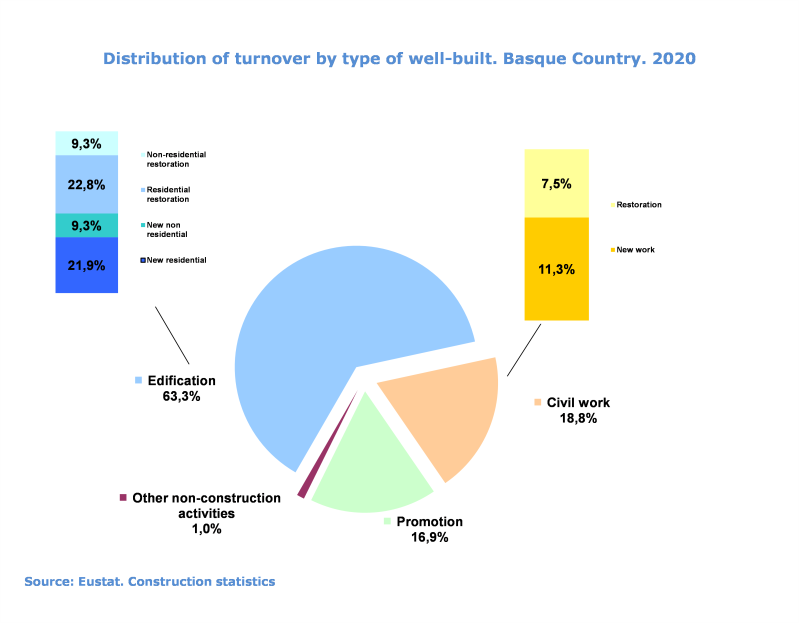
21.2% of turnover was generated by construction of new residential buildings
As regards the type of property built, it should be pointed out that just over a fifth (21.2%) of turnover in the construction sector of the Basque Country came from construction of new residential buildings, although the greatest contribution came from renovation of residential buildings, with 22.8% of the sector’s total turnover.
New civil works (such as roads, sewage systems, dams, bridges, etc.) accounted for 11.3% and renovation of non-residential buildings and construction of new non-residential buildings (such as shops, warehouses, industrial buildings, buildings intended for tourism, recreation, etc.) represented 9.3% each.
For further information:
Eustat - Euskal Estatistika Erakundea / Basque Statistics Institute
C/ Donostia-San Sebastián, 1 01010 Vitoria-Gasteiz
Press Service: servicioprensa@eustat.eus Tel.: 945 01 75 62