Press Release 25/03/2022
SCHOOL ACTIVITY STATISTICS. 2021
The number of students enrolled in formal non-university education in the Basque Country was down 1.8% in the 2020/21 academic year
More than half of foreign students pursued their studies following the D model
In the 2020/21 academic year, 412,130 people enrolled in formal non-university education in the Basque Country, 1.8% less than in the previous academic year, according to Eustat data. This is the largest decline in the last 20 years.
The fall in the number of students in General Education stood at 1.6%, primarily due to the decrease in enrolments in Early Childhood Education and Adult Education, which reached -7.8% and -12.9%, respectively. In contrast, both Upper Secondary Education and Intermediate and Advanced Level Vocational Training registered increases in the number of enrolments of over 4%.
Furthermore, there was a 5.1% drop in enrolment in Specialised Education caused by the decline in students at Official Language Schools.
Students enrolled in non-university education in the Basque Country by study level, according to province. 2020/21


| | Total | Araba/Álava | Bizkaia | Gipuzkoa | Variation with respect to the previous course (%) |
| TOTAL | 412.130 | 67.420 | 206.380 | 138.330 | -1,8 |
| General teaching | 383.150 | 62.749 | 189.435 | 130.966 | -1,6 |
| Infant education | 78.613 | 13.061 | 38.906 | 26.646 | -7,8 |
| Primary education | 128.125 | 21.021 | 64.311 | 42.793 | -1,5 |
| Obligatory secondary education | 87.189 | 13.555 | 43.465 | 30.169 | 1,0 |
| Basic vocational training | 4.820 | 644 | 2.906 | 1.270 | 2,6 |
| Baccalaureate | 32.502 | 5.038 | 16.344 | 11.120 | 4,1 |
| Professional Training middle grade | 15.752 | 2.520 | 7.230 | 6.002 | 4,3 |
| Professional Training higher grade | 23.056 | 3.331 | 10.457 | 9.268 | 4,7 |
| Task learning | 1.555 | 276 | 809 | 470 | 5,9 |
| Adult education | 11.538 | 3.303 | 5.007 | 3.228 | -12,9 |
| Special teaching | 28.980 | 4.671 | 16.945 | 7.364 | -5,1 |
| Language studies | 24.507 | 3.722 | 14.281 | 6.504 | -7,6 |
| Artistic studies - music | 2.600 | 482 | 1.334 | 784 | -1,7 |
| Artistic studies - dance | 137 | 105 | 32 | . | - |
| Plastic arts and design teachings | 639 | 362 | 217 | 60 | 9,4 |
| Sports studies | 1.044 | . | 1.028 | 16 | 82,5 |
| Arts Education in dramatic art | 53 | . | 53 | . | -3,6 |
Date March 25, 2022
Source: Eustat. School activity statistics
In terms of centre ownership, enrolment in General Education was slightly higher at public centres, with 52.4% of students compared to 47.6% at private centres, which, in absolute terms, translated into 18,618 more students in public education.
There continued to be gender differences with regard to Upper Secondary Education pathways and Vocational Training specialisations
More than 32,500 people enrolled in Upper Secondary Education and over 43,600 enrolled in one of the three levels of Vocational Training (basic, intermediate and advanced). Distribution by gender at these levels was disparate. The most even distribution was seen in Upper Secondary Education, with 54% women. On the other hand, there was a significant imbalance in favour of men at all levels of Vocational Training, which decreased as the level of education increased. Thus, in Basic Vocational Training, the proportion of men exceeded 73%, while in Intermediate and Advanced Level Vocational Training, men accounted for 66% and 64% of students, respectively.
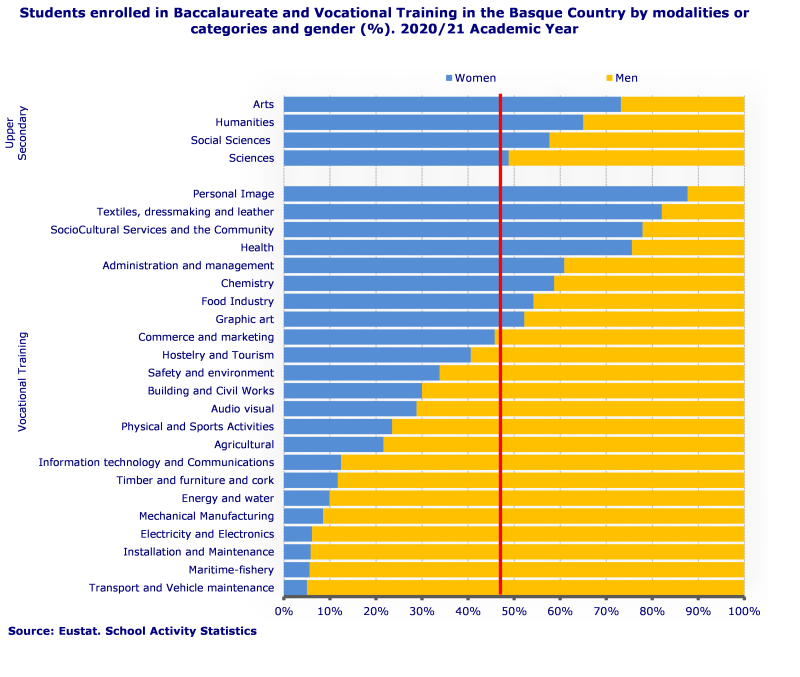
As in previous academic years, there were differences by gender in the choice of Upper Secondary Education pathways. Except for the science route, which was at gender parity, there was a prevalence of females, especially in the Arts pathway, where almost three quarters of enrolled students were female.
Likewise, gender gaps continued to be recorded in the occupational families into which Vocational Training is classified. In families related to personal image and care of persons, more than three in four students were women. In contrast, there were six entirely male-dominated families, where the presence of women was almost inconsequential as they accounted for less than 10% of all students: Transport & Vehicle Maintenance, Marine Fishing, Installation & Maintenance, Electricity & Electronics, Mechanical Manufacturing and Energy and Water.
There was an increase in the number of foreign students following the D model
In the 2020/21 academic year, 38,631 foreign nationals enrolled at education centres in the Basque Country. Just over half of them pursued their studies following the D model, while one in three did so via the A model and only 15% used the B model. This distribution contrasts with that of the total student population, where the proportion of students following the D, B and A models was 69%, 18% and 13%, respectively.
Significant differences were observed in the distribution of the linguistic model according to centre ownership. Thus, foreign students at public centres, 72% of the total, were distributed among the linguistic models as follows: 58% in the D model, 34% in the A model and just 8% in the B model. However, those who attended private centres were distributed equally between the three options.
As regards evolution over time, it was observed that the A and D models swapped roles over the last 10 years, whereas the B model remained constant. In the 2011/12 academic year, the most popular choice among the foreign student population was the A model, with 53% of students. Since then, this option has seen a decline in enrolments, falling to 34% in the 2020/21 academic year. On the other hand, the D model has seen an upward trend, going from 29% in the 2011/12 academic year to 51% at present.
The amount of grants received by students in Upper Secondary Education and Vocational Training increased by 76%
In the 2020/21 academic year, 115,748 students in General Education benefited from grants and aid awarded by the Public Administration of the Basque Country totalling close to 52 million euros. Of these, around 15 million went to students in Upper Secondary Education and Vocational Training, 76% more than in the previous academic year. This increase was due to the change in income thresholds in the call for grants and aid for the 2020/21 academic year.
Students at public centres received approximately two thirds of the budget earmarked for this purpose. 39% of students at public centres were recipients of some form of aid, while the proportion stood at 24% in private education. The difference was particularly notable in Primary Education, where half of students at public centres received aid, as opposed to only a quarter of those enrolled at privately owned centres.
Fewer students had school meals compared to the 2019/20 academic year
42% of students enrolled in General Education used the school canteen, 8 percentage points down on the 2019/20 academic year, when half of students had lunch at their place of study. In absolute figures, the number of students using the canteen fell by almost 33,000 people.
However, use of the school meals service was uneven across the provinces. While half of students used the service in Bizkaia, 35% and 28% did so in Gipuzkoa and Álava, respectively.
School transport, however, saw hardly any change in respect of the previous academic year. 52,205 students travelled to their education centres by school bus, 14% of the total. Once again, there was a higher demand for this service in Bizkaia (17%) than in Gipuzkoa (12%) and Álava (9%). There were differences between public centres, where only one in 10 students used school transport, and private centres, where the proportion stood at 17%.
For further information:
Euskal Estatistika-Erakundea / Basque Statistics Institute
C/ Donostia-San Sebastián, 1 01010 Vitoria-Gasteiz
Press Service: servicioprensa@eustat.es Tel.: 945 01 75 62