Press Release 11/02/2022
INTERNATIONAL DAY OF WOMEN AND GIRLS IN SCIENCE. 2022
The proportion of women studying Engineering in the Basque Country rose by almost 3 percentage points in the last 10 years
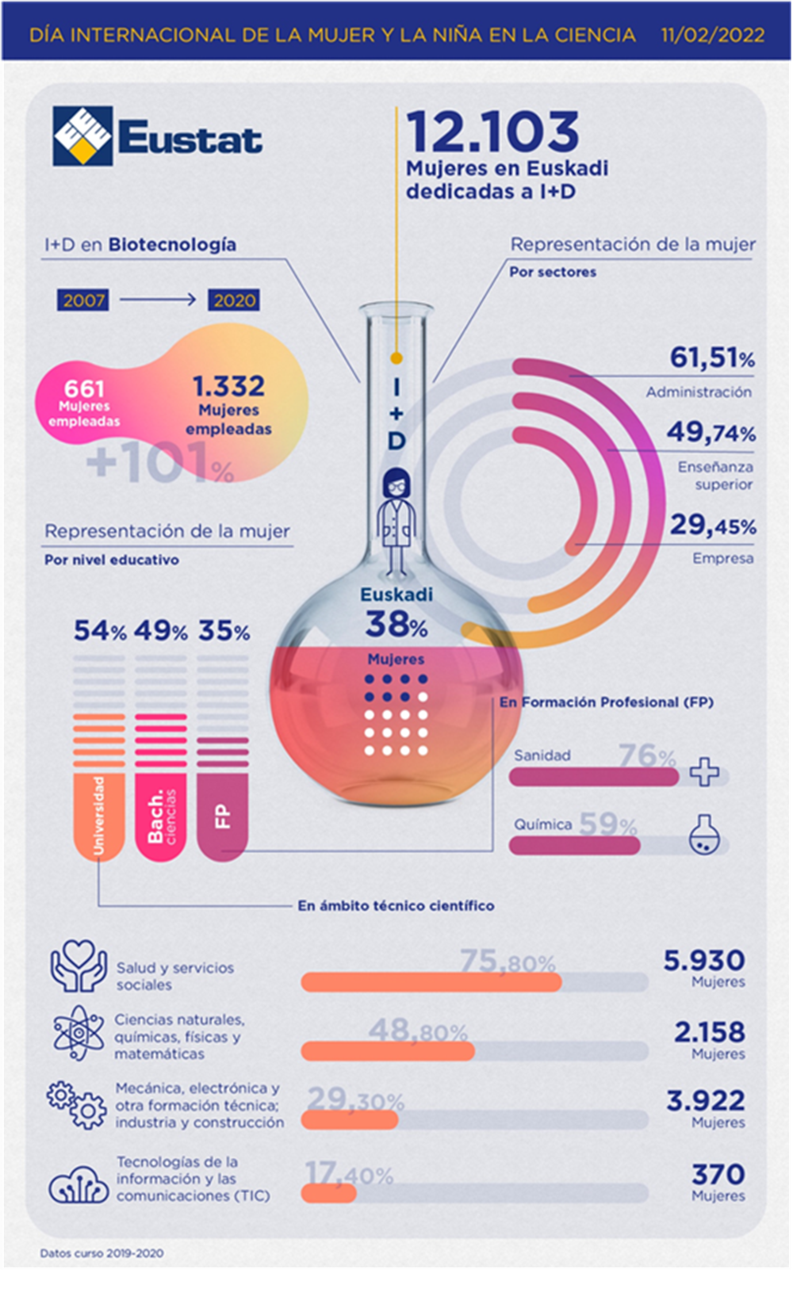
12,103 women were engaged in R&D in the Basque Country, equivalent to 38% of the total number of people working in this field
According to data prepared by Eustat to analyse the presence of women in Science in the Basque Country, both in university education and in R&D, to mark the International Day of Women and Girls in Science celebrated today, 11 February, the proportion of women in the branch of Engineering, one of the most male-dominated fields of study, increased slightly over the last ten years. Specifically, it grew 2.7 percentage points, going from 25% in the 2010/2011 academic year to 27.7% in 2019/2020.
Although this field is male-dominated and the evolution has been disparate, since practically all of the degrees with less than a quarter of women students belong to this branch, some specialisms with a high prevalence of women stood out, such as Fundamentals of Architecture, with women accounting for 57%, Industrial Engineering and Product Development, with 53.1%, and Industrial Chemical Engineering, with 58.3%.
In the Sciences branch, there was a more equal proportion of men and women in some specialisms. For example, in Mathematics, the percentage of women reached 48% and in the case of Chemistry, this figure rose to 54.2%. However, the study of Physics continued to be a predominantly male choice and the proportion of women stood at 27.9%.
In Health Sciences, all the degrees were very female-dominated and some of them are becoming increasingly so. The highest percentage of women was in Nursing, with 84.1%, similar to the 2010/2011 academic year. In Medicine, another very characteristic and sought after branch of Health Sciences, the percentage stood at 73.4% in 2019/2020, significantly higher than the 67.6% in 2010/2011. Dentistry recorded similar data and increases to Medicine, rising from 67.6% to 74.2%.
In general, there was a considerable proportion of women undergraduate students, reaching 55%, 10 percentage points more than that of men. In university education, which includes, in addition to undergraduate degrees, all types of studies carried out at university (masters, doctorates, etc.), women accounted for 54% and the vast majority of them, 75.80%, studied a degree in the field of Health and Social Services, whereas only 17.40% took degrees in Information & Communications Technology (ICT).
In 2020, 38% of the total number of people working in R&D were women, compared to 31.3% in 2003 and 22.3% in 1993
In the Basque Country, a total of 31,922 people worked in R&D in 2020, of whom 12,103 were women, representing 38% of the total. Of the total number of people employed in this field, 61.51% of Public Administration workers were women, followed by Education, where there was barely any difference between men and women (49.9% female) and, lastly, the Business sector, where they accounted for just 29.5%.
By scientific discipline, Engineering was the activity where the most people worked in R&D, with 20,219, or 63.3% of the total. It was also the largest employer of women, as 47.1% of women working in R&D were engineers, although this proportion was much lower than that of men, with 73.3%. However, of the total number of women working in R&D, 23.8% of them were employed in Medical Sciences, compared to 9.7% of the total number of men, and 15.5% worked in Social Sciences, versus 7.8% of men who worked in R&D.
A significant rise in the number of women in R&D has been observed in recent years. They accounted for 22.3% in 1993, 31.3% in 2003, and this figure has steadily increased to reach the current percentage of 37.7%. The number of women in R&D increased from 1,928 in 1993 to 12,103 in 2020. The scientific discipline that was the biggest driver of this change in trend was Engineering, with the percentage of women in R&D doubling from 14.1% to 28.2%.
For further information:
Eustat - Euskal Estatistika Erakundea / Basque Statistics Institute
C/ Donostia-San Sebastián, 1 01010 Vitoria-Gasteiz
Press Service: servicioprensa@eustat.eus Tel.: 945 01 75 62