Press Release 12/01/2022
MUNICIPAL GDP. 2019
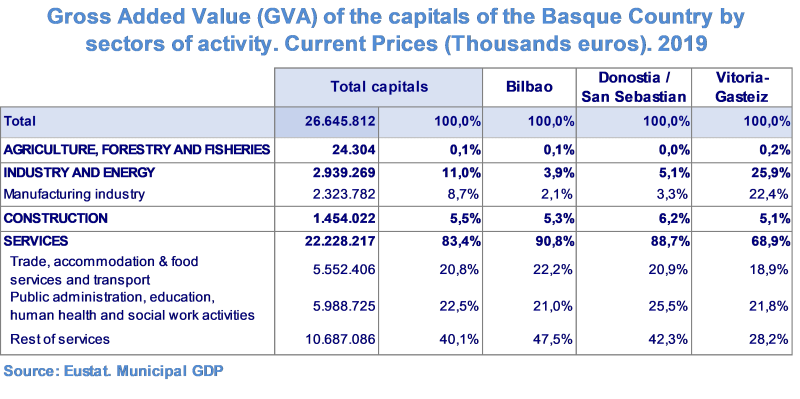
The services sector accounted for 90% of economic activity in Bilbao and San Sebastián, while Vitoria-Gasteiz combined the services (68.9%) and industry (25.9%) sectors
Gipuzkoa recorded a more even provincial distribution of economic activity compared to the other two provinces
Economic activity, measured in terms of Gross Value Added (GVA), generated by the municipalities of Bilbao, San Sebastián and Vitoria-Gasteiz primarily came from the Services sector, which accounted for 83.4% of all activity generated by the 3 Basque capitals in 2019, according to Eustat data.
This situation was particularly notable in the case of Bilbao, where services activities represented 90.8% of all economic activity, and in San Sebastián, where they accounted for 88.7%, deriving in both cases from the strong presence of activities such as Property Activities, Trade and Hospitality, among others.
Vitoria-Gasteiz, for its part, had a significantly lower weight in the Services sector (68.9%), having given way to a more industrial economic structure, which, underpinned by the manufacturing output of the Automotive Industry and Rubber Products, represented 25.9% of its economic activity.
Vitoria-Gasteiz generated 72.6% of the total GVA for the province of Álava
Among the municipalities that generated the most GVA in the province of Álava, of particular note was the capital, Vitoria-Gasteiz, which, with a GVA of over 8,000 million euros, accounted for 72.6% of GVA generated in the province as a whole.
Source: Eustat. Municipal GDP
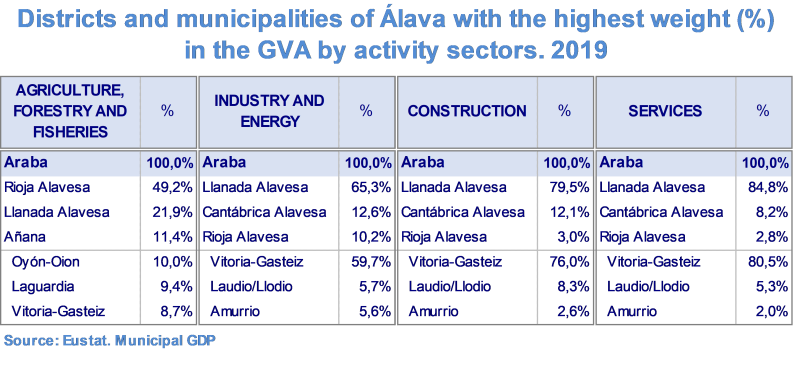
In turn, the region of Llanada Alavesa, underpinned by the strong business landscape of Vitoria-Gasteiz, was the region that provided the most value added to the province of Álava, both in the Industry and Energy sector, where it contributed 65.3% of the total for the province, and in Construction, with 79.5%, and in Services, representing 84.8%. It was followed in these sectors by the region of Cantábrica Alavesa, where it is worth highlighting the municipalities of Laudio/Llodio, with significant weight in activities such as the Manufacture of glass and glassware and Iron and Steel products, and Amurrio, also with considerable weight in Iron and Steel products and the Manufacture of Furniture.
Only the region of Rioja Alavesa surpassed Llanada Alavesa in the Primary Sector, accounting for 49.2% of the value added for this sector in the province, as a result of agriculture linked to the region’s wine sector, in which the municipalities of Oyón-Oion and Laguardia stood out, contributing 10.0% and 9.4% of the total, respectively.
The municipalities that generated the most GVA in Bizkaia were in Gran Bilbao
The region of Gran Bilbao includes 9 of the 10 municipalities that generated the most GVA in Bizkaia, which together produced 60.8% of the total GVA for this province in 2019. These municipalities were Bilbao, with more than 11,200 million euros in GVA in 2019, followed by Barakaldo, Zamudio, Getxo, Leioa and Basauri, which in turn generated more than 1,000 million euros each, and Erandio, Galdakao and Santurtzi, with more than 900 million euros each.
Source: Eustat. Municipal GDP
By activity sector, Gernika-Bermeo was the region that generated the highest volume of GVA in the Agriculture, Livestock and Fishing sector in 2019, accumulating 54.0% of the total for Bizkaia. However, unlike Álava, where agricultural activity predominated, in Gernika-Bermeo, fishing contributed the most GVA to the province of Bizkaia in this sector. The municipality with the most fishing activity was Bermeo (48.4%), followed by Ondarroa (9.8%).
In the other major economic sectors, Gran Bilbao was the dominant region, with a weight of 58.4% in Industry and Energy in Bizkaia, 78.9% in the case of Construction and 81.9% in the Services sector as a whole in the province, among which Property Activities, Trade, Hospitality and Public Administration services were of particular relevance, among others.
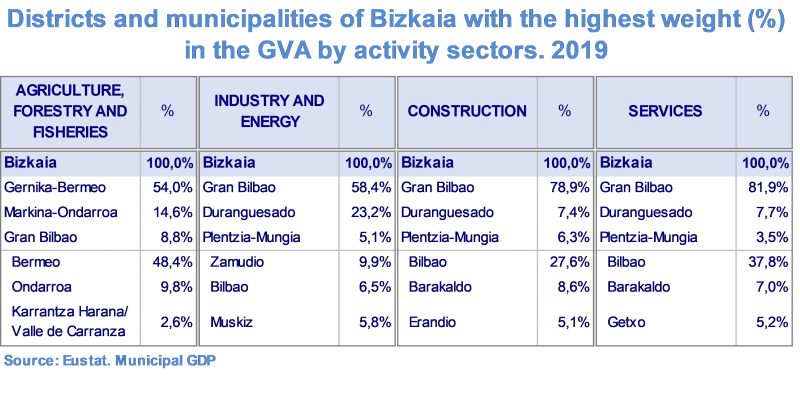
It is worth noting that in the Industry and Energy sector, the generation of GVA in Bizkaia was fairly evenly distributed among many municipalities, with Zamudio accounting for the greatest weight with 9.9% of the total. This was not the case in the Construction and Services sectors, as Bilbao was the municipality that represented the highest percentage of GVA, with a weight of 27.6% and 37.8%, respectively.
The region of Donostialdea generated 48.2% of GVA in Gipuzkoa
In Gipuzkoa, Donostialdea was the region that generated the most GVA in 2019, more than 11,000 million euros, accounting for 48.2% of the total for the province. The municipality of San Sebastián took the lead with a GVA of over 7,000 million euros and a weight of 29.7%.
Irun, in the region of Bajo Bidasoa, was the municipality that generated the second highest volume of GVA, with more than 1,700 million euros, largely due to its location on the border and the activities generated by this, such as Trade, Hospitality and services related to transport.
Gipuzkoa recorded a more even distribution of GVA compared to the other two provinces, where a greater concentration of GVA was observed.
Source: Eustat. Municipal GDP
In the Agriculture, Livestock and Fishing sector, coastal regions predominated. Urola Kosta was the region that posted the highest GVA, generating 32.2% in the sector for the province, followed by Bajo Bidasoa (17.9%) and Donostialdea (15.8%). The municipalities that produced the most GVA had a strong fishing industry, with Hondarribia (with 16.8% of the sector), Getaria (15.3%) and Pasaia (7.1%) being the most significant.
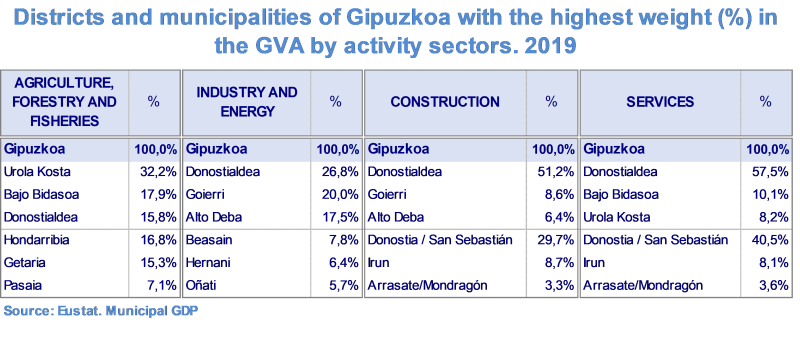
GVA in the Industry and Energy sector was very evenly distributed among the different municipalities. Beasain came out top, with a weight of 7.8% of the total GVA for the province, primarily due to the strong presence of the manufacture of railway material. It was followed by Hernani (6.4%) and Oñati (5.7%), with the production of General Use Machinery standing out in both, among others.
In the Construction and Services sectors, the greatest concentration of value added was seen in the region of Donostialdea, specifically, as with the other two provinces, due to the spillover effect from activity in the capital, San Sebastián, which generated 29.7% in Construction and 40.5% in Services in the province of Gipuzkoa. In the latter, Property Activities and accommodation and catering activities (Hospitality) linked to tourism had a strong presence.
Methodological note: Economic activity, measured by the value added generated by the production sectors (primary, industry, construction and services), is linked to the province where their production units are located. Income, on the other hand, is related to individuals and their place of residence.
For further information:
Eustat - Euskal Estatistika Erakundea / Basque Statistics Institute
C/ Donostia-San Sebastián, 1 01010 Vitoria-Gasteiz
Press Service: servicioprensa@eustat.eus Tel.: 945 01 75 62