Press Release 30/11/2021
HOSPITAL MORBIDITY STATISTICS. 2020
In 2020 hospitalisations were down in acute care hospitals in the Basque County, but average length and stay and mortality increased
COVID-19 was the main cause of a total of 10,481 admissions in acute care hospitals, which accounted for 5% of hospitalisations
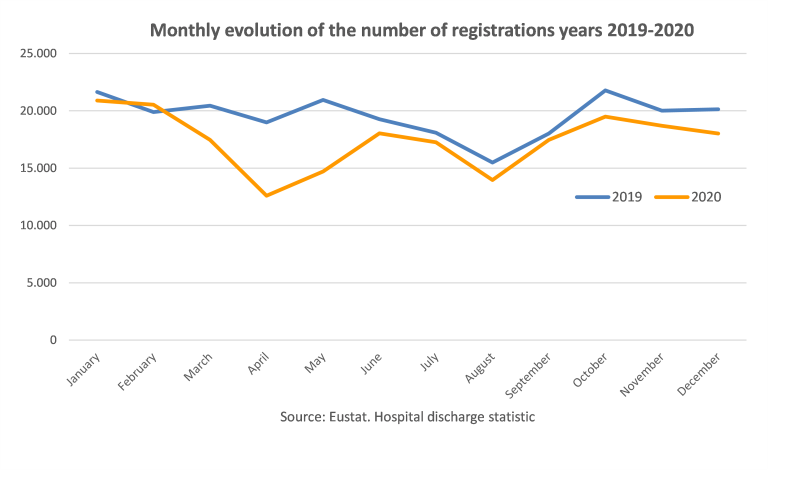
In 2020, 209,150 people in total were hospitalised in acute care hospitals in the Basque Country (not including medium and long-stay hospitals and psychiatric hospitals), which was a decrease of 10.9% compared to the previous year, according to Eustat data. This decrease was 10.7% in the case of public hospitals and 11.7% in that of private ones.
The greatest decrease in the number of hospitalisations was in March, April and May, coinciding with the period of confinement. The impact of COVID-19 has meant a decrease in hospital admission activity and outpatient surgery in acute care hospitals, especially during the months of confinement, as well as an increase in the average length of hospital stay and mortality.
As was the case one year ago, 84% of admissions were registered in the public sector. 65.7% of hospitalisations were emergencies, a percentage that rose to 72% in public hospitals and dropped to 34% in private ones.
Of the total number of discharges, 89.5% were due to recovery or improvement, 3.9% due to death (3.2% in 2019) and the rest due to transfers to other centres or other reasons. March was the month with the highest number of deaths (10.9%), unlike the previous year when it was January.
51% of hospital admissions corresponded to men and 49% to women. If we exclude cases of care for childbirth, pregnancy and postnatal issues, which, in general do not constitute a health problem, this percentage stood at 55% for men, ten percentage points above that for women (45%).
Furthermore, almost half of those admitted to hospital were aged 65 and over and among these, 56.6% were in the 65-79 age group, with the most common age being 72 for men and 86 for women.
The drop in hospital admissions affected all the major groups of diseases, the two main causes of admission remained diseases of the digestive system (13%) and circulatory system (12.6%). They were followed, with similar rates, by tumours (9.5%), trauma and injuries (9.3%) and diseases of the respiratory system (9%).
The treatment pattern varied depending on the ownership of the hospital. In public hospitals, the most frequently treated conditions involved the circulatory and digestive systems (13.3% and 12.9%, respectively), whereas in private hospitals it was those that affected the musculoskeletal system (18.5%) and trauma and injuries (13.2%), as well as the digestive system (13.1%).
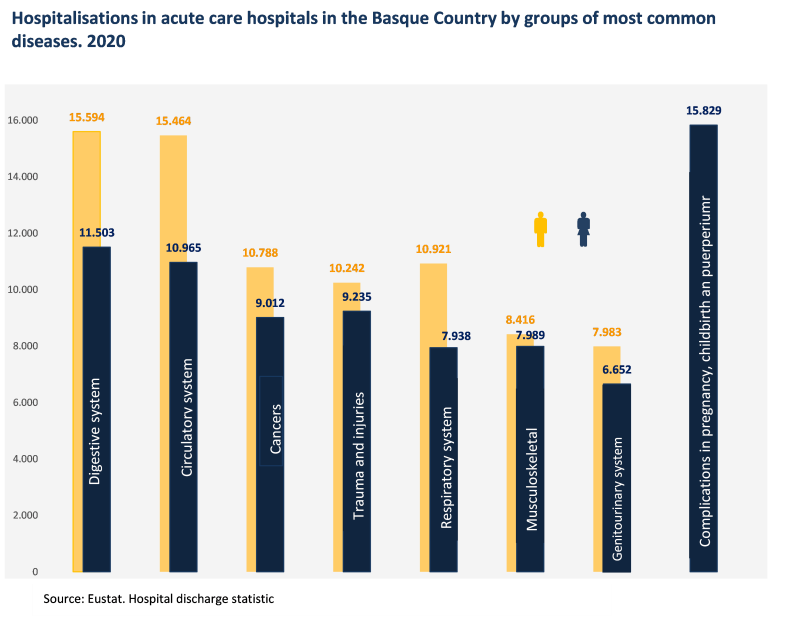
Despite a decrease in recent years, pregnancy, birth and postnatal incidents continued to be the most common reason for hospital care among women (15.5%), followed by digestive diseases (11.2%) and circulatory diseases (10.7%).
The main causes of hospitalisation for men were the same as those for women, but for men there was a higher prevalence in both diseases of the digestive system (14.6%), and the circulatory system (14.5%).
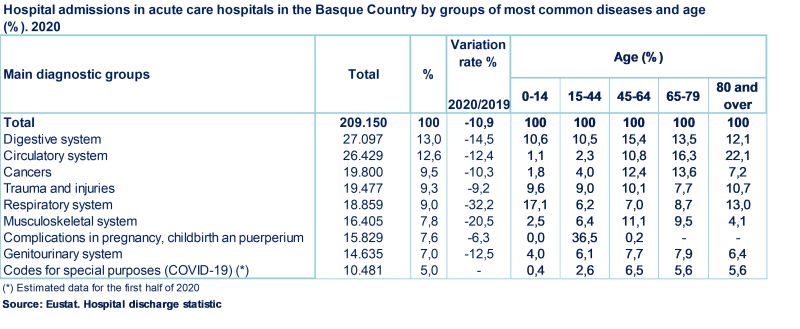
The groups of diseases and the specific causes responsible for the most frequent admissions in the population aged 0-14 arose from perinatal issues (disorders due to premature birth or low birth weight) and respiratory diseases (tonsil and adenoid hypertrophy); in the 15-44 age group it was treatment for pregnancy and birth, in the case of women, and trauma and injury in that of men (cruciate ligament knee sprain); standing out in the 45-64 age group were digestive diseases (inguinal hernia) for men and tumours (breast and uterine) for women; of particular note in those aged 65 and over were circulatory diseases (heart failure), followed by digestive diseases (gallstones).
If we do not take into account pregnancy, childbirth and postnatal care, the average age of those admitted to hospital was 62; over this age, the highest corresponded to circulatory diseases, for both men (70) and women (76). Generally, men were admitted to hospital at an earlier age than women, the most significant cause being trauma and injuries (54 for men compared to 67 for women).
The number of hospital stays decreased, but the average length of stay increased
The number of hospital stays was down 8.6%, while the average length of stay rose to 5.8 days (5.6 in 2019), being 6 days in public hospitals and 4.5 in private ones; among the longest stays were those for mental health disorders (13.4 days) and perinatal conditions (10.3 days)
5% of hospitalisations were for COVID-19 and the average length of stay stood at 9.2 days (*)
It is estimated that COVID-19 was the main cause of a total of 10,481 admissions in acute care hospitals, which accounted for 5% of hospitalisations in 2020. Furthermore, these admissions caused 96,619 stays, which represented an average length of stay of 9.2 days, above the average for all causes (5.8 days). 95% of admissions were in public hospitals and, of these, 97% were emergencies.
58% of admissions corresponded to men and 42% to women. By age groups, the highest percentage of these cases corresponded to the 45-64 age group (33.8%), followed by those aged 65-79 (31.3%) and 80 and over (24%). The average age stood at 65 for men and 67 for women.
Admissions for outpatient surgery were down 20%
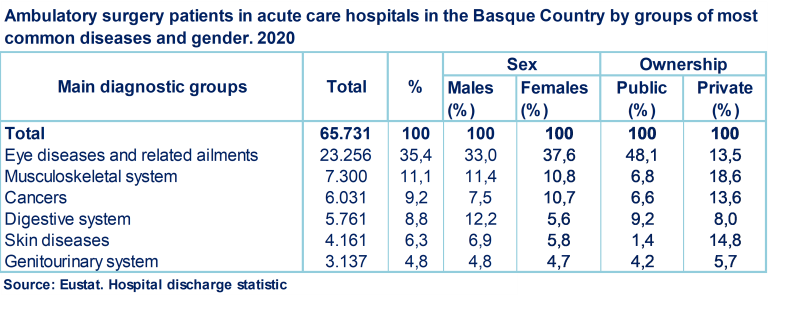
Outpatient surgery, where patients are admitted, treated and discharged on the same day, recorded 65,731 admissions (20.3% down on 2019), this decrease being more pronounced in March, April and May. The group of eye diseases was the most common, accounting for 35.4% of cases treated, of which 86% were carried out in public hospitals, with cataracts being the most treated pathology.
In private hospitals it was cases associated with the musculoskeletal system (18.6%); with inner knee disorders being the most common; followed by skin diseases (14.8%) and cancers (13,6%), in particular skin cancer, which had the most weight.
Methodological note
(*) The WHO established an emergency code for classifying COVID-19 infections in Spain in the International Classification of Diseases (ICD-10). In Spain this classification was implemented in July 2020, therefore in order to identify hospital admissions in the first quarter of 2020 due to COVID-19 these cases have been estimated, taking into account the main diagnosis that prompted the admission (primarily those that affected the respiratory system), together with other secondary diagnoses associated with the same hospitalisation.
For reasons of comparability with Spanish and international statistics, the hospital admissions mode only takes into account admissions with a stay equal to or greater than 1 day, that is, admissions with 0 days are not counted. The length of stay is calculated as the number of days between the date of admission and the date of discharge, without taking into account the time of admission or discharge.
For further information:
Eustat - Euskal Estatistika Erakundea / Basque Statistics Institute
C/ Donostia-San Sebastián, 1 01010 Vitoria-Gasteiz
Press Service: servicioprensa@eustat.eus Tel.: 945 01 75 62