Press Release 16/12/2021
SOCIAL PROTECTION ACCOUNT. Advance. 2020
Expenditure on social protection in the Basque country grew by 9.6% in 2020 to reach 21,431 million, 30% of GDP
The greatest increase in social benefits was in the “unemployment” function, which practically doubled, 1,024 million more
Expenditure on social protection in the Basque country in 2020 stood at 21,431 million euros, 1,870 million more than in 2019, which, in percentage terms, was an increase of 9.6%, according to Eustat data. As a percentage of GDP, expenditure on social protection grew by 5.4 points, reaching 30.0%. Expenditure per capita increased by 9.4% to 9,757 euros.
The Social Protection Account is prepared using the methodology of the European System of Integrated Social Protection Statistics (ESSPROS) and calculates the income and expenditure of the social protection systems in the Basque Country for any public or private body.
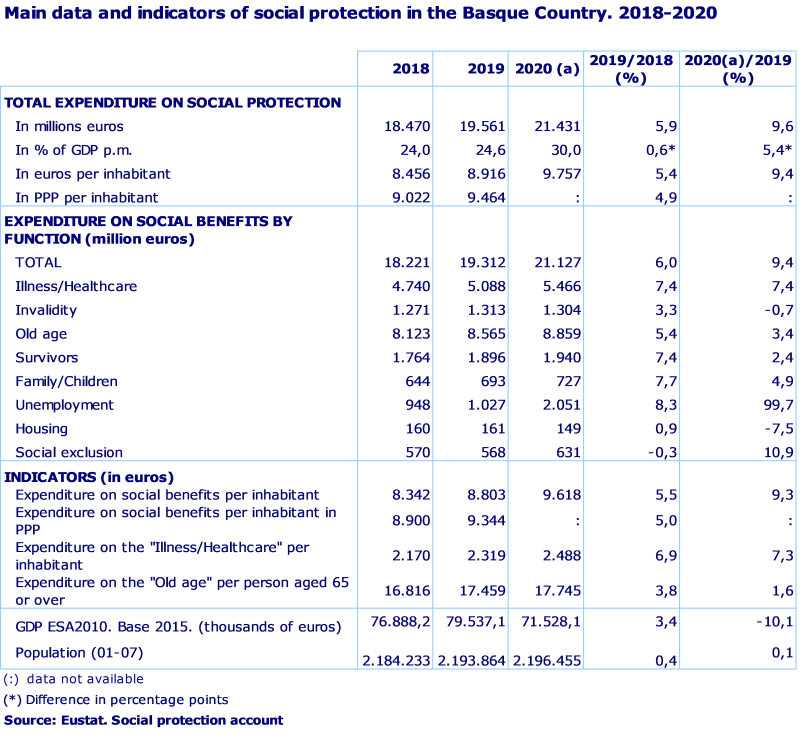
Expenditure on social protection includes administrative expenses and spending on social benefits; the latter include both cash payments and benefits in kind that households receive from the social protection systems. The breakdown of these benefits enables the analysis of the functions on which the money is spent.
Excluding administrative expenses, the value of social benefits in 2020 was 21,127 million euros, 9.4% higher than in 2019, which, in absolute terms, was an increase of 1,815 million euros.
The function with the greatest increase was “Unemployment”
Most of the increase in social benefits corresponded to the “Unemployment” function, which rose by 1,024 million, reaching 2,051 million in 2020, an increase of 99.7% compared to 2019. This function had already seen significant growth in 2019, mainly due to the improvements made to unemployment assistance and the increase in the amount of contributory benefits. In 2020, the rise was largely due to the extraordinary emergency measures adopted to combat the economic and social impact of COVID-19, both in favour of self-employed workers, with the establishment of a benefit for cessation of activity or a reduction in turnover, and in favour of salaried workers, who, in the event of suspension of contracts and reduction of working hours due to temporary force majeure (ERTES - Temporary Labour Force Adjustment Plans), were entitled to contributory unemployment benefits.
The next function that saw the largest growth in absolute values in 2020 was “Illness/Healthcare”, which increased by 7.4% compared to 2019, a rise of 378 million euros; of which 192 million corresponded to the increase in expenditure on healthcare services and 186 million to the rise in cash benefits, starting with benefits for temporary disability. In total, expenditure on this function amounted to 5,466 million euros.
In third place, another of the functions that grew the most in absolute values was “Old Age”, which reached 8,859 million euros in 2020, 294 million more than the previous year, up 3.4%. However, although significant, this increase was lower than that registered in previous years.
In relative values, the “Social exclusion” function grew by 10.9% compared to 2019, equivalent to a further 62 million in absolute values, reaching 631 million in 2020. Most of the expenditure on this function corresponded to Guaranteed Basic Income and Emergency Social Assistance, which together increased by approximately 42 million in 2020.
The functions with the highest expenditure on social benefits continued to be “Old Age” and “Illness/Healthcare”
As in previous years, the function that received the largest spending was still “Old Age”, which includes expenditure on pensions, financial benefits related to dependence and other benefits in kind, such as residential services and home care. Although the weight of this function fell by 2.4 percentage points in 2020, it continued to account for the highest percentage of expenditure, 41.9% of total spending on social benefits.
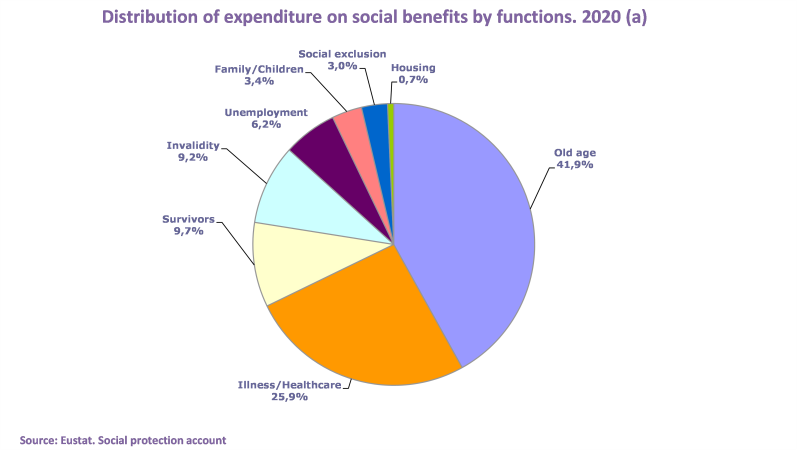
The next largest amount of expenditure corresponded to the “Illness/Healthcare” function, which, with 5,466 million in 2020, represented 25.9% of expenditure on benefits, although its weight also decreased by half a percentage point in respect of 2019.
In third place, as a result of the significant growth in expenditure, was the “Unemployment” function, which increased its weight by 4.4 percentage points, reaching 9.7% of expenditure on social benefits in 2020.
The remaining functions maintained a similar relative weight to previous years: expenditure on “Survivors” accounted for 9.2%, “Disability” 6.2%, “Family and children” 3.4%, “Social exclusion” 3.0% and “Housing” 0.7%.
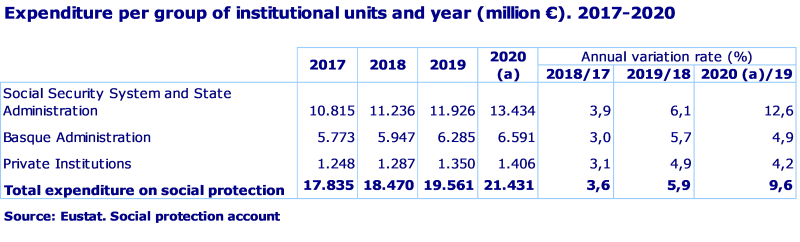
With regard to the institutional units that spend money on social protection, spending by the Social Security System and State Administrations accounted for 62.7% of total expenditure in 2020; 12.6% up on 2019, an increase of 1,508 million. The causes thereof have already been mentioned: the increase in financial benefits for temporary disability, which are included in the “Illness/Healthcare” function (which went up by 127 million) and the increase in financial benefits related to the “Unemployment” function, deriving, in part, from the adoption of extraordinary measures linked to the impact of COVID-19 (which saw a rise of close to 1,000 million).
Expenditure by the Basque Administrations accounted for 30.8% of the total, reaching 6,591 million euros, 4.9% more than in 2019. On the one hand, this growth was due to the increase in expenditure by the public health system, which was up 5.1%, reaching 4,190 million euros. On the other hand, the remaining expenditure went on the public system of social benefits, which includes the institutions of the Basque Government, Provincial Councils and Local Administrations, which reached a total of 2,401 million euros, 4.5% more than in 2019.
Lastly, spending on Private Institutions represented 6.5% of the total, with 1,406 million euros, an increase of 4.2%.
For the comparison with Europe, we analysed the latest data published by Eurostat, corresponding to 2019. The indicator for expenditure on social protection per inhabitant, measured in terms of Purchasing Power Parity (PPP), stood at 9,464 in the Basque Country, above the average for the EU27, with 9,066, Spain (6,752) and Ireland (7,491), among others. At the very top of the table were Luxembourg (15,621) and Denmark (12,233).
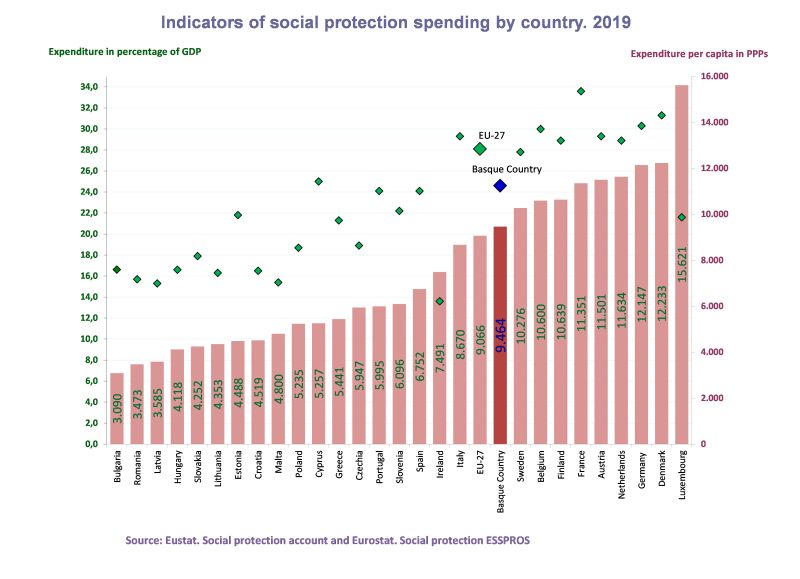
Furthermore, social protection expenditure as a percentage of GDP in the Basque Country stood at 24.6% in 2019, below the EU27 average (28.1%) but above Spain (24.1%) and also Luxembourg (21.6%) which, as mentioned above, was at the top of the table for expenditure per inhabitant.
For further information:
Eustat - Euskal Estatistika Erakundea / Basque Statistics Institute
C/ Donostia-San Sebastián, 1 01010 Vitoria-Gasteiz
Press Service: servicioprensa@eustat.es Tel: 945 01 75 62