Press Release 19/11/2021
STATISTICS ON SCIENTIFIC RESEARCH AND TECHNOLOGICAL DEVELOPMENT - R&D ACTIVITIES 2020
Expenditure on R&D in the Basque Country in 2020 reached the maximum in the series with 1,490 million euros, despite the pandemic
In relation to GDP, it exceeded 2% (2.08%) due to the negative impact of the COVID-19 crisis on GDP, which did not have a knock-on effect on R&D expenditure
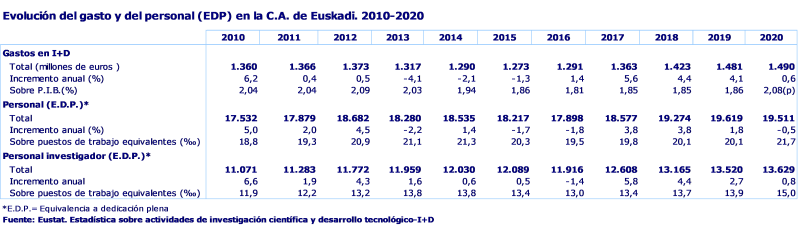
Expenditure on internal R&D (Research and Technological Development) in 2020 reached a total of 1,490 million euros in the Basque Country, a record figure in R&D expenditure according to Eustat data.
This figure accounted for expenditure of 8.6 million euros more than in the previous year, an increase of 0.6%, and all despite the fact that 2020 was a year marked by the crisis caused by COVID-19.
Internal R&D provided employment for 19,511 people in Full-Time Equivalent Jobs in 2020, following a decrease of 0.5% in respect of the previous year. In contrast, research staff, 13,629 people in Full-Time Equivalent Jobs, increased by 0.8%.
In relation to GDP, expenditure on internal R&D in the Basque Country reached 2.08% in 2020. This significant increase in respect of the data from the previous year, 1.86%, is primarily due to the fact that the pandemic had a greater impact on GDP than on R&D expenditure. In order to compare this data with the last available data from the European Union 27 (EU-27), we have to use the data corresponding to 2019, where in the EU-27 it accounted for 2.23% of its GDP and in Spain 1.25%.
On a provincial level, 47.3% of total expenditure on internal R&D in the Basque Country in 2020 was carried out in Bizkaia, 42.6% in Gipuzkoa and 10.1% in Álava. It should be pointed out that this expenditure represented 2.63% of GDP in Gipuzkoa, 1.95% in the case of Bizkaia and 1.35% in that of Álava.
76.7% of expenditure on internal R&D in the Basque Country was implemented by the business sector
In terms of the sector that carried out internal R&D expenditure, the majority, 76.7% (1,143.0 million euros) was implemented by businesses, whereas 17.4% (258.7 million) corresponded to Higher Education and the remaining 5.9% (88.3 million) was carried out by various bodies dependent on the Administration.
This sectorial distribution of implementation of R+D expenditure, with the exception this year in Administration, has remained relatively stable in recent years. Compared to the previous year, two of the three sectors, Businesses and Higher Education, increased their expenditure on internal R+D by 1.2% and 1.9%, respectively, while in Public Administration it fell by 9.9%.
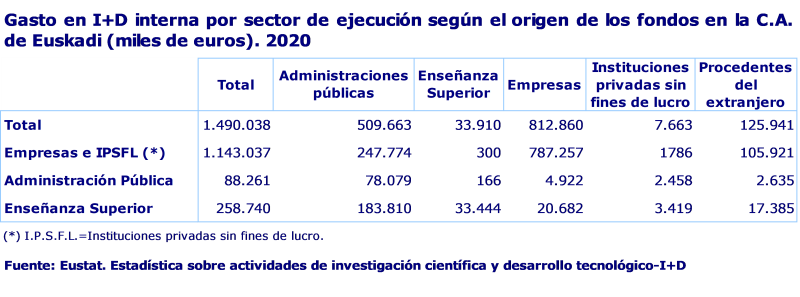
In terms of funding internal R&D expenditure, companies spent 813 million euros on research, 1.8% more than in 2019, accounting for 54.6% of total funding, remaining the primary source of funding. Public funding contributed 510 million and represented 34.2% of total expenditure on internal R&D, having also increased by 1.8%.
The remaining funding sources were the Higher Education sector, 33.9 million; Private Non-Profit Institutions, 7.7 million; and overseas, 125.9 million. In all three cases these contributions meant reductions in respect of the previous year of 25.7%, 2.0% and 1.9%, respectively.
As regards the origin of public funding, the contribution from the autonomous administration predominated (411.7 million), up 0.9% on the previous year and representing 80.8% of total funding by the public administration in 2020. For its part, the central administration (74.7 million) increased its funding by 8.1% this year and its share stood at 14.7% of total funding. Finally, the provincial and local administrations (23.3 million) share was 4.6%, although they reduced their contribution, down 1.9%, in relation to the previous year.
There were 19,511 people in full-time employment who, by implementation sectors, corresponded to: 13,801 people to the Business Sector (70.7% of the total), 4,546 to Higher Education (23.3%) and 1,164 to Public Administration (6.0%). The number of research staff, 13,629 people, increased by 0.8%, compared to the 0.5% decrease in total personnel.
36.5% of R&D personnel were women in 2020
36.5% of R&D personnel in full-time employment were women, a percentage practically identical to that of the previous year; specifically it was 0.1 percentage down on total personnel. However, from a more long-term perspective, its weight increased by 3.1 percentage points in relation to 2010 and 4.8 points on 2005.
Considering the sector implementing R&D, it can be observed that there are higher numbers of women in the Business and Higher Education sectors: 4,245 and 2,237 women, respectively, compared to 648 women in the Public Administration sector. However, in relative terms in the Public Administration women represented 55.7% of its total personnel, compared to 49.2% in Higher Education and 30.8% in the Business sector.
Note: Eustat would like to thank all the companies and institutions that have collaborated in preparing this survey, the information for which was gathered between April and October 2021, for the effort made. Without their collaboration it would not have been possible.
For further information:
Eustat - Euskal Estatistika Erakundea / Basque Statistics Institute
C/ Donostia-San Sebastián, 1 01010 Vitoria-Gasteiz
Press service: servicioprensa@eustat.es Tel.: 945 01 75 62