Press Release 28/10/2021
ENVIRONMENTAL ACCOUNTS. ENVIRONMENTAL GOODS AND SERVICES ACCOUNT. 2019
The value added generated by the environmental economy in the Basque Country grew by 10.6% in 2019
In terms of employment, it generated 22,086 jobs, 2.27% of the total economy
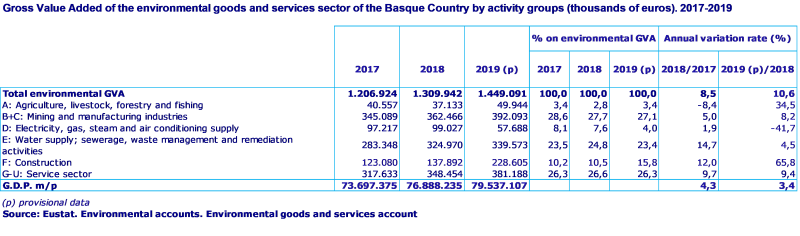
The Gross Value Added (GVA) of the environmental economy rose to 1,449 million euros in 2019, which constituted 1.8% of the Gross (GDP) for that year according to Eustat data. In relation to 2018, the year-on-year growth rate of the environmental GVA was 10.6%, clearly higher than that of the Gross Domestic Product of the whole economy, 3.4%.
The Environmental Goods and Services Account is part of the system of environmental accounts and is prepared according to Eurostat's methodology. These accounts allow for a coherent integration of economic and environmental aspects within the National Accounts system. The environmental goods and services (environmental economy) sub-sector is composed of the segment of the economy dedicated to the production of goods and services for environmental protection and activities related to the management of natural resources to reduce or eliminate environmental pressures.
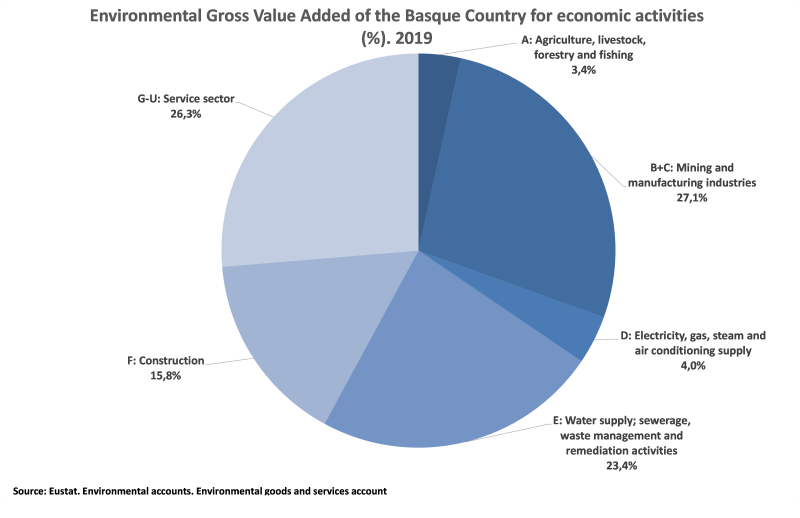
By economic sector, and in relation to GVA, it is worth highlighting the contribution of Extraction and Manufacturing Industries, with 27.1% of the environmental total, followed by the Services sector with 26.3% and Water Supply and Waste Cleanup and Management activities, with 23.4%. In 2019, the sectors with the largest environmental contribution were Construction (15.8%), Supply of Electricity, Gas and Air Conditioning (4.0%) and, lastly, the Primary sector, with 3.4%.
Analysing the evolution over time reveals that the majority of the sectors increased environmental GVA, particularly encouraging was the Construction sector, with year-on-year growth of 65.8% in 2019 and an increase of 5.3 percentage points in its contribution to the environmental GVA in respect of the previous year; the changes to legislation on energy certification that new buildings must comply with explains this evolution. In second place, the Agriculture, Livestock, Forestry and Fishing sector, showed growth of 34.5%. In contrast, with a negative trend, the Supply of Electricity, Gas and Air Conditioning sector fell by 41.7%.
Employment generated by environmental activities, measured as full-time equivalent (FTE) jobs, accounted for 2.3% of total employment recorded in 2019, with growth of 15.8%.
If we look at environmental employment by economic sector, the Services sector comes out top with 28.7% of total environmental employment, followed by Extraction and Manufacturing Industries with 26.7%, Construction with 22.2%, and Water Supply and Waste Cleanup and Management activities, with 18.8%. Conversely, the sectors with the lowest contribution to environmental employment were the Primary and the Supply of Electricity, Gas and Air Conditioning sectors, with 3.3% and 0.2%, respectively.
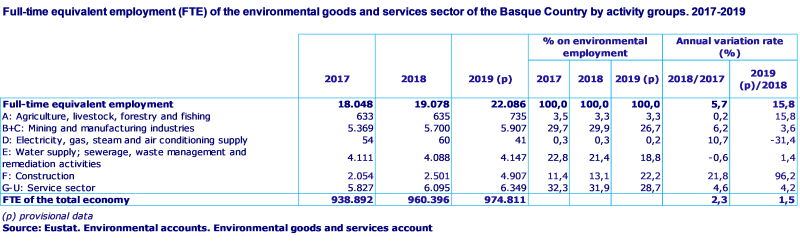
In year-on-year terms, the sectors that stand out in terms of the evolution in environmental employment in 2019 were the Construction sector, with a strong year-on-year rate of 96.2%, and, some way behind, the Primary Sector, with growth in respect of the previous year of 15.8%.
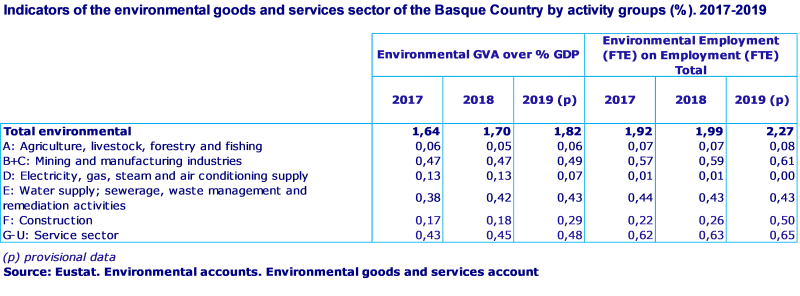
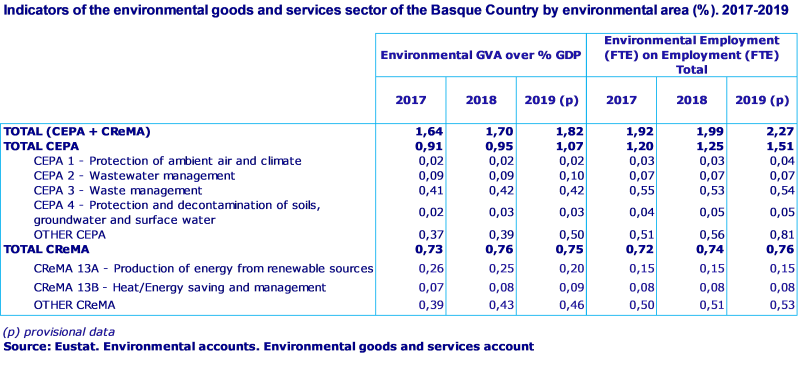
Taking into account the main indicators that relate the environmental sub-sector with the economy as a whole, environmental GVA accounted for 1.8% of GDP in 2019, twelve hundredths more than the previous year, and Full-time Employment accounted for 2.3% of employment as a whole, 28 hundredths more than in 2018.
Compared with Spain, environmental activities in the Basque Country accounted for a higher percentage of employment in relation to the economy as a whole: 2.27% in the Basque Country as opposed to 1.78% for the rest of Spain. With regard to environmental GVA in relation to GDP, the value in Spain stood at 2.11%. In the Basque Country it was higher, reaching 1.82% in 2019.
Analysing the contribution of the Basque Country to the total economy of Spain, it was observed that the GVA of the environmental economy in the Basque Country generated 5.53% of the environmental GVA of Spain in 2019. In turn, environmental employment in the Basque Country represented 6.75% of environmental employment generated nationally.
The last available data for making an international comparison in relation to this account corresponds to 2018. As regards the contribution of environmental GVA to total GDP, this year both the European (EU-27) and Spanish average stood at 2.27%, whereas that of the Basque Country reached 1.7%.
Following the European Regulation, two major domains stand out in terms of their environmental goals: environmental protection activities and resource management activities, both categorised into two mutually exclusive classifications. On the one hand, environmental protection activities are described in the Classification of Environmental Protection Activities (CEPA) and, on the other, resource management activities for environmental protection are described in the Classification of Resource Management Activities (CRMA).
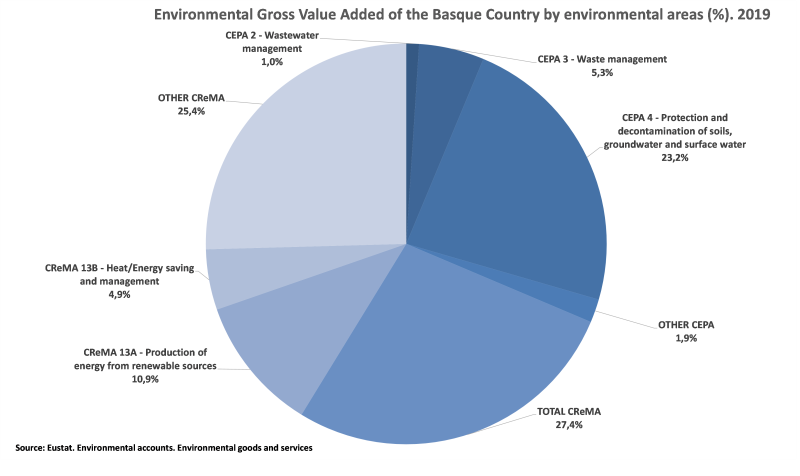
The domain that stood out with the highest proportion of total environmental GVA generated in 2019, corresponded to the category of Other CEPA, which includes activities related to noise reduction, preservation of biodiversity, protection against radiation and environmental R&D, among others, and contributed 27.4%. Behind this were other activities such as Waste Management, which contributed 23.2% of the total.
The category of Other CRMA, which comprises activities such as the management of water, forest resources and wild fauna and flora, among other, contributed 25.4%.
In terms of GDP, environmental protection activities (CEPA) contribute 1.07% of GDP in 2019, higher than the 0.75% contribution from resource management activities.
In terms of employment (full-time equivalent jobs), activities associated with environmental protection also accounted for a large proportion of the total, 1.51% compared to 0.76% of resource management. More specifically, the environmental domain that contributed most to employment as a whole was Other CEPA (0.81 points), followed by Waste Management (0.54 points)
For further information:
Eustat - Euskal Estatistika Erakundea / Basque Statistics Institute
C/ Donostia-San Sebastián, 1 01010 Vitoria-Gasteiz
Press Service: servicioprensa@eustat.eus Tel.: 945 01 75 62