Press Release 08/11/2021
MARRIAGE STATISTICS. 2020
In 2020, the year of the pandemic, marriages in the Basque Country fell by 45.7%
The decline reached 96.2% in April 2020
There was a total of 4,057 marriages in the Basque Country in 2020, the year of the COVID-19 pandemic, down 45.7% on the previous year, according to Eustat data. If we take into account marriages between opposite-sex couples resident in the Basque Country, the number was 3,911, 3,354 fewer weddings than in 2019.
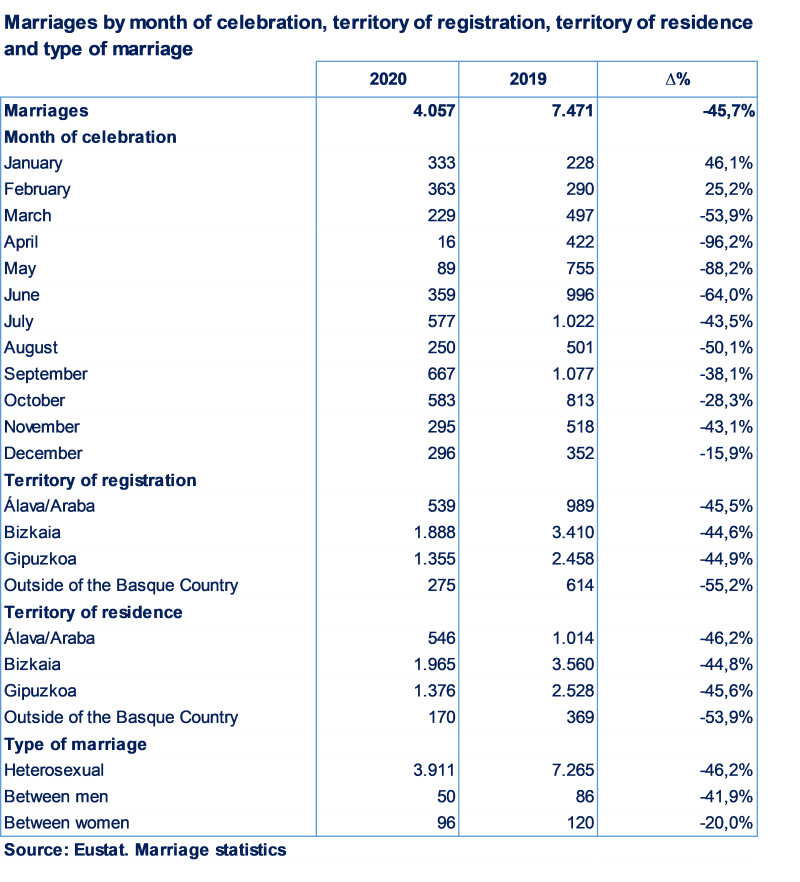
The Basque marriage rate also reached an all-time low, with 1.7 weddings per thousand inhabitants, a figure close to the Spanish rate (1.9‰), and lower than that of the European Union (27 countries), which in 2019 (latest available data and before the pandemic) stood at 4.3‰.
The average age at marriage of single men was over 39
The age at marriage continued to increase in 2020, as single men married at 39.2 years of age on average and single women at 37.1, in all cases in opposite-sex marriages . The average age of the husbands and wives in 2019 was 37.7 and 35.7, respectively. The difference in ages between both spouses remained stable at around 2 years.
146 of the married couples resident in the Basque Country were in same-sex marriages, down 29.1% on 2019, when there were 206. Marriages between women have exceeded marriages between men since 2012, and account for 65.8% of same-sex marriages. Regarding distribution between provinces, 21 were resident in Álava, 35 in Gipuzkoa, 81 in Bizkaia and 9 outside the Basque Country.
In 2020 there was an increase in the number of divorcees entering into opposite-sex marriages. The percentage of previously divorced husbands and wives stood at 19.4% and 18.6%, respectively, values higher than in 2019, when they were 15.2% and 14.6%.
97.2% of marriages in 2020 were civil
Civil marriages continued to increase and accounted for 93.6% of opposite-sex marriages, 6.4 percentage points more than the previous year. In 1990 civil marriages only accounted for 23% of the total. If we also take into account same-sex marriages, all of which were civil, the percentage raises the total of civil marriages to 97.2%.
Taking residency into account, in the three provinces the percentage of civil weddings, between opposite-sex couples, exceeded 93%; it was in the case of civil weddings between couples residing outside the Basque Country where the percentage dropped to 87.6%.
The preferred destinations for the 161 couples who fixed their residency outside the Basque Country after getting married were Cantabria (35) and Madrid (33), as well as Navarra (25).
Weddings celebrated on Fridays exceeded those on Saturdays
The large increase in civil weddings, along with the fact that, from 2009, almost half of them were celebrated on a Friday, along with the significant reduction in religious weddings, meant that, from 2017, there were more weddings on Fridays than on Saturdays in the Basque Country; the proportion was 51.3% compared to 27.3% in 2020.
In 27.2% of marriages between opposite-sex couples, at least one of the spouses was of foreign nationality
During 2020 and regarding the nationality of opposite-sex couples entering into marriage, in 1,064 marriages (27.2% of the total) at least one of the spouses was foreign. In 2019 this percentage was 20.4%. In 42.5% of these couples the wife had foreign nationality, in 18.2% the husband and in the remaining 39.3%, both spouses were foreigners.
In the case of marriages in which only the woman had foreign nationality, 71.2% corresponded to an American country (mainly Colombia, Nicaragua and Brazil), followed by 17.9% who had a European nationality (with Romanians and Ukrainians standing out). If it was only the man with foreign nationality, this was shared across European countries (34%), with Portugal, Germany and France standing out, among others, and American countries (33.5%), primarily Colombia. Also of note was that in 14.9% of cases they had Moroccan nationality.
In the marriages in which both spouses were foreigners, most had American nationality, although the percentage was greater amongst women (72.2%) than men (63.4%). The second nationality continent was Africa, with 20.1% of men and 15.8% of women.
For further information:
Eustat - Euskal Estatistika Erakundea / Basque Statistics Institute
C/ Donostia-San Sebastián, 1 01010 Vitoria-Gasteiz
Press service: servicioprensa@eustat.es Tel.: 945 01 75 62