Press release 31/08/2021
HIGH TECHNOLOGY SECTOR STATISTICS. 2019
The high and medium-high technology sector generated 8.8% of value added in the economy of the Basque Country in 2019
This sector includes 4,927 companies and represents 94,777 jobs
In 2019, the high and medium-high technology sector generated 8.8% of the total gross value added of the Basque economy, according to EUSTAT data. This sector, which covers all activities with a sound technological base and a fast renewal of knowledge, generated 94,777 jobs, 8.6% of the total. The number of companies carrying out these activities was 4,927. They had a turnover of 22,430.2 million euros.
In relation to Spain, the Basque high and medium-high technology sector includes 5.5% of the companies generating 8.3% of the GVA. However, the high and medium-high technology sector has the greatest weight in the manufacturing industry, accounting for 7.2% of companies and 11% of value added.
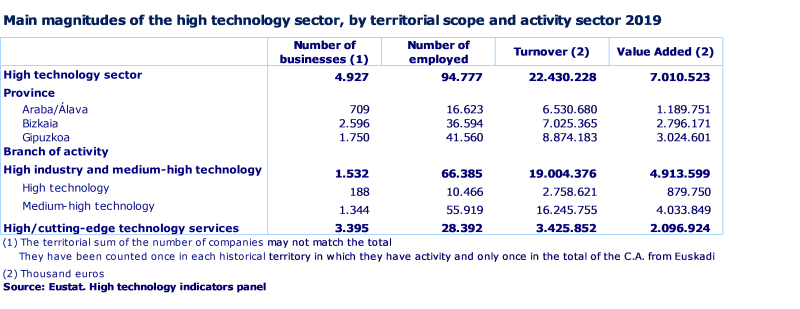
Compared with the previous tax year, there were increases in both the number of companies, +0.9%, and the number of jobs, +1.4%, generating an average of 19.2 employed people per company dedicated to this activity in 2019, higher than that registered the year before (19.1). Moreover, turnover increased by 5.1% and value added by 3.4%.
In 2019 this sector spent 72.0% of total internal expenditure on R&D and accounted for 44.3% of companies that carried out R&D
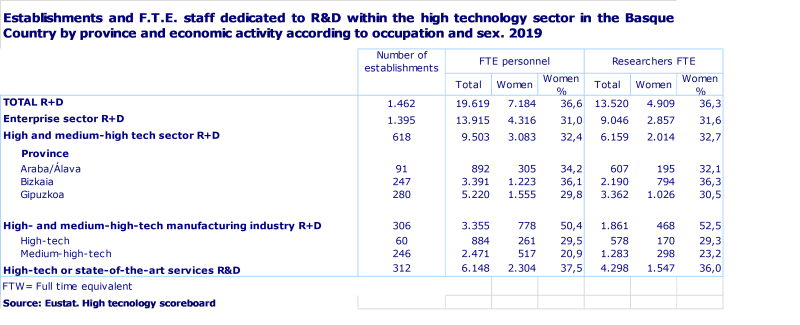
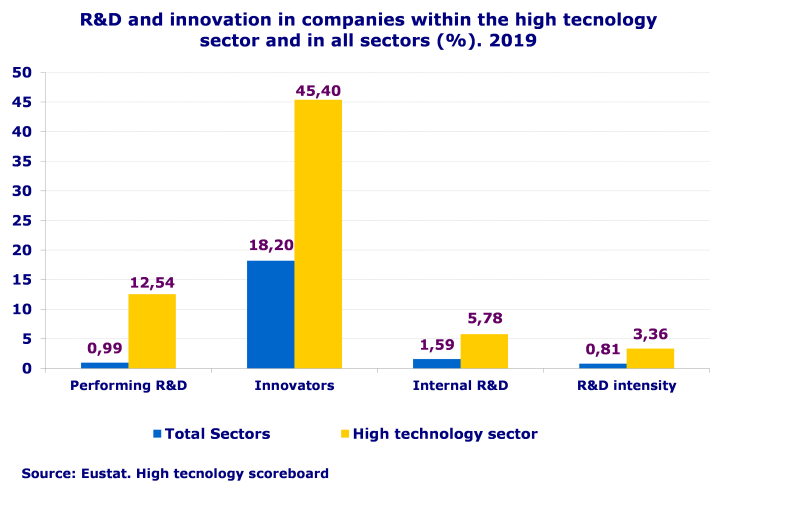
12.5% of companies in the high and medium-high technology sector carried out R&D activities, a percentage that is far higher than the total for all sectors (1.0%). Furthermore, this sector, representing 3.3% of total companies, accounted for 44.3% of those undertaking R&D in the commercial sector and, with 812.9 million euros, carried out 72.0% of the total expenditure on internal R&D in the commercial sector.
With regards to people working in R&D in this sector, it should be pointed out that in 2019 there were 9,503 people employed in “full-time equivalent jobs (FTE)”, 68.3% of personnel dedicated to R&D in the commercial sector, or 48.4% if the comparison is made with personnel who are dedicated to these activities across all sectors. There were 3,083 women, representing 32.4%. Of the total number of personnel in full time equivalent jobs, 6,159 belonged to the category of researchers; 2,014 were women (32.7%).
Regarding innovation, as with R&D, there were significant differences between the total for all sectors and for the high and medium-high technology sector. In 2019, 45.4% of establishments in the sector were innovators compared to 18.2% of the total for all sectors. For establishments with 10 or more employees these percentages reached 67.8% in the first case and 30.8% in the second.
High and medium-high technology establishments spent a total of 1,516 million euros on innovation activities in 2019, 52.4% of total expenditure of all the sectors. Of this expenditure, 1,381 million corresponded to establishments with 10 or more employees, which was 56.4% of the total expenditure by companies of that size on this activity.
This sector allocated a greater proportion of resources towards R&D+i and e-commerce than the average for all sectors as a whole
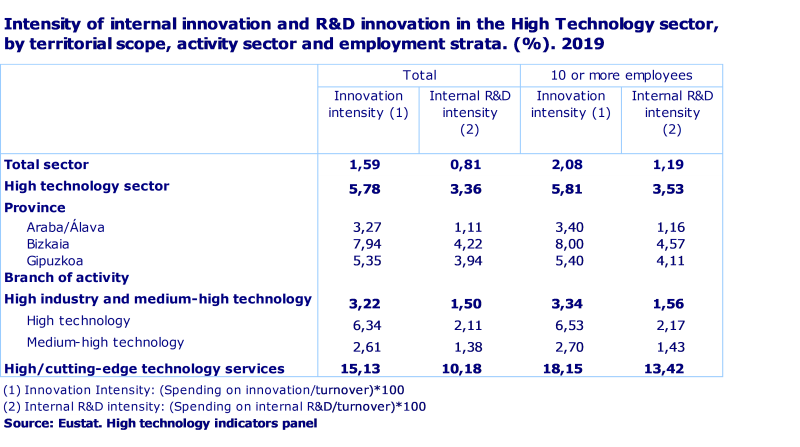
It was also clear that the high and medium-high technology sector allocated a greater proportion of resources towards R&D+i than the other sectors, observing the “innovation” and “internal R&D” intensity ratios, i.e. the amounts that this sector spends compared to the turnover figure. Specifically, innovation intensity in this sector was 5.78% compared to 1.59% for all economic sectors as a whole. In the case of internal R&D, the ratio was 3.36% for the sector and 0.81% for all the economic sectors.
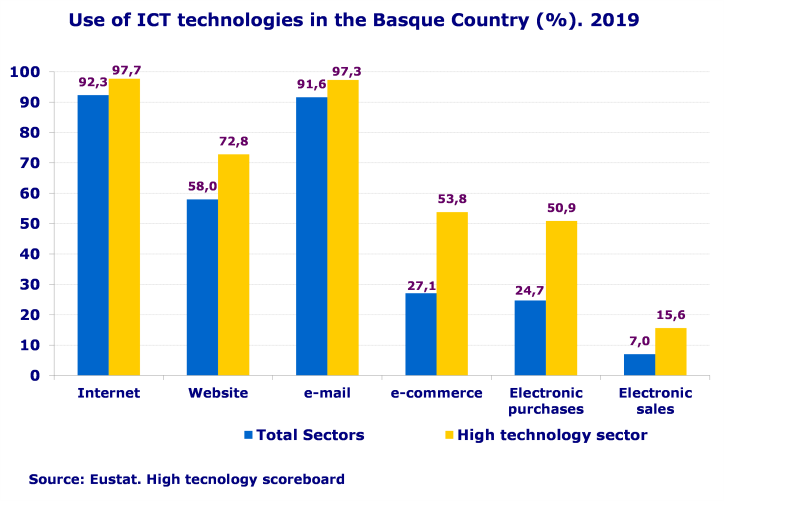
Both the use of Information & Communications Technology (ICT) and e-commerce are much more widespread amongst the companies in this sector than in the total of all sectors. In 2019, 50.9% of establishments in this sector made electronic purchases, compared to 24.7% of those in all sectors as a whole. Furthermore, 15.6% of sales in the technology sector were electronic, whilst in the case of all sectors as a whole, this figure was 7.0%. Hence, what we define as “e-commerce” is offered by 53.8% of establishments belonging to the high or medium-high technology sector, as opposed to 27.1% of all establishments as a whole.
On the other hand, the impact of this sector on the foreign trade of goods was not particularly significant. Whilst exports accounted for 858.4 million euros out of a total of 25,485.8 million, imports stood at 741.7 million out of the 20,158.7 million of total imports. These figures represented 3.4% and 3.7%, respectively, out of total exports and imports.
Standing out among the most common products traded in terms of exports were: Machinery and Mechanical Equipment (39.7%), Manufacture of Aircraft and Spacecraft (18.9%) and Electronic material, Radio, TV, and Communications Equipment (14.5%). Of particular note in imports were Electronic Material, Radio, TV and Communications Equipment (41.1%); Scientific Instruments (18.6%); and Manufacture of Aircraft and Spacecraft(13.8%).
Turnover in the high and medium-high technology sector increased by 28.1% since 2010
From a wider perspective, since 2010, it can be seen how this sector has steadily increased its size over the last five years, that is since 2015.
Thus, since 2010 turnover in this sector is over 16,800 million euros, having exceeded 21,300 euros in 2018 and reaching its record in 2019 with 22,430 million, which represented an increase of 4,918 million euros in respect of 2010, up 28.1%.
For the same period the total number of employees in companies in the high technology sector (HTS) increased by 3,263, having been below 90,000 from 2011 to 2017; however during the last year of this analysis, the total figure reached 94,777 employees, 3.6% above that registered in 2010.
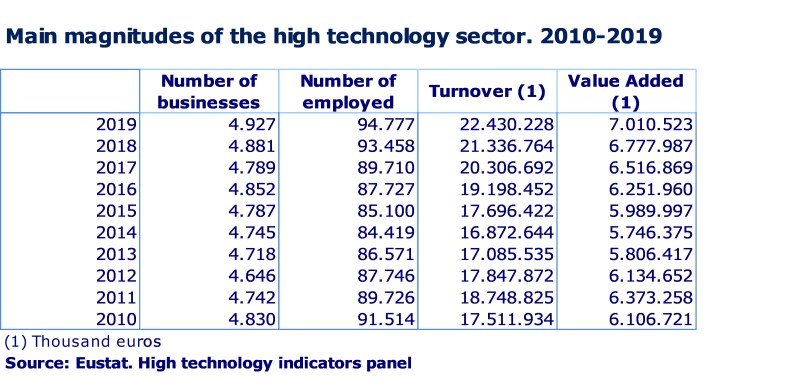
In turn, during the last 10 years the number of High and Medium-High technology companies has remained above the threshold of 4,600, with percentages out of the total of Basque companies standing around 3%, going from 2.9% in 2010 to 3.3% in 2019. As can be seen, there is a slight percentage increase that translates into 97 more HTS companies than in 2010.
Finally, gross value added has risen by 904 million in respect of 2010, since when it has remained above 5,700 million and reached another record in 2019 with 7,011 million euros (14.8% more than in 2010).
Methodological note:
The sectors that belong to the high technology sector are those that, given their degree of complexity, require an ongoing research effort and a sound technological base. The activities included in this sector, according to the CNAE 2009, are listed on the Eustat website. Methodology file: The high technology statistics sector
For further information:
Eustat - Euskal Estatistika Erakundea / Basque Statistics Institute
C/ Donostia-San Sebastián, 1 01010 Vitoria-Gasteiz
Press service: servicioprensa@eustat.es Tel.: 945 01 75 62