Press Release 29/09/2021
STATISTICS ON RESOURCES FOR HOMELESS PEOPLE. 2020
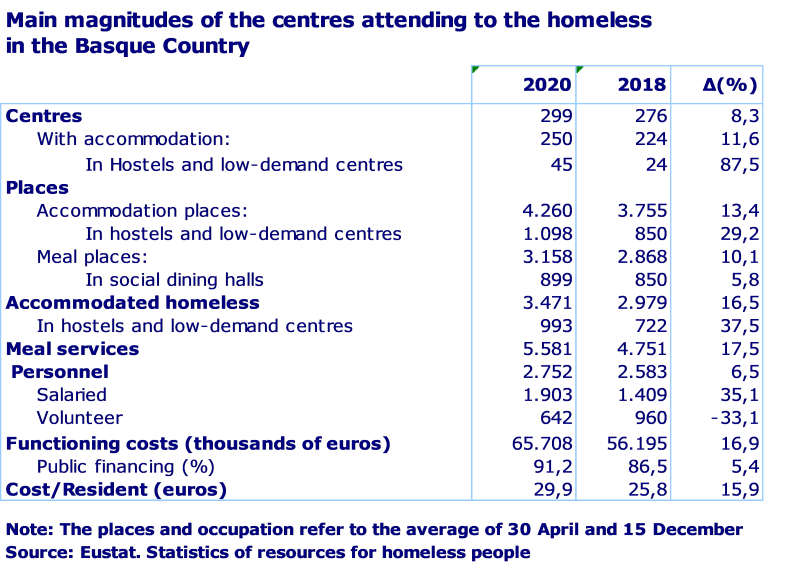
In 2020, the year of the pandemic, centres for the homeless in the Basque Country attended to 16.5% more people per day than in 2018
Expenditure on centres for the homeless in the Basque Country increased by 16.9% in 2020 compared to 2018
Care for the homeless by social services in the Basque Country in 2020 was provided through a network made up of 299 centres and services that accommodated a daily average of 3,471 people, 16.5% more than in 2018, according to Eustat data. 622 of those who were accommodated were “homeless” people experiencing more serious housing exclusion. The network was served by 2,752 workers and expenditure amounted to 65.7 million euros, 16.9% more than in 2018.
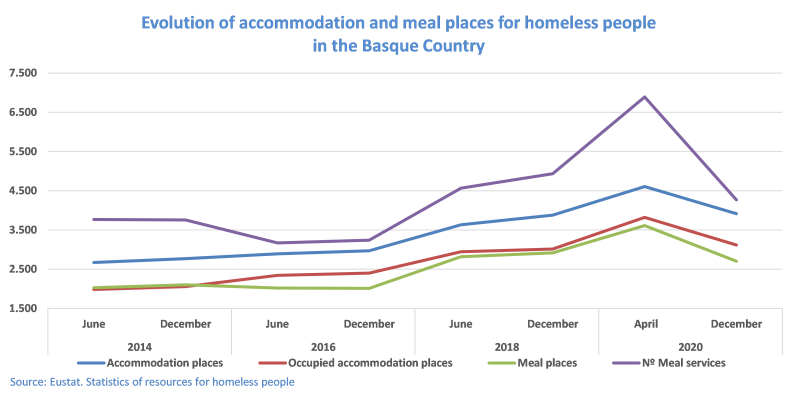
These resources had an annual average of 4,260 accommodation places, 505 more than in 2018, with an occupancy level of 81.5%. They also had 2,147 day places, with an occupancy rate of 87.2%. Regarding meals, a daily average of 5,581 breakfasts, lunches and dinners were served.
Thus, although the number of resources and users is usually higher in winter than in summer, due to the pandemic, the opposite was true on this occasion. There was a sharp rise in both supply and demand of these services during the period of total confinement in the spring of 2020.
20 centres were set up to accommodate homeless people during the confinement, a total of 913 accommodation places, with an occupancy rate of 90.6%, and a daily average of 2,484 meals were served. In the case of social dining halls, social distancing measures were imposed, so the number of sittings for breakfasts, lunches and dinners were doubled in order to be able to provide the services needed.
303 people worked in these special COVID-19 centres, 56.8% of whom were women. Expenditure of nearly 4 million euros was allocated, which was almost entirely funded by local public bodies (local and provincial councils).
The Basque Country provided 20.7% of the accommodation places in Spain
Two characteristics stood out in the Basque homeless care network: the smaller size of Basque centres and the higher number of paid workers among their staff, taking into account that in the Basque Country 69.1% were salaried employees compared to 23.3% who were volunteers, while nationally these figures were 48.5% and 44.5%, respectively.
Regarding the use of these resources, a daily average of 3,471 homeless people slept at centres offering accommodation in the Basque Country, while the figure stood at 17,772 in Spain as a whole, representing 19.5%.
The vast majority of resources were located in the capitals
Homeless people tend to converge on big cities, so resources were also mainly directed towards the three Basque provincial capitals. 95.3% of accommodation places and 100% of meal provision capacity and day centre places in Álava were located in Vitoria-Gasteiz. 75.4% of accommodation places, 76.1% of meal provision capacity and 71.1% of day centre places in Bizkaia were in Bilbao. Gipuzkoa, for its part, was the most decentralised province, as 42.2% of accommodation places, 33.7% of meal provision capacity and 44.5% of day centre places were available in San Sebastián.
47.2% of the centres provided internet access
A variety of services were offered by the Basque network of centres as a whole, focused on improving quality of life for homeless people. Of the total of 299 centres in the Autonomous Region, 79.9% provided “information and shelter”, 70.6% “guidance and referral”, 61.2% “assistance” and 43.1% "professional guidance", in addition to “personal services” such as personal hygiene (54.2%), laundry (50.5%) and clothing (25.8%). Healthcare, psychological and legal services were provided at 24.4%, 36.8% and 32.4% of centres, respectively. 47.2% of the centres also provided internet access.
33.3% of the centres devoted to people with specific circumstances attended to immigrants
56.8% of the homeless care centres were focused towards people with no particular specific circumstances; they are resources that can adapt to a variety of emergency situations. Among the centres that attend to people experiencing specific circumstances, of particular note were those devoted to immigration, 33.3%; people with addictions (alcohol and drugs), which represent 31%; and female victims of gender violence or trafficking, 30.2%.
As regards the gender of the people who were attended, most centres were focused towards both sexes (72.2%), although differences can be observed between provinces as Gipuzkoa had the highest percentage of mixed centres at 87.7%, compared to Álava and Bizkaia, with 65% and 62.1%, respectively.
More than half of the people attended in the Basque Country (57.8%) were foreign nationals and the distribution by province was similar: Álava, 58.5%; Bizkaia, 58.3%; and Gipuzkoa, 56.8%.
Current expenditure rose to 65.7 million euros
Assistance provided to homeless people via the Basque Country social services network represented current expenditure of 65.7 million euros in 2020, 16.9% higher than in 2018. Most of this expenditure (83.5%) was allocated to centres providing accommodation, amounting to 54.9 million euros, an average annual expenditure of 17,595 euros per person served.
Public administrations (principally provincial and local councils) funded 91.2% of this expenditure. The remaining 8.8% was funded by the organisations’ own resources (4.7%), private institutions (2.2%), donations from individuals (1.4%) and companies (0.5%). The funding model was similar in Bizkaia and Gipuzkoa, with public funding at 88.9% and 91.6%, respectively; in Álava, the percentage of public funding was higher (97.4%).
Women accounted for 67.7% of the total staff working in the network of centres
In 2020, 2,752 people worked in these centres, 6.5% more than in 2018. The number of salaried employees grew by 35.1% compared to 2018, while the number of voluntary staff dropped by a third (-33.1%). Most of the staff in this sector were female and there was a higher proportion of women among salaried employees (71.1%) than volunteers (56.9%).
622 homeless people slept in shelters and low-threshold centres
Of the 3,118 people who spent the night in centres offering accommodation in December, on average 622 were “homeless” people who slept in the 45 shelters and low-threshold centres set up in the Basque Country; 89 of them were women. Moreover, an average of 2,496 homeless people were living in the network's centres and flats, 862 were women.
Methodological note: For the purposes of this survey, a homeless person is considered to be an individual aged over 18 who does not have access to accommodation during the reference period that meets commonly accepted criteria of human habitability, whether the accommodation is legally owned or rented or occupied without charge (including that provided by the public sector or non-governmental organisations and that provided by employers). Other situations include people with addictions, migrants, individuals with an application for international protection, young people who were formerly in care and female victims of gender violence who must abandon their primary residence to ensure their safety.
This statistical operation was performed by Eustat in collaboration with the Spanish National Statistics Institute (INE) in the Basque Country.
For further information:
Eustat - Euskal Estatistika Erakundea / Basque Statistics Institute
C/ Donostia-San Sebastián, 1 01010 Vitoria-Gasteiz
Press Service: servicioprensa@eustat.eus Tel.: 945 01 75 62