Press Release 28/09/2021
MUNICIPAL EDUCATION STATISTICS. 01-01-2020
In 2020, 95.6% of the population of the Basque Country aged 16 and over held some level of official qualification
40% of working women held a higher education qualification, compared to 26% of the male working population
In 2020, 1,797,673 people aged 16 and over residing in the Basque Country, 95.6%, had some kind of official education qualification, according to Eustat data. In that year, the distribution of the population aged 16 and over, according to qualification level, was as follows: 31.8% of people from this collective (597,765 people) had completed primary education; 21.9% (411,075 people) had completed secondary education and 8.5% (160,239 people) held a basic and/or intermediate vocational training qualification. Lastly, as regards higher education, 22.7% had completed university studies (427,141 people) and 10.7% (201,453 people) had finished advanced vocational training.
More women held a university qualification and more men had vocational training
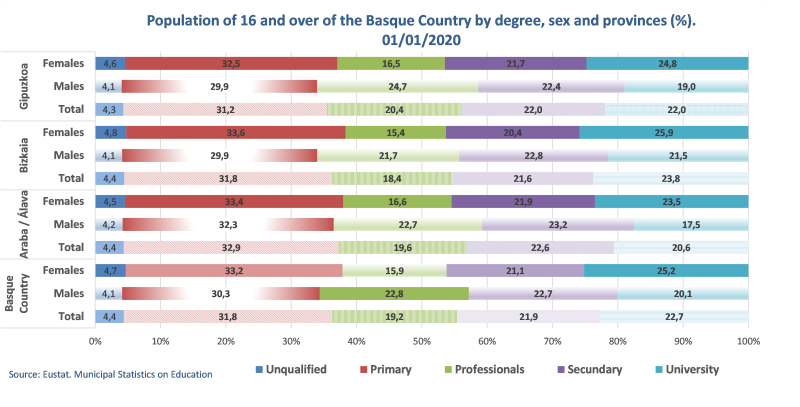
If we introduce the gender variable into the analysis, similar proportions of men and women had higher qualifications, including university qualifications and advanced vocational training (33.2% and 33.7%, respectively). However, the percentage of men with vocational training qualifications (at any level) reached 22.8%, a higher proportion than that of women, 15.9%. Likewise, university qualifications were more common among women (25.2%) than men (20.1%). Lastly, there were no differences by gender in the proportions of people with primary school qualifications (33.2% of women compared to 30.3% of men) and those with secondary school qualifications (21.1% and 22.7%, respectively).
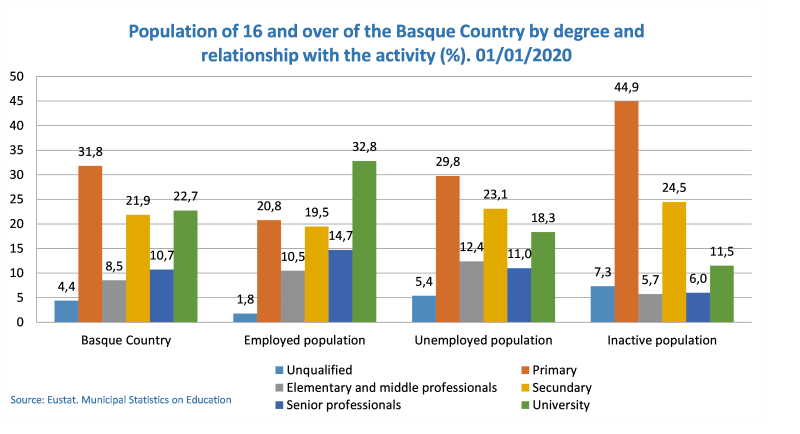
If we link the level of qualifications to activity, distributions can change within the employed, unemployed and inactive population. It is worth noting that, among the working population, the proportion of people with university studies was 32.8%, whereas this proportion was lower among the unemployed population, 18.3%. As regards primary education, 29.8% of the unemployed population had primary school qualifications, while this percentage fell to 20.8% among the working population.
With regard to the field of activity, there were differences between the male and female working population: more than half of the female working population (52.5%) had higher qualifications (whether a university or vocational qualification), while this proportion was only 42.9% among employed men. Likewise, among the unemployed population, the proportion of women with higher education was higher than that of men (32.4% and 25.8%, respectively).
The profile of the inactive population was different to the two previous groups, particularly because 44.9% of this population had completed primary education, which is probably a reflection of the age groups it comprises, the youngest and the oldest. Lastly, the lack of qualifications was more prevalent among the inactive (7.3%) and unemployed (5.4%) population than among the working population (1.8%).
There were slight provincial differences: the greatest proportion of people with a vocational training qualification was in Gipuzkoa, with primary education in Álava and with university studies in Bizkaia
At provincial level, a number of differences were observed in the distributions by level of qualification. Specifically, Álava presented a greater proportion of people aged 16 and over with primary school qualifications (32.9%) than Bizkaia (31.8%) and Gipuzkoa (31.2%). Bizkaia, in turn, recorded the highest proportion of the population with a university qualification (23.8%), more than three percentage points above the proportion in Álava (20.6%) and almost two above that in Gipuzkoa (22%). Lastly, considering vocational qualifications as a whole (basic, intermediate and advanced), Gipuzkoa registered a slightly higher proportion (20.4%) than Álava (19.6%) and Bizkaia (18.4%).
There tended to be a larger concentration of the population with university studies in the provincial capitals, particularly in Bilbao (27.5%) and, to a greater extent, in San Sebastián (31.4%). In Vitoria-Gasteiz, the proportion stood at 21.8%.
There were pronounced differences between the regions. In the case of university qualifications, of particular note were the regions of Plentzia-Mungia (31.6%), Donostialdea (24.8%) and Gran Bilbao (24.4%). As regards vocational qualifications, the regions that stood out were Bajo Deba (23.1%), Encartaciones (22.7%) and Alto Deba (22.6%). Finally, the highest percentages of people with primary school qualifications were concentrated in Montaña Alavesa (43.4%), Rioja Alavesa (43%) and Añana (38.7%), all pertaining to Álava.
At a municipal level, the proportion of the population with primary education was higher than 50% in six municipalities in the Basque Country, the first two of which were in Álava: Harana/Valle de Arana (58.3%) and Elvillar/Bilar (57.3%). In the case of vocational qualifications, at the top of the list were Galdames (29.9%), Irura (28.2%) and Alkiza (27.7%). In terms of secondary school qualifications, municipalities in Bizkaia headed the list: Gatika (30.1%), Laukiz and Plentzia, both with 28.6%. Municipalities in Bizkaia also registered the largest proportions of the population with university education: Getxo (41.7%), Sukarrieta (39.7%) and Ibarrangelu (38%). It is also worth noting that the first 14 municipalities in this list were in Bizkaia.
A final indicator of the education level in the Basque Country is the illiteracy rate. In 2020, this indicator stood at a residual level, only affecting 0.3% of the population aged 10 and over (around 6,000 people): 0.2% in the case of men and 0.4% in the case of women. Logically, this rate was high among older people and, therefore, while the rate stood at 0.1% for the under 65s, it jumped to 0.8% for the over 65s. The illiteracy rate for women aged 65 and over was 1.1% and for men in the same age group it stood at 0.4%.
For further information:
Eustat - Euskal Estatistika Erakundea / Basque Statistics Institute
C/ Donostia-San Sebastián, 1 01010 Vitoria-Gasteiz
Press service: servicioprensa@eustat.es Tel.: 945 01 75 62