Press Release 01/09/2021
MIGRATORY MOVEMENTS STATISTICS. 2020
The positive migration balance in the Basque Country fell to 4,500 people in 2020 from 19,400 the year before
During the year of the pandemic, emigration fell by 6.5% and immigration fell even further, by 32.7%
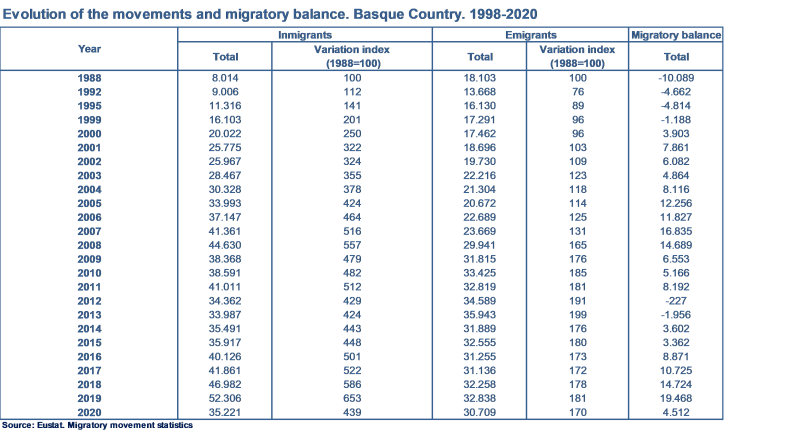
The migration balance of the Basque Country in 2020 was positive and stood at 4,512 people, with migration contributing less to the population than in recent years, according to Eustat data. Specifically, the migration balances in the last three years stood at 10,725 in 2017, 14,724 in 2018 and 19,468 in 2019.
In 2020, 35,221 immigrants arrived compared to 52,306 in 2019, a drop of 32.7%. In 2020, the number of emigrants also fell compared to the previous year, albeit to a lesser extent: in 2020 there were 30,709 emigrants, 6.5% fewer than the 32,838 recorded in 2019.

By province, Gipuzkoa, which gained 2,130 people, recorded the highest migration balance in absolute figures; Bizkaia had a positive balance of 1,583 people and Álava gained 799 people. In relative terms, Bizkaia saw a sharper drop compared to the previous year, with a 85.9% lower migration balance. The migration balance saw a decline of 72.1% in Álava and 60.5% in Gipuzkoa. Looking at the provincial capitals, the migration balance was negative in Bilbao (-1,029 people) and Vitoria-Gasteiz (-163 people). San Sebastián was the only capital whose population grew, with a positive balance of 802 people.
Taking into account migratory movements with the various autonomous regions, the Basque Country had a positive migration balance with half of them. The autonomous regions that contributed most to the balance were, in order, Madrid (654 people), Catalonia (312 people) and Andalusia (264 people).
On the other hand, although the balance with other countries was positive in 2020 (5,245 people), it was significantly lower than in 2019 (18,133 people).
In 2020, a total of 16,942 immigrants came from a foreign country, a 45% decrease on the 30,821 in 2019. In terms of emigration, a total of 11,697 people moved abroad, compared to 12,688 in 2019, i.e. 7.8% fewer than in 2019.
The rate of emigration from the Basque Country was lower than the average for the autonomous regions
In 2020 external or extra-community geographical mobility involved 30 per thousand inhabitants of the Basque Country, i.e. 5 points below the other autonomous regions, where 35 inhabitants per thousand moved on average. By provinces, Álava reached 34.6‰, Bizkaia stood at 29‰ and Gipuzkoa at 29.5‰.
On the other hand, the autonomous regions that attracted the emigrants from the Basque Country were, in order, Cantabria, Castilla y León, Navarra and Galicia, as the Basque Country had a negative migration balance of -1,157, -632, -343 and -272 people, respectively. These four autonomous regions therefore accounted for more than 90% of the people who left the Basque Country for other regions, all in terms of migration balance. In 2020, the negative balance with the autonomous regions exceeded 2,600 people, compared to the negative balance of 150 people in 2019.
Almost 59% of immigrants and 43% of emigrants were foreign nationals
The average age of the emigrants (37.3 years old) was higher than that of the immigrants (33.7 years old). 50% of immigrations and 45% of emigrations were by people in the 21-39 age group.
There were moderate differences in relation to gender: men represented 53% of immigrants and women 47%, similarly 54% of emigrants were men and 46% were women.
Immigration of foreign nationals stood at 20,955 in 2020. Of these 6,433 came from other autonomous regions, primarily Madrid, Catalonia and Andalusia, and another 14,522 came directly from abroad. 13,193 foreign nationals emigrated, or 43% of the total, with 64% moving to a foreign country. Therefore, the balance of foreign nationals was positive by 7,762.
68% of the changes of residence among the Basque population occurred within the Autonomous Region of the Basque Country itself
In total, 205,575 changes of normal places of residency were recorded in the Basque Country. We can therefore state that 9.3% of the Basque Country changed their place of residence in this period. Of these changes of normal places of residency, a total of 139,645 were within the Basque Country (68%). Focusing on the municipal level, a total of 88,891 people changed address within the same municipality.
For further information:
Eustat - Euskal Estatistika Erakundea / Basque Statistics Institute
C/ Donostia-San Sebastián, 1 01010 Vitoria-Gasteiz
Press Service: servicioprensa@eustat.es Tel.: 945 01 75 62