Press Release 20/07/2021
UNIVERSITY STATISTICS 2020
Universities in the Basque Country increased their student population in the 2019/20 academic year, exceeding 68,000 students
14,002 people finished their university studies in 2020, 8% more than in 2019, and 57% were women
In the 2019/20 academic year, universities with centres located in the Basque Country increased their student population for the third consecutive year. There were a total of 68,237 enrolments, an increase of 1.3% on the previous year, according to Eustat data.
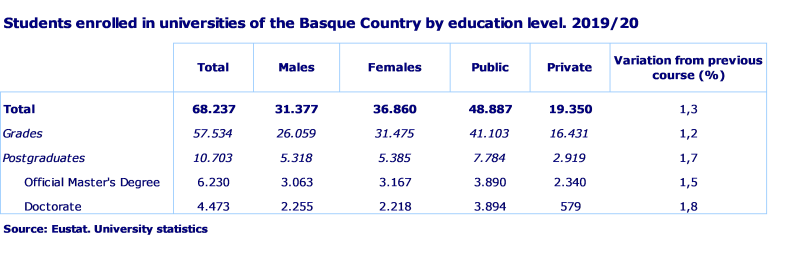
72% of students attended public universities, which have maintained a downward trend in recent years, and the proportion of students who opted for public centres has fallen by 9 percentage points since the 2010/11 academic year. For undergraduate studies the proportion is practically the same (71%), whereas it reduces to 62% for master's degrees and rises to 87% for doctorates undertaken in the Basque Country.
In terms of where students studied, 58% attended universities in Bizkaia, 29% in Gipuzkoa and 13% in Álava.
The proportion of women university students stood at 54%
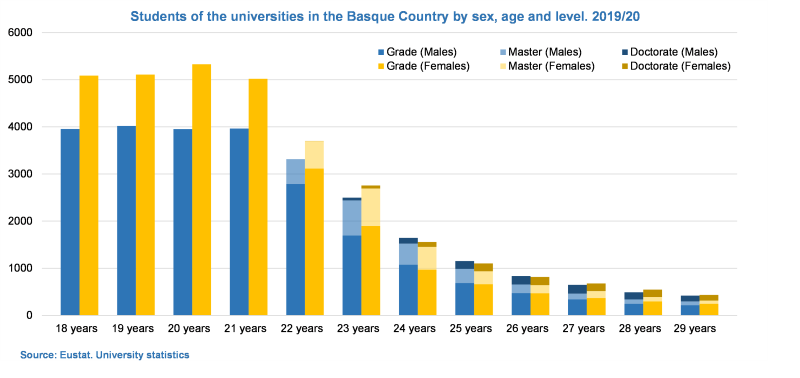
There was a considerable proportion of women undergraduate students (55%), exceeding men by 10 percentage points. There was a notable difference at younger ages, from 18-21, in favour of women. In this age range, the gap in favour of women varied between 12 and 15 percentage points.
There was parity between both sexes in official master’s degrees and doctorates.
Engineering continued to be male-dominated
The ranking of the most in-demand undergraduate degrees barely changed compared to previous years. Half of enrolled students were concentrated in eleven degrees: Business Management and Administration (5,633), Primary Education (4,137), Law (3,496), Psychology (2,794), Mechanical Engineering (2,118), Early Childhood Education (2,117), Medicine (1,851), Social Education (1,546), Nursing (1,524), Industrial and Technological Engineering (1,420) and Social Work (1,386).
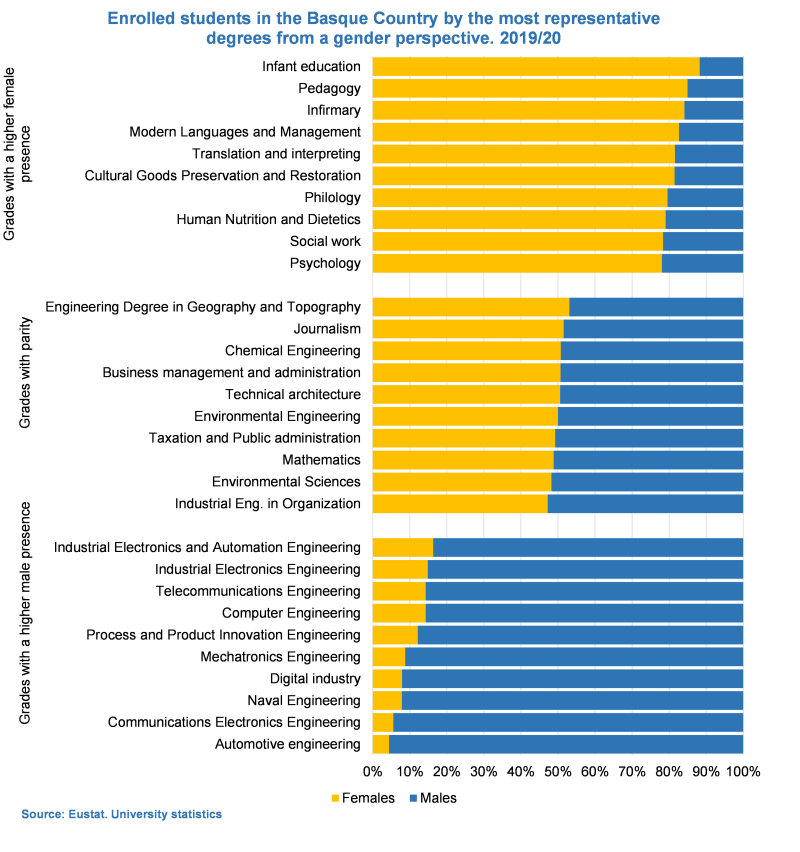
There were twenty-eight degrees in which a balance existed between the sexes, four more than in the 2018/19 academic year. However, they only constituted 27% of the total. Among them, Environmental Engineering, Architecture, Business Management and Administration, Taxation and Public Administration and Chemical Engineering had a more equal distribution of students.
The degrees that did not enjoy parity were distributed equally among those with a majority of women and those with a stronger male presence.
In this sense, it is once again worth mentioning that the more male-dominated studies were in the branch of engineering. Practically all of the degrees with less than a quarter of women students belonged to this group. The imbalance was especially pronounced in Vehicle, Communications Electronics, Naval, Mechatronic and Digital Industry engineering, where the proportion of women was less than 10%.
On the other hand, the degrees with a higher proportion of women were Early Childhood Education, Pedagogy, Nursing, Modern Languages and Management, Translation and Interpreting and Preservation and Restoration of Cultural Assets. However, in none of them did the percentage of women exceed 90%.
Dual degrees gained momentum
A dual degree is a dual university qualification in which two degrees are studied simultaneously within a period of time longer than that of one degree, but shorter than that of two degrees undertaken separately. Universities in the Basque Country began to offer dual degrees in the 2011/12 academic year and since then the number of students who choose this option has continued to grow.
In the 2019/20 academic year, 2,679 students enrolled in this type of degree, 11% more than in the previous academic year and more than twice as many as five years ago. The dual degree with the highest number of enrolments was the one combining Business Management and Administration with Law.
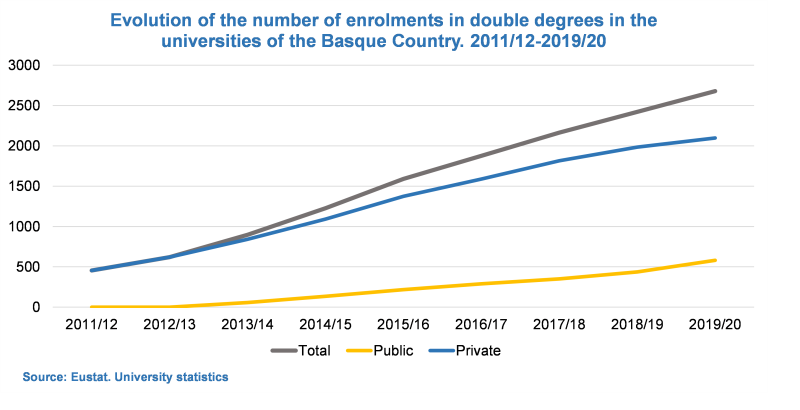
Initially, dual degrees were offered only at private universities, until in the 2014/15 academic year they began to be taught in public centres as well. In the 2019/20 academic year, one in five people who enrolled in combined undergraduate degrees did so at a public university.
The interest of young people in this mode of study was also reflected in the first choice of degree among those who passed entrance exams for the University of the Basque Country. In the 2020 exams, 894 students opted for a dual degree, 65% more than in 2019.
Women constituted 57% of the people who obtained a university degree in the 2019/20 academic year
Among the 14,002 students who finished their studies in 2020, 10,146 did so in undergraduate studies, 3,421 in official masters and 435 successfully completed their doctoral theses. Compared to 2019, these figures represented an increase of 9% in undergraduate degrees and 6% in masters. On the other hand, the number of people who obtained a doctorate fell by 5%.
Half of graduates were enrolled in one of the degrees comprising the Social and Legal Sciences branch and approximately one in five were in one of the technical subjects of the Engineering and Architecture branch.
As occurred with enrolled students, gender also played a decisive role in the distribution of degree-holders by fields of study. The Engineering and Architecture and Health Sciences branches were the least equal from the gender perspective. In the former, the imbalance occurred in favour of men, the proportion of whom exceeded that of women by 40 percentage points, 70% men compared to 30% women. In the latter, on the other hand, the ratio was reversed and the presence of women was 56 points higher than that of men.
For further information:
Euskal Estatistika-Erakundea / Basque Statistics Institute
C/ Donostia-San Sebastián, 1 01010 Vitoria-Gasteiz
Press Service: servicioprensa@eustat.es Tel: 945 01 75 62