Press Release 30/07/2021
PUBLIC ADMINISTRATION ACCOUNTS 2019
The Public Administrations in the Basque Country registered a deficit of 668 million euros in 2019, 0.8% of its GDP
Gross Capital Formation (Public investment) reached 1,512 million euros, 11.3% more than the previous year
In 2019, the Public Administrations (Basque Administrations, Provincial State Administration and Provincial Social Security) registered a deficit of 668 million euros, which was the result of a greater increase in non-financial spending, 1,510 million euros, than in non-financial resources, 1,125 million, according to data prepared by Eustat, in accordance with the criteria established by the System of National and Regional Accounts of the European Union (ESA-2010).
In terms of GDP, the negative balance of the Public Administrations in the Basque Country represented 0.8%, i.e. it rose 0.4 percentage points compared to the previous year.
This negative evolution of the balance was also registered in the surrounding countries. Thus, in the 27-country European Union, the deficit in GDP percentage increased by 0.1 points, going from 0.4% in 2018 to 0.5% in 2019. In Spain, the deficit went up by 0.4 percentage points, going from 2.5% of GDP in 2018 to 2.9% in 2019.
From the institutional point of view, the Basque Administrations (which include the Basque Government, Provincial Councils, Municipal Entities and dependent entities categorised as public administration) registered a decline in their balance, as their funding capacity (surplus) in GDP percentage decreased by 0.5 points, i.e. it went from representing 1.5% in 2018 to 1.0% in 2019. In contrast, the Provincial Administration as a whole (State plus Social Security) improved its funding requirement (deficit) in GDP percentage by 0.1 points, going from 1.9% in 2018 to 1.8% in 2019.
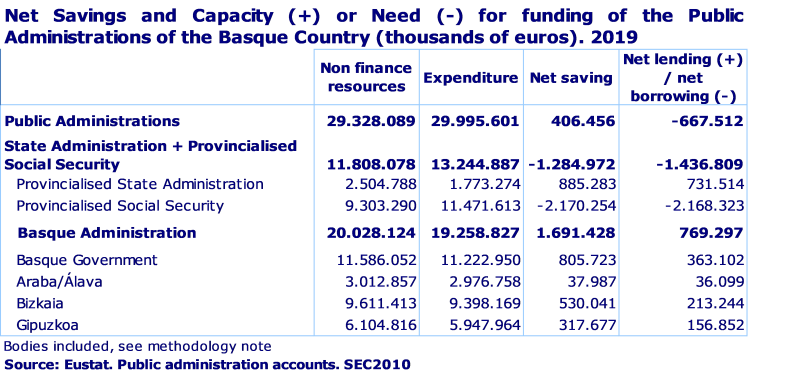
In absolute values, the Provincial State Administration obtained a positive balance or funding requirement of 732 million euros, improving the balance of the previous year by 74 million. On the other hand, Provincial Social Security recorded a drop in its balance in 2019, registering a funding requirement of 2,168 million, 55 million more than in 2018.
Regarding the Basque Administrations, they went from having a funding capacity of 1,172 million euros in 2018 to 769 million in 2019. All the institutions included in this grouping saw a decrease in their balance.
The funding capacity of entities of the Basque Government as a whole fell by 168 million euros, going from 531 million euros in 2018 to 363 million in 2019.
The Regional and Municipal Administration of Álava overall posted a positive balance of 36 million euros, 21 million down on the previous year. Bizkaia went from registering a funding capacity of 360 million euros in 2018 to 213 million in 2019. The funding capacity for Gipuzkoa as a whole also decreased, going from 224 million in 2018 to 156 million in 2019.
The Public Administrations in the Basque Country managed Non-Financial Resources totalling 29,328 million euros in 2019, which represented an increase of 4.0% compared to 2018, whilst Non-Financial Spending reached 29,996 million euros and grew by 5.3%. As a result, the funding requirement increased by 385 million euros in respect of the previous year and stood at 668 million in 2019.
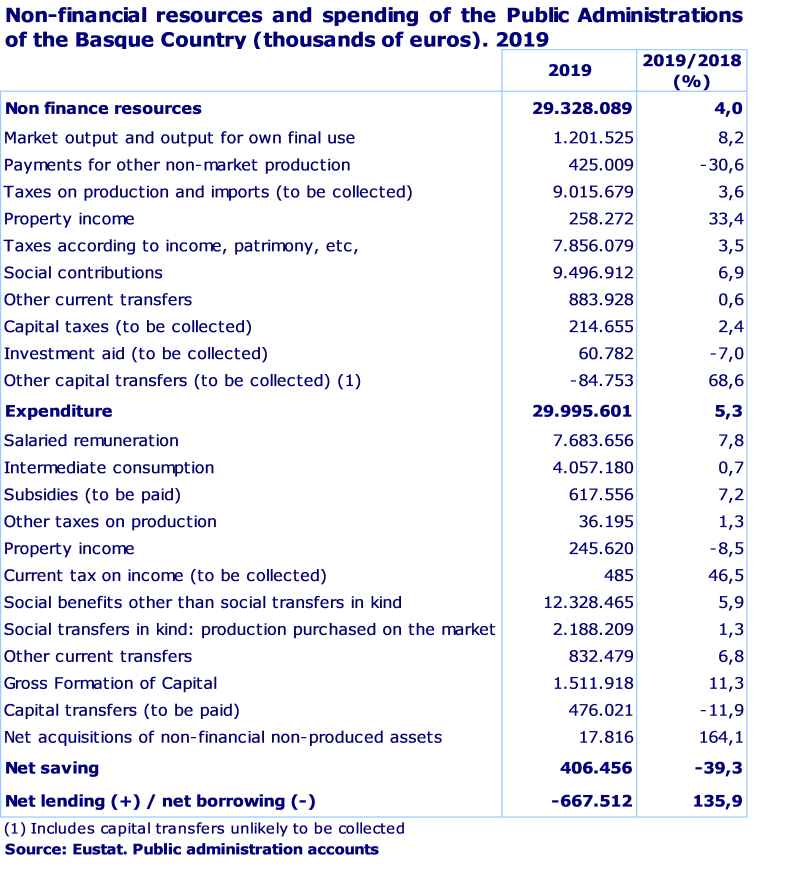
Within Non-Financial Resources, the largest sector was Social Security Contributions (32.4% of the resources), which registered a significant rise of 6.9%, amounting to 611 million euros more than in 2018. In second place was Taxes on Production and Imports, which accounted for 30.7%, and Taxes on Income, Assets and Other Components represented 26.8%. These operations grew by 3.6% and 3.5%, respectively, an upturn of 575 million euros compared to the previous year. In short, Non-Financial Resources increased by 1,125 million compared to 2018.
Non-Financial Spending stood at 29,996 million euros, that is, 1,510 million more than in 2018. The operations that registered the greatest increases were: Social benefits different from social transfers in kind (including pensions), which were up by 688 million euros in respect of the previous year and represented 41.1% of expenditure; and in second place, Employee remuneration, which increased by 557 million and accounted for 25.6% of expenditure. However, the next largest sector, Intermediate consumption, registered a slight growth of 0.7%, i.e. 28 million more than in 2018. Capital spending (Gross Capital Formation, Capital transfers (to be paid) and Acquisitions of other assets) accounted for 6.7% of expenditure and increased by 135 million euros compared to the previous year. Another smaller sector that also grew was Subsidies, 2.1% of expenditure, which increased by 41 million in respect of 2018. The operation that saw a decrease compared to the previous year was Property Income (primarily interest), which recorded 23 million euros less than the previous year, reaching 246 million in 2019.
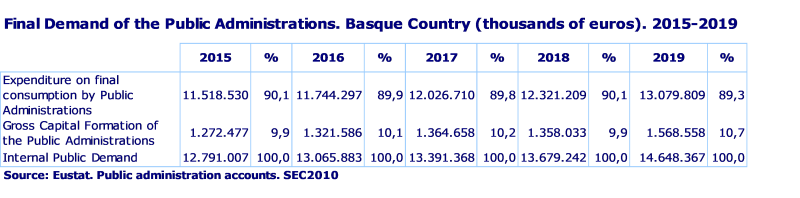
In the final expenditure structure of the Public Administrations, Final Consumption Expenditure, which is the total expenditure by the administrations on the production of goods and services plus the purchase of goods and services produced by market producers which are supplied to households (social transfers in kind), represented 89.6% of Internal Public Demand in 2019, 0.4 percentage points down on the previous year. Gross Capital Formation (Public investment) reached 1,512 million euros, 11.3% more than the previous year, and its share in Public Internal Demand rose to 10.4%. Institutionally, 96.3% of investments corresponded to the Basque Administrations, which increased their expenditure by 216 million euros to 1,455 million in 2019. On the other hand, the amount corresponding to the Provincial Administration as a whole, State plus Social Security, decreased by 62 million euros, registering 57 million in 2019.
For further information:
Eustat - Euskal Estatistika Erakundea / Basque Statistics Institute
C/ Donostia-San Sebastián, 1 01010 Vitoria-Gasteiz
Press Service: servicioprensa@eustat.es Tel.: 945 01 75 62