Press Release 14/07/2021
INFORMATION SOCIETY SURVEY. COMPANIES. 2021
12% of employees at Basque companies telework in 2021, more than double the year before
The use of social networks for business purposes (51.5%) was the most significant indicator of Industry 4.0 and stood at 70% among companies with 10 or more employees
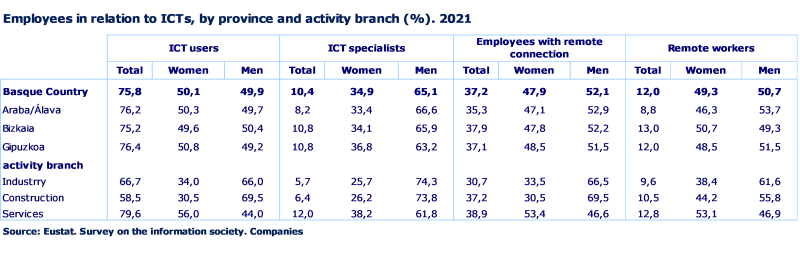
In 2021, 12.0% of staff at Basque companies worked off company premises for at least a third of the working day on a regular basis, using telematic networks to connect to the company’s ICT systems, and can therefore be considered remote workers, according to data prepared by Eustat. This is double the percentage obtained the year before, i.e. 5.4%.
Furthermore, on average, we find that 75.8% of employed people used ICT (Information & Communication Technology) systems and 10.4% were ICT specialists. Additionally, just over a third of the total personnel (37.2%) have a remote connection via a portable device for professional use.
Unlike in equipment and in Industry 4.0, the size of the establishment made no significant difference to the percentage of employees using ICT.
If these staff are analysed by gender, it is worth noting that, except for ICT specialists, where the percentage of men, 65.1%, was higher than that of women, 34.9%, in the other categories mentioned the percentages were very similar, with a share of around 50%. However, there are differences if we take activity sectors into consideration. In Industry and Construction there was a higher percentage of men, whereas in Services the percentage of women was higher.
22.9% of industrial companies with 10 or more employees use robotics in their business
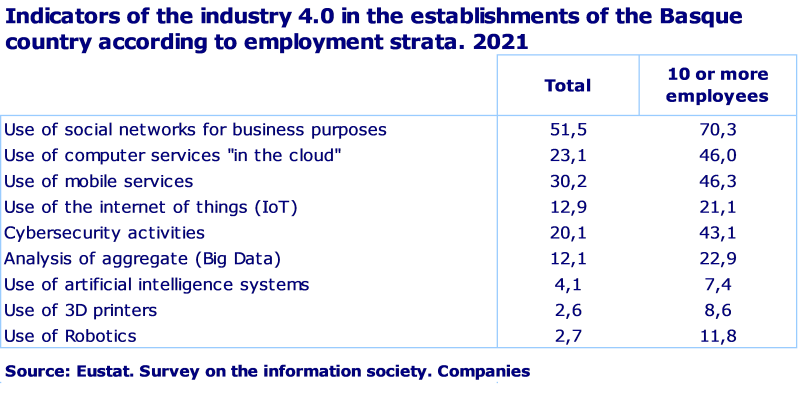
As regards the digital transformation of companies, Social Networks, with 51.5% of companies that use them for business purposes, was the top indicator of the nine analysed.
It was followed by Mobile Services, with 30.2%. Mobile Services is understood as the use of applications relating to the activity and production processes of the company.
Cloud Computing came third, with 23.1% of establishments paying for this service in order to access company information or services, through an internet connection from any mobile or fixed device in any location.
Next, with percentages ranging from 10% to 20%, were Cyber Security Activities, 20.1%; the Internet of Things (IoT), 12.9%; and Big Data Analysis, 12.1%. Finally, with percentages below 5%, were Artificial Intelligence, 4.1%; Robotics, 2.7%; and 3D Printers, 2.6%.
In the case of establishments with 10 or more employees these percentages were clearly higher: Social Networks reached 70.3% of establishments of this size, and above 20% were Mobile Services, 46.3%; Cloud Computing, 46.0%; Cyber Security Activities, 43.1%, Big Data Analysis, 22.9%; and the Internet of Things (IoT), 21.1%. It is worth mentioning the use of Robotics by 11.8% of companies, and that in the Industry sector the share was 22.9%.
Companies with 10 or more employees have practically already reached the availability threshold
As regards the ICT equipment of Basque companies, it is worth noting that they are becoming better prepared and the percentage of employees who use these technologies was also higher. At present, 94.2% of establishments have a computer, 90.8% use email, 92.6% have Internet access and 94.9% use mobile telephones. In addition, just over half of the companies, 53.0%, have a website.
These equipment percentages were higher in establishments with 10 or more employees. However, as they now have such widespread use (99.8% have a computer; 99.0% have e-mail; 99.3% have internet access; 97.1% have a mobile phone and 92.5% have a website), unlike small establishments, they now have practically no growth margin.
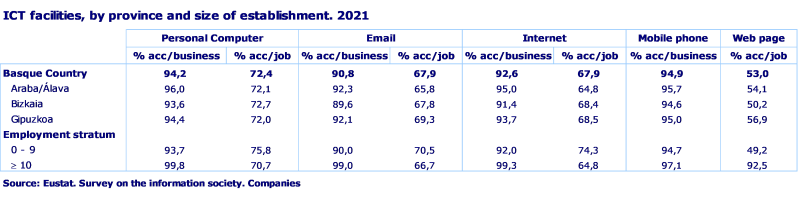
As regards the percentage of employees using these technologies, 72.4% of employed people use a computer; 67.9% have email; and 67.9% have Internet access.
Computer security is very widespread among Basque companies
Furthermore, 88.1% of companies have some form of computer security measure, up 2.4 percentage points on the previous year. Standing out among these measures, above 30%, were updated software (83.4%), secure passwords (82.4%) and external backups (61.7%), network access control (37.9%) and data encryption (32.8%). In the case of companies with 10 or more employees all these percentages were higher, with those using some form of computer security reaching 98.4%.
Furthermore, in 2021, 41.9% of Basque companies had open-source software, such as Internet browsers, office programs, free or open operating systems (Linux), etc. At companies with 10 or more employees this percentage increases to 55.5%.
Fibre optic connection is the fastest growing way of accessing the Internet while ADSL continues to decline
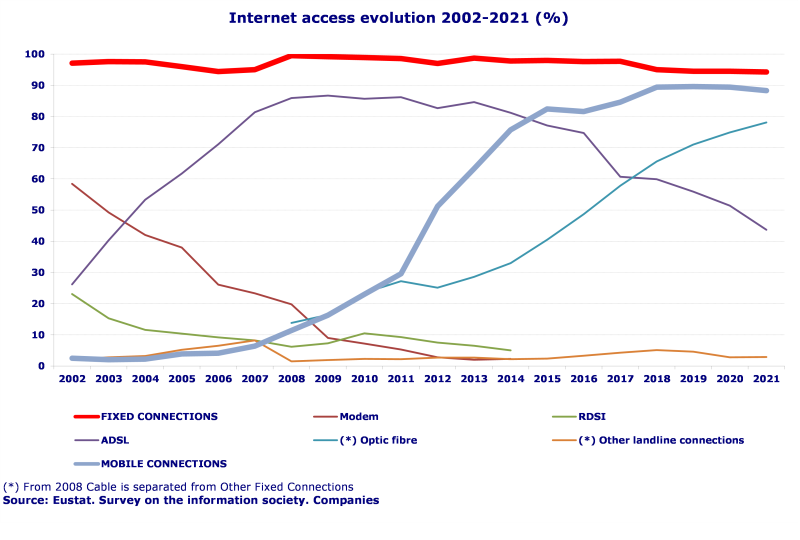
Basque companies with Internet access currently stand at 92.6% of the total, after those connected rose by 0.3 percentage points the previous year.
94.3% of companies with internet access had fixed connections, be they via ADSL, Cable or Other connections, whereas 88.3% of connected companies had mobile connections.
At companies with fixed connections, Fibre Optic (Cable, FTTH, etc.), 78.1%, was the most common way access the Internet. Its growth rate has continued to rise and it now vastly surpasses ADSL access, 43.7%.
If we consider size, 99.3% of companies with 10 or more employees had Internet access, 99.2% had fixed connections and 92.4% had mobile connections. Here, too, Fibre Optic connections (Cable, FTTH, etc.), 86.5%, was the most common way to access the Internet. It was followed by ADSL lines, 54.5%, which have continued to decline in recent years.
53.0% of all Basque companies, and 92.5% of those with 10 or more employees, had an online presence via a website
Companies are increasingly aware of the importance of maintaining a presence on the Internet via a website. In the last year, those that had a web presence accounted for 53.0% of the total, whilst in companies of 10 or more employees this figure rose to 92.5%.
These websites provide general information on the company, a catalogue of products and services offered, a data privacy statement, job offers and after-sale services, amongst other options.
Regarding languages that they can be accessed in, Spanish particularly stands out, available in 98.9% of cases; Basque was available in 42.5% of cases; English, 30.6% and other languages, 13.0%.
Internet access and online presence in Basque companies of 10 or more employees exceeded the EU-27 average, putting us in second place behind Denmark
At the international level, and for a perfect comparability with the EU-27, as well as employing the data of companies with 10 or more employees and the activities that Eurostat groups them into (they do not take into account the financial sector, the public administration, etc.), information from 2020, the previous year, must be used. This year, Basque companies obtained Internet access percentages (99%) higher than the European Union 27 average (98%), and had a greater percentage of businesses with Internet presence, 92% in the Basque Country in 2020, compared with the EU-27 average of 77%.

INFORMATION NOTE
Eustat would like to thank all the companies and institutions that have collaborated in the realization of this statistic, whose collection of information has been carried out during the months of January to April 2021.
For further information:
Eustat - Euskal Estatistika Erakundea / Basque Statistics Institute
C/ Donostia-San Sebastián, 1 01010 Vitoria-Gasteiz
Press Service: servicioprensa@eustat.es Tel: 945 01 75 62