Press release 25/06/2021
MUNICIPAL HOUSING STATISTICS 01-01-2020
Housing stock in the Basque Country increased by 7,188 units in 2020 compared to the previous year
Eight out of ten dwellings are used as the primary home for a family
The housing stock in the Basque Country consisted of 1,067,718 units on 1 January 2020, 7,188 more than in 2019, comprising family homes and collective establishments, according to data prepared by Eustat.
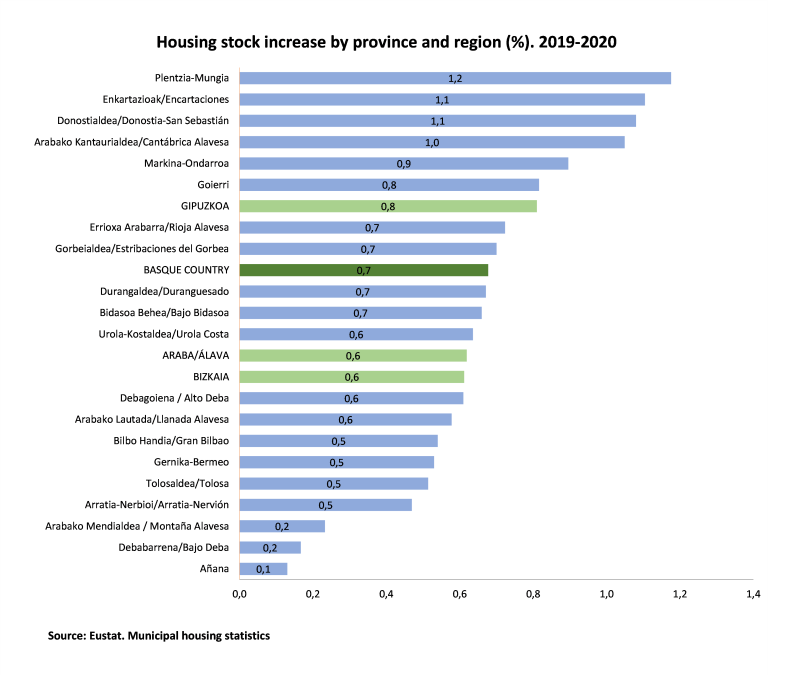
The greatest absolute increase corresponds to Bizkaia with 3,361 more dwellings, followed by Gipuzkoa with an increase of 2,800 units and, lastly, Álava where the stock grew by 1,027 dwellings. The differences are slight in relative terms: in Gipuzkoa, 0.8 tenths higher and in both Bizkaia and Álava, a rise of 0.6 tenths compared to 2019.
With these variations, the distribution of residential units is as follows: more than half of the dwellings are located in Bizkaia, 552,376, representing 51.7% of the total, Gipuzkoa, with 348,432 units, accounts for 32.6 %, while the remaining 15.6%, 166,910 homes, correspond to Álava.
At regional level, all regions registered moderate growth in housing stock. It is worth highlighting the regions of Plentzia-Mungia (1.2%) and Encartaciones (1.1%) in Bizkaia; the region of Donostialdea (1.1%) in Gipuzkoa and the region of Cantábrica Alavesa (1%) in Álava, as they were higher than the aforementioned average for the Basque Country (0.7%). At the other end of the scale, with below-average increases, are the regions of Añana (0.1%), Montaña Alavesa and Bajo Deba (both 0.2%).
85.3% of family homes are used as primary residences
An analysis of family housing stock usage reveals that 85.3% of dwellings function as primary residences and the remaining 14.7% are used as second homes or are empty. The proportion of dwellings used as primary residences ranges from 83.1% in Álava to 86.2% in Bizkaia, while in Gipuzkoa it is 84.8%.
Compared with the figures for main family homes from the previous year, there are 5,789 more units, broken down by province as follows: There were increases of 3,049 in Bizkaia, 0.6% higher, 2,086 in Gipuzkoa (0.7%) and 654 in Álava (0.5%). In addition, non-primary dwellings grew by 0.9% in the Basque Country.
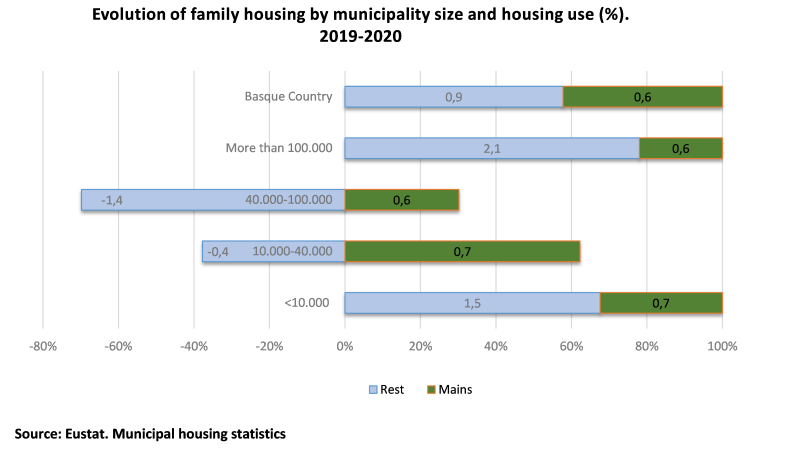
In terms of municipality size, it is worth highlighting the stratum of the largest municipalities, that is, the three provincial capitals, where non-primary dwellings grew by 2.1% with the greatest increase in San Sebastián (3%), followed by Bilbao (1.9%) and Vitoria-Gasteiz (1.2%). Primary dwellings in this stratum registered a smaller increase, 0.6%, with regard to the previous year. Bilbao increased its stock of primary family homes by 800 units (0.5%), San Sebastián by 608 homes (0.8%) and Vitoria-Gasteiz by 530 homes (0.5%).
In municipalities with fewer than 10,000 residents, the number of family homes grew in comparison with 2019 and the increase was above the Basque Country average for both primary homes (0.7 % v. an average of 0.6%) and other dwellings (1.5% v. an average of 0.9%).
In contrast, it should be noted that it in municipalities with a population of between 40,000 and 100,000 residents and those with between 10,000 and 40,000 inhabitants, a loss of non-primary dwellings was registered in comparison with the previous year (-1.4% and -0.4%, respectively).
Basque family homes are 46.2 years old and have a usable floor area of 87.3 square metres, between four and five living spaces and 1.4 bathrooms, on average
The average age of the family housing stock in the Basque Country was 46.2. At provincial level, the most modern housing stock corresponds to Álava at 39.7 years old, followed by Gipuzkoa with an average age of 46.7, whereas Bizkaia, with 47.8, is the province with the oldest housing stock.
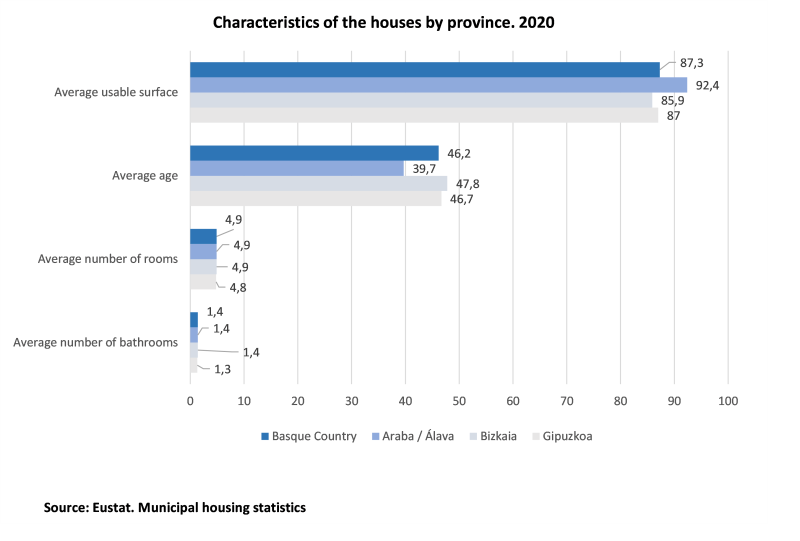
The average usable floor area of dwellings in the Basque Country as a whole is 87.3 m2. Álava has the largest family homes with an average of 92.4 m 2, followed by Gipuzkoa with 87 m2 and Bizkaia with 85.9 m2.
Lastly, as regards the number of rooms, three quarters of Basque family homes had 4 or 5 rooms (including bedrooms, living room and kitchen) and 1.4 bathrooms, on average.
For further information:
Eustat - Euskal Estatistika Erakundea / Basque Statistics Institute
C/ Donostia-San Sebastián, 1 01010 Vitoria-Gasteiz
Press Service: servicioprensa@eustat.es Tel: 945 01 75 62