Press release 09/06/2021
SURVEY ON PERSONAL WELL-BEING. 2020
In 2020, the overall life satisfaction of the Basque population increased in spite of the pandemic
All personal well-being indicators, except state of mind, improved
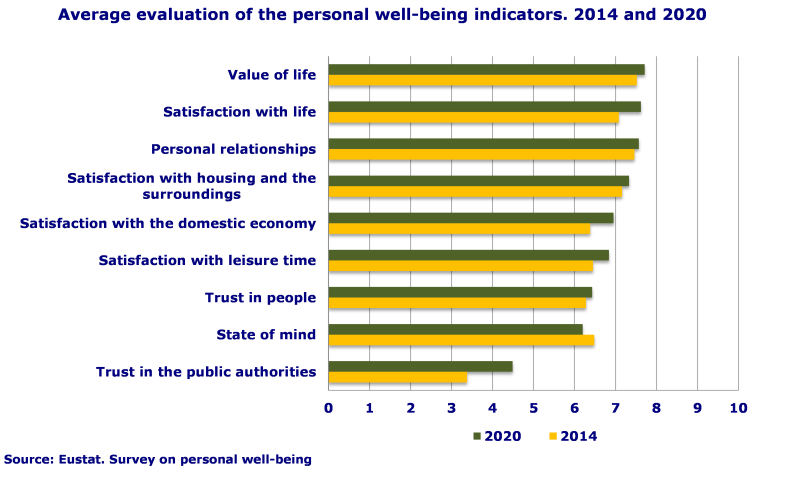
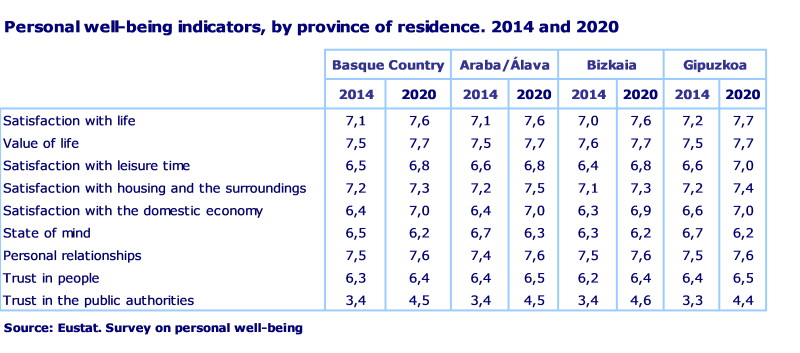
The population of the Basque Country aged 16 and over scored 7.6 for satisfaction with life in general in 2020 on a scale of zero to ten, according to Eustat data. Despite the fact the year was marked by the pandemic, this score has improved in relation to 2014, when it stood at 7.1, and also in respect of 2019, when it reached 7.4.
The highest score (7.9) was observed among people who declared having net monthly household incomes of over €2,500, with no noticeable difference between women and men.
This indicator yields lower assessments as both household income and the level of education decrease. People with higher education had the highest score (7.9), while those with no education had a lower score than the population as a whole (6.8).
As for the relationship with activity, unemployed people gave one of the lowest scores (6.9), compared to active people (7.6) and people in work (7.8).
Another factor to consider is concern for the environment, as those who claim to be very concerned are the most satisfied with their life (7.7), while those who were not at all concerned scored 7.2.
As regards age, people under 50 were more satisfied with their life (7.7) than those aged 50 and over (7.5).
The Value of Life indicator received the highest score: 7.7
The value of one's own life, or the view that life is worthwhile, reached an average score of 7.7, up 0.2 compared to 2014 and down 0.1 compared to 2019, with 57.5% rating it as “high” compared to 1.2% of the population who considered it to be “low”.
The highest score (8.0) was observed among people who declared having net monthly household incomes of over €2,500, and the lowest (6.9) among those with no education.
Young people aged between 16 and 24 scored slightly better than average (7.9), whereas at the provincial level or by gender no significant differences were observed.
In terms of the relationship with activity, employed people valued their life more (7.8), compared to unemployed people (7.3) and inactive people (7.7), though they all scored “good” values.
As for the level of education, the best results came from people who received higher education (7.9), compared to those with no education (6.9).
Personal relationships were the third highest rated aspect (7.6)
The evaluation of Personal relationships, as with the indicators above, was highest (7.7) among people with higher education, whereas it was lowest (7.1) among those with no education.
Higher scores were observed as household income and concern for the environment increased.
Unemployed people (7.4) had worse personal relationships than those in employment or inactive people (7.6 in both cases), whilst there were no significant differences by province of residence.
As for place of birth, the lowest score was from the group of people born abroad (7.3).
Satisfaction with housing and surroundings was high across practically all the groups
For the Satisfaction with housing and surroundings indicator (7.3 average), people born in Álava achieved the highest result (7.5). The lowest (6.9) arose among people with a monthly income of less than €1,000, and the score increased with income, reaching 7.5 when income was over €2,500.
As regards the level of education, the best results came from people with higher education (7.4), compared to those with no education (7.0).
Men (7.5) were more satisfied with their housing and surroundings than women (7.2).
State of mind is the only indicator that has worsened compared to both 2014 and 2019
The State of mind indicator, with an average of 6.2 (down 0.3 since 2014) among the population aged 16 and over, was highest among young people between 16 and 24 years of age (6.4) and fell as age increased.
People with no education had the lowest score (5.6), increasing to 6.4 among those with higher education.
Higher scores were also observed as household income and concern for the environment increased.
Men (6.4) scored more highly for this indicator than women (6.1) and, taking into account civil status, single people (6.3) had a better state of mind than widowed, separated or divorced people (5.9), and slightly better than married people (6.2).
Elderly people were the ones most satisfied with their leisure time
With an average Satisfaction with leisure time of 6.8, people aged 65 and over gave the highest score (7.8) whilst those aged 35 to 49 gave the lowest (6.1). Inactive people also gave a good score (7.5), the opposite to what occurred for those in work (6.2).
People residing in Gipuzkoa were more satisfied (7.0) than people in Álava or Bizkaia (6.8 in both cases), we were those born in other provinces outside the Basque Country (7.3), compared to those born abroad (6.6).
As for civil status, widowed, separated or divorced people were more satisfied with their leisure time (7.3), than single (6.6) and married people (6.9).
Satisfaction with the household economy improved 0.6 points compared to 2014
Naturally, the indicator Satisfaction with the household economy (7.0) increased with net monthly household income, ranging from 5.7 among people with a net monthly income of less than €1,000 to 7.4 among those earning over €2,500.
People residing in Bizkaia (6.9) were less satisfied than those living in Álava or Gipuzkoa (7.0 in both cases) and those born abroad (6.4).
As for age, it was observed that the group of people aged 65 and over (7.1) were the most satisfied and there were no significant differences between men and women.
The worst score for this indicator was in the unemployed population (5.6), as opposed to the score of 7.1 for those in work.
Young people had the most Trust in people
The Trust in people indicator (6.4) achieved its highest score (6.8) among young people aged between 16 and 24.
Trust was "high" for 26.8% of the population, whilst it was "low" for 9.7%.
Women (6.5) had slightly more trust than men (6.3), and people resident in Álava and Gipuzkoa (6.5) had more trust than those in Bizkaia (6.4).
People who claimed to have no concern at all for the environment scored the lowest (6.0), compared to 6.3 for those who were a little concerned or 6.5 for those who were very concerned.
Trust in the public authorities obtained the lowest result (4.5), although it is the indicator that has improved the most (1.1 points) in respect of 2014
Only 4.3% of the population trusts the public authorities "a lot", compared with 46.6% who have "little" trust in them. It is the only indicator with an average below the "pass level".
In all the population groups aged 16 and over, trust in the public authorities scored a “fail”, except among people born abroad, which achieved the highest score (5.5).
Trust among women (4.6) was higher than among men (4.4) and, in terms of age, people aged 65 and over were the age group who had the most trust in the political and legal systems and the police (4.7), compared to the score of 4.4 for the 50 to 64 age group.
For further information:
Eustat - Euskal Estatistika Erakundea / Basque Statistics Institute
C/ Donostia-San Sebastián, 1 01010 Vitoria-Gasteiz
Press service: servicioprensa@eustat.es Tel: 945 01 75 62