Press release 04/06/2021
QUARTERLY ACCOUNTS. I/2021
The GDP of the Basque Country grew by 0.2% in the first quarter of 2021 and employment was up 0.5%
It was the third consecutive quarter of GDP growth in quarter-on-quarter rates
The Gross Domestic Product (GDP) of the Basque Country rose by 0.2% in the first quarter of 2021 in quarter-on-quarter terms, according to Eustat data. However, compared to the same quarter of the previous year, a 2.9% decrease in GDP was estimated.
In this first quarter of 2021, the Basque economy saw three consecutive quarters of consolidated GDP growth in quarter-on-quarter terms, after upturns of 15.5% in the third quarter of 2020, 0.5% in the fourth quarter of 2020 and 0.2% in the first quarter of 2021, as mentioned above.
In the first quarter of the year, employment, measured in terms of full-time equivalent jobs, was up by 0.5% in quarter-on-quarter terms, but dropped by 2.1% compared to the first quarter of 2020.
These estimates, which incorporate all the relevant economic information available at the time they were prepared, confirm the estimates obtained in Eustat’s Advance Quarterly Accounts of 19 April 2021.
In the first quarter, the 2.9% year-on-year decrease in the GDP of the Basque Country was lower than the estimate for the Spanish economy, which saw an estimated year-on-year decline of 4.3%. The downturns were more moderate in the Eurozone (-1.8%) and the European Union as a whole (-1.7%). In the United States, estimated GDP increased by 0.4% in year-on-year terms in the first quarter.
The difference between the Basque economy and those around it, namely the Spanish and European Union economies, was that Basque GDP rose in quarter-on-quarter terms in the first quarter of 2021, while the Spanish and European Union economies were down by 0.5% and 0.4%, respectively.
From the point of view of Supply, the decrease in the value added in year-on-year terms (first quarter of 2021 compared to the first quarter of 2020) was widespread, with the exception of the Public Administration, Education, Health and Social Services branch.
The Primary sector has recorded a decline in added value in real terms of 7.1% compared to the same quarter of the previous year, while remaining 20.1% higher than that estimated in the previous quarter.
The Industry sector experienced a downturn in year-on-year terms of 1.1%, with a 0.7% decline in the Manufacturing Industry. These drops were lower than those observed throughout 2020. In fact, compared to the last quarter of 2020, the Industry’s value added recovered during this quarter of 2021 by 1.4% and, in the case of the manufacturing industry, by 1.3%.
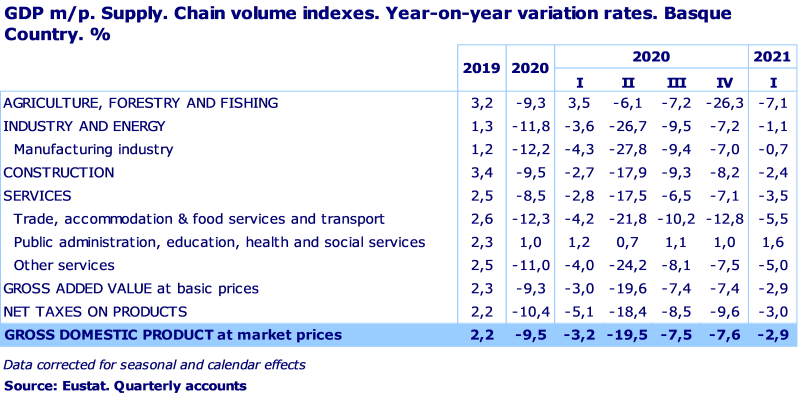
The Construction sector also saw a lower year-on-year downturn than in the previous quarters, with a 2.4% drop in value added in the first quarter of 2021 (it was 8.2% in the previous quarter). In quarter-on-quarter terms, on the other hand, the estimated upturn in the first quarter of the year (1.0%) was lower than the estimate for the third quarter of the year (1.7%).
Overall activity in the Services sector in the first quarter of the year experienced a more moderate year-on-year downturn than observed in the previous quarter, with a drop of 3.5% in the first quarter (the previous quarter it dropped by 7.1%). In quarter-on-quarter terms a decrease of 0.5% in value added was noted in Services as a whole.
The performance of the Services sector varied by branches during this last quarter. The branch of Trade, Hotel Management & Catering and Transport posted a decrease in value added of 5.5% compared to the first quarter of the previous year, following a 2.2% rise compared to the previous quarter. The drop in year-on-year terms was lower than in previous quarters. The year-on-year downturn also eased in the Other Services branch, with a year-on-year decrease of 5.0% (it was 7.5% in the previous quarter). In fact, compared to the last quarter of 2020, a decline of 2.7% is estimated in activities falling within the Other Services branch, such as property, professional, scientific and technical activities, as well as finance and insurance.
The Public Administration, Education, Health and Social Services branch, after rising by 0.5% compared to the previous quarter, maintained a steady increase in value added, with a year-on-year growth rate of 1.6%.
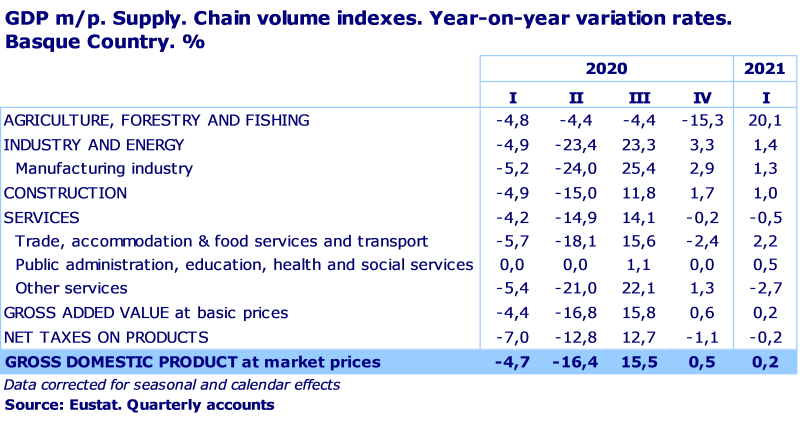
The year-on-year negative performance of almost all sectors brought the Value Added of the Basque Country down by 2.9%, though the decrease was lower than that observed throughout 2020. Compared to the previous quarter, Gross Value Added recovered by 0.2%.
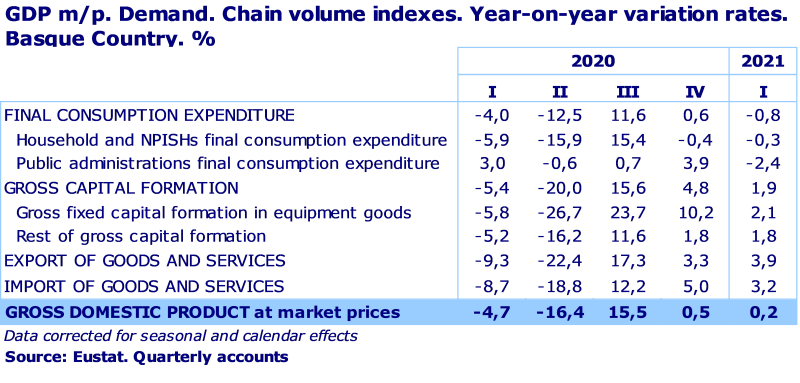
The performance was similar from the point of view of Demand, with more moderate year-on-year downturns than in previous periods in all macromagnitudes, except for Final Consumption Expenditure of Public Administrations which, though positive, was lower than in the previous quarter. The quarter-on-quarter performance was uneven: it was negative for Consumption and positive for the other magnitudes.
Final Consumption Expenditure of Households and Non-profit Institutions Servicing Households (ISFLSH) (Private Consumption) recorded a year-on-year decrease of 3.7%, which was significantly lower than that estimated the previous quarter (9.1%). This was obtained after observing a 0.3% downturn compared to the previous quarter.
The final consumption expenditure of the Public Administrations (Public Consumption) once again saw a positive performance in year-on-year terms, despite having fallen by 2.4% in quarter-on-quarter terms. Year-on-year growth stood at 1.6% this quarter, lower than in previous quarters.
The overall performance of public and private consumption resulted in a year-on-year drop in Final Consumption Expenditure of 2.6%. Compared to the last quarter of 2020, it saw a 0.8% decline.
In Gross Capital Formation (Investment), there was a year-on-year fall of 1.3%, lower than estimated in the previous quarter (8.4%). Compared to the fourth quarter of 2020, GDP was up 1.9%. Investment in Capital Goods registered a 1.9% rise compared to the same quarter of the previous year, which represents a recovery in quarter-on-quarter terms of 2.1%.
In Other Gross Capital Formation, which is more closely linked to the performance of construction, the year-on-year decline stood at 3.1% (less of a drop than in the three previous quarters), after estimating growth of 1.8% on the previous quarter of the year.
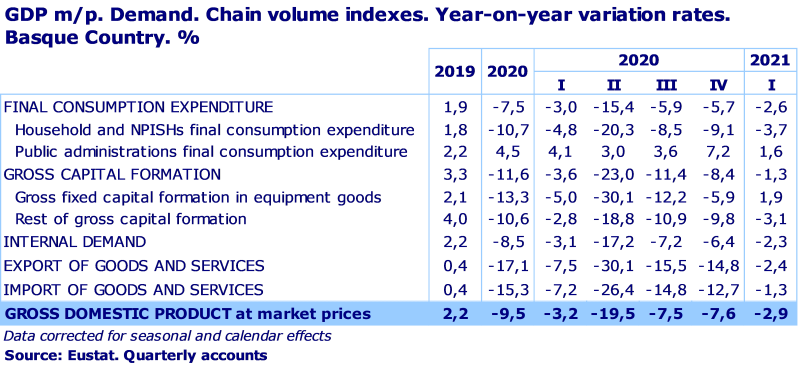
Internal Demand, composed of Final Consumption Expenditure and Gross Capital Formation, fell by 2.3% in year-on-year terms in the first quarter of the year (less of a decrease than in all quarters of 2020). This decrease was below that estimated for GDP as a whole (2.9%), for which the contribution of the Foreign Sector was also negative in the first quarter of the year. Exports of goods and services was down 2.4% in year-on-year terms, to a greater extent than Imports, which fell by 1.3%. The foreign balance therefore contributed negatively to the year-on-year performance of the economy of the Basque Country.
In relation to the level of employment (measured in Full-Time Equivalent Jobs), employment as a whole was down 2.1% compared to the first quarter of 2020, though it was up 0.5% compared to the previous quarter.
In this regard, it should be remembered that the definition of a job, according to the European System of Accounts (ESA), excludes persons temporarily not at work but who have a formal attachment to their job, for example, an assurance of return to work or an agreement as to the date of return, as is the case with ERTEs (Temporary Labour Force Adjustment Plans).
The Primary sector saw a 1.3% drop in employment in relation to the first quarter of 2020, an increase of 1.3% in quarter-on-quarter terms. In Industry, job losses in year-on-year terms stood at 3.6%, although this figure is 0.5% higher than in the previous quarter. In Construction, there was also a negative trend in employment, both in year-on-year (decrease of 1.2%) and in quarter-on-quarter terms (drop of 1.8%). Finally, the number of Full-Time Equivalent Jobs in the Services sector decreased by 1.7% in year-on-year terms, following a rise of 0.8% in quarter-on-quarter terms.
As regards the trend in GDP by province in the first quarter of 2021, there were drops in year-on-year terms of 2.4% in Álava, 2.6% in Gipuzkoa and 3.3% in Bizkaia. Conversely, compared to the last quarter of 2020, Bizkaia performed better, with a quarter-on-quarter upturn of 0.2%, compared to the 0.1% observed in Álava and Gipuzkoa.
For further information:
Eustat - Euskal Estatistika Erakundea / Basque Statistics Institute
C/ Donostia-San Sebastián, 1 01010 Vitoria-Gasteiz
Press Service: servicioprensa@eustat.es Tel: 945 01 75 62