Press release 11/05/2021
SURVEY ON TRADE AND REPAIRS. 2019
Before the pandemic, in 2019, the Trade and Repairs sector employed 131,000 people in the Basque Country, almost 12% of the total
Six out of ten worked in Retail Trade, although Wholesale Trade had the highest turnover, more than half of the total for the sector
In 2019, the last year before the arrival of COVID-19, the Trade and Repairs sector had a turnover of 35,537 million euros and employed 131,000 people in the Basque Country, 11.9% of total employment, according to data prepared by Eustat.
Compared to 2017, the last year with which a comparison can be made, the sector’s turnover increased by 3.7%, while there was no significant change in employment, with a slight reduction of 0.2%. As regards turnover, it is worth noting that increases equal to or greater than 2% have been observed since 2014 and that the 35,537 million euros reported in 2019 was the highest turnover figure in the known historical series.
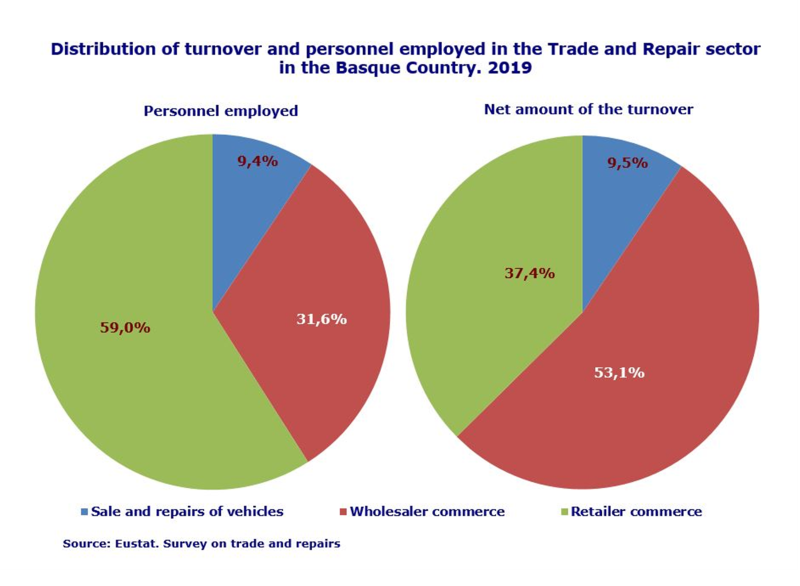
Taking into account the size of the establishments in terms of employment, significant differences were observed. While the smallest stratum, those with between 1 and 9 employees, reported reductions both in turnover, -3.7%, and employment, -4.2%, those with between 10 and 49 employees experienced a 4.2% increase in the number of staff and 8.9% in sales, and in the stratum of establishments with more than 50 employees, the number of jobs grew by 7.9% and turnover was up 11.9%, all compared to 2017.
Thus, small businesses (up to nine employees) accounted for 94.3% of total establishments, 56.3% of staff and 41.6% of turnover in the Basque Country; medium-sized businesses (with between 10 and 49 employees) accounted for 5.2% of establishments, 28.5% of jobs and 41.7% of turnover; and, in turn, large businesses represented 0.5% of all establishments, 15.3% of employed people and 16.7% of sales.
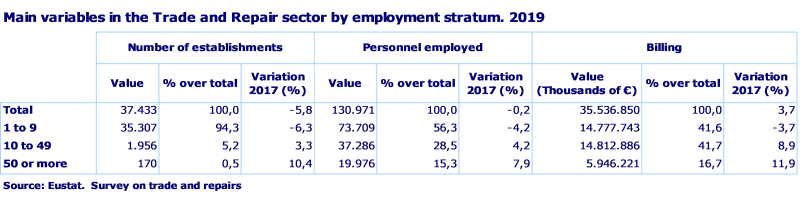
By province, Álava performed the best out of the three provinces in both indicators in 2019, with increases of 8.2% in sales and 1% in employment. Bizkaia’s sales were up 3.4% but employment was down by 0.2%, while in Gipuzkoa sales were up 2.1% and employment fell by 0.6%.
With these increases, Bizkaia turned over a total of 18,071 million euros, 50.9% of the total, Gipuzkoa turned over 11,490 million and 32.3%, and Álava turned over 5,976 million and 16.8% of the Basque Country total.
With regard to employment, 68,753 people were employed in the trade sector in Bizkaia, 43,108 in Gipuzkoa and 19,110 in Álava. In relative terms, 52.5% of all jobs were in Bizkaia, 32.9% were in Gipuzkoa and the remaining 14.6% were in Álava.
The trade margin on sales – the proportion of the gross trade margin over the net sales value of goods for resale – for the sector was 24.5%, up 0.3 percentage points on 2017. No differences were found between Gipuzkoa and Álava, both with a margin of 24.2%, although the former increased by 0.7 percentage points and the latter by 0.3. Conversely, the trade margin in Bizkaia was slightly higher, by 0.7 percentage points, at 24.9%, with an increase of 0.2 percentage points compared to two years before.
Six out of ten people were employed in Retail Trade and in Wholesale Trade turnover was more than half of the sector’s total
This sector is divided into three major activity groups: Sale and Repair of Vehicles, Wholesale Trade and Trade Intermediaries and Retail Trade.
In 2019, the trends were positive in all three in terms of turnover volume and uneven in terms of employment.
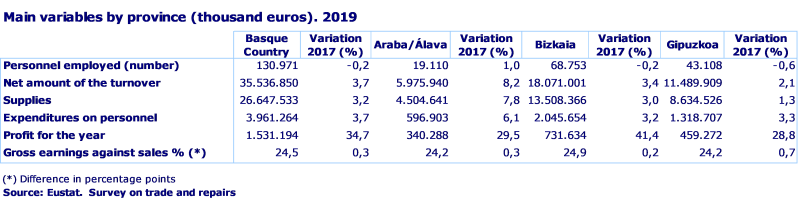
The Sale and Repair of Vehicles division showed the most favourable trend, with a 5.5% increase in turnover, while employment was down 1.1%. This section accounted for 9.4% of total employment and 9.5% of total trade turnover.
Within this division particularly noteworthy is the sale of motor vehicles group, which accounted for 63.5% of the turnover figure and 33% of employment in the division. In this group, turnover was up 9.8% and employment increased by 7% compared to 2017.
For its part, the Wholesale trade and trade intermediaries division, with almost 53.1% of sector sales and 31.6% of employment, added a further 4.9% to its turnover figure and 2.1% to employed personnel. The groups with the greatest weight were Other Specialised Wholesale Trade� and Food Products, Drinks and Tobacco, as between them they accounted for over 61.7% of the division, and provided 47.5% of total employment. However, while in the former turnover increased by 7.8% and employment was up 7%, in the latter turnover fell by 1.7% despite the 3.9% increase in employment.
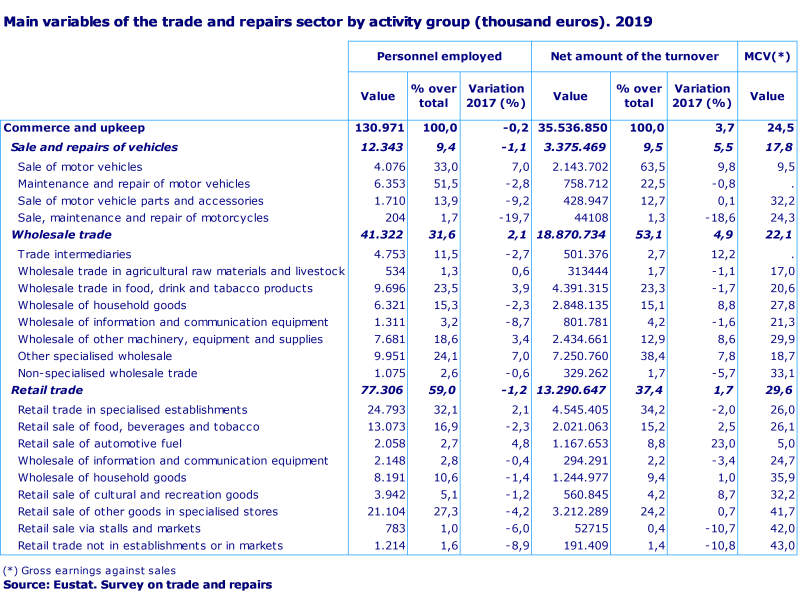
The Retail Trade division, the largest in terms of personnel as it accounts for 59% of employment, turned over 37.4% of the total, increasing its turnover figure by 1.7%.
Within Retail Trade, the group that made the most significant contribution to turnover (34.2%) and employment (32.1%) was Retail Trade in Non-Specialised Establishments�, whose turnover was down 2% compared to 2017, although there was a 2.1% increase in employment. The next biggest contributing group in this division was Retail Trade of Other Items�, which saw its turnover increase by 0.7% and its employment by 4.2%, reaching 24.2% of turnover and 27.3% of Retail Trade employment.
Lastly, the trade margin on sales for Retail Trade was 29.6% and for Wholesale Trade it was 22.1%, while the margin of Sale and Repair of Vehicles stood at 17.8%.
Notes:
1. This includes the wholesale of fuel, metals, construction materials, ironmongery, plumbing, chemical products, other semi-finished products, scrap and others.
2. Includes large stores and warehouses, amongst others.
3. Includes retail trade in clothes, footwear, pharmaceutical, medical, orthopaedic, cosmetic and hygiene products, watches and jewellery items and others.
For further information:
Eustat - Euskal Estatistika Erakundea / Basque Statistics Institute
C/ Donostia-San Sebastián, 1 01010 Vitoria-Gasteiz
Press service: servicioprensa@eustat.es Tel: 945 01 75 62