Press Release 18/05/2021
INDUSTRIAL SURVEY – REGIONS. 2019
Employment in the extraction and manufacturing industry increased in 13 of the 20 regions in the Basque Country in 2019
Nine of the twenty regions also recorded increases in sales and eleven saw a rise in value added
Employment in the extraction and manufacturing industries grew in thirteen of the twenty regions of the Basque Country in 2019, according to Eustat data. The average increase in the Basque Country was 0.4%, with the largest increases in Plentzia-Mungia, in Bizkaia, where it was up 4.4%, Estribaciones del Gorbea, in Álava, where it rose by 3.5%, and Tolosaldea, a region in Gipuzkoa where employment increased by 3.2%.
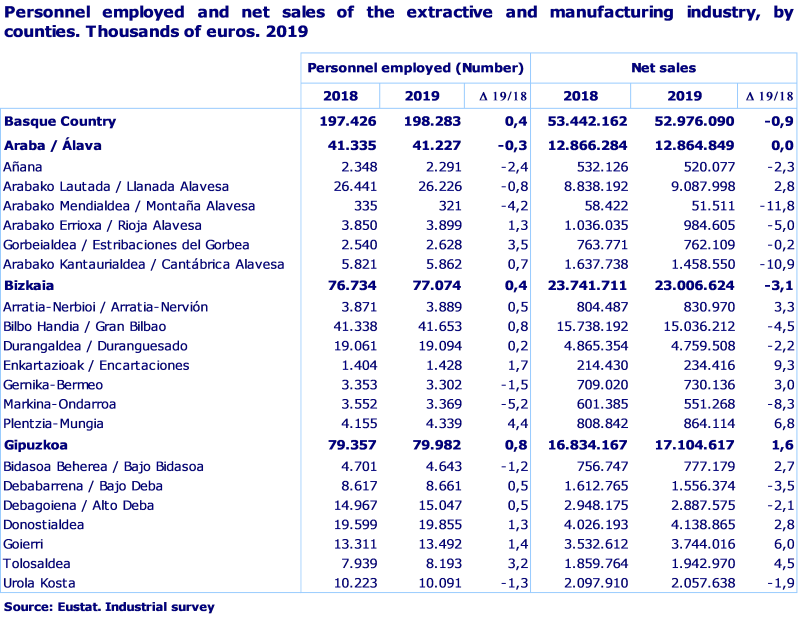
Employment decreased by 0.3% in all regions of Álava, despite the 3.5% increase in Estribaciones del Gorbea and the upturn in Rioja Alavesa and Cantábrica Alavesa of 1.3% and 0.7%, respectively. The three other regions in the province also saw decreases, of 4.2% Montaña Alavesa, 2.4% in Añana and 0.8% in Llanada Alavesa, the region where the provincial capital, Vitoria-Gasteiz, is located.
In Bizkaia, with an average of 0.4% employment in the province, only two of its seven regions showed negative annual variation, namely Markina-Ondarroa, where it fell by 5.2%, and Gernika-Bermeo, where it was down 1.5%. In the other regions, the largest increase was in Plentzia-Mungia, with 4.4% more employment, followed by Encartaciones with 1.7%. Increases were also seen in the provinces of Gran Bilbao, of 0.8%, Arratia-Nervión, up 0.5%, and Duranguesado, of 0.2%.
Gipuzkoa saw the largest increase, 0.8% higher than in Tolosaldea, with 3.2%. Goierri, Donostialdea, Alto Deba and Bajo Deba increased by percentages ranging from 1.4% for the former and 0.5% for the latter two. On the other hand, employment fell in both Urola Kosta (-1.3%) and Bajo Bidasoa (-1.2%).
Encartaciones and Plentzia-Mungia in Bizkaia, and Goierri and Tolosaldea in Gipuzkoa, performed best in terms of industrial sales. In Álava, sales were only up in Llanada Alavesa
Net sales at the regional level reflect positive annual growth in the industrial sector in nine of the twenty regions. These include two regions in Bizkaia, Encartaciones, where it was up 9.3%, Plentzia-Mungia, where it rose by 6.8%, and Goierri, in Gipuzkoa, which saw 6% growth in net sales.
At the provincial level, each province was in a different situation. While in Álava sales remained at the same level as in 2018, in Gipuzkoa they rose by 1.6% and in Bizkaia they were down 3.1%. In the Basque Country as a whole, there was a decrease of 0.9% compared to 2018.
Net sales in Álava remained similar to those in 2018, which was made possible solely due to the increase in one region, while the rest saw downward trends to greater and lesser degrees. Sales in Llanada Alavesa were up by 2.8% compared to the year before, 2018. This region, where the provincial capital, Vitoria-Gasteiz, is located, concentrated the highest percentage of total sales in the province, 70.6% of sales and 63.6% of jobs.
Sales in the other regions in the province declined by varying degrees. In two of them the decrease exceeded 10%, namely Montaña Alavesa, -11.8%, and Cantábrica Alavesa, -10.9%. The latter region was the second largest in terms of turnover and volume of employment, accounting for 11.3% of total turnover in Álava and 14.2% of jobs. There was a significant decrease in sales of 5% in Rioja Alavesa, which was followed by Añana with a decrease of 2.3% and Estribaciones del Gorbea, which was down 0.2%.
In Bizkaia, two regions set the trend in the province, where there was a 3.1% drop in sales. Both contributed 86% of total sales. They were Gran Bilbao, with 65.4% of total turnover, and Duranguesado, with 20.7%. The regions both experience a downward trend in sales of 4.5% and 2.2%, respectively. The first, which is in Bilbao, the provincial capital, accounted for 54% of employment and the second accounted for 24.8%, equal to almost 80% of total jobs. Markina-Ondarroa was the third region in Bizkaia where sales fell, by up to 8.3%, although it accounted for only 2.4% of sales.
The most significant increases were in Encartaciones, where sales were up 9.3%, and Plentzia-Mungia, where sales rose by 6.8%. They were followed by Arratia-Nervión, with 3.3%, and, lastly, Gernika-Bermeo, with a 3% increase in sales.
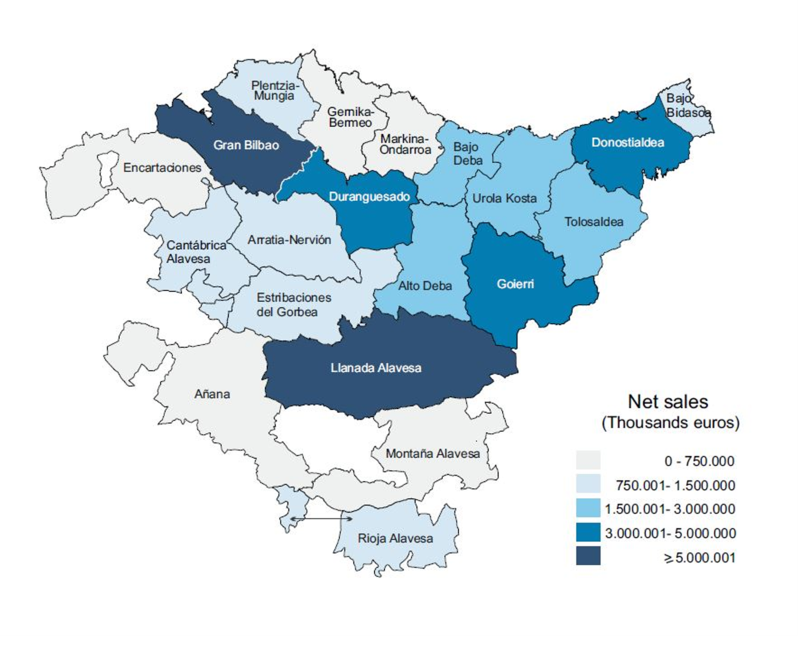
In Gipuzkoa there was more regional distribution of net sales. The percentage weight of total sales in the regions in the province as a whole varied between 4.5% in Bajo Bidasoa and 24.2% in Donostialdea. Goierri, with 21.9%, and Alto Deba, with 16.9% had similar shares.
Furthermore, this was the only province in the Basque Country where sales grew. At the regional level, sales increased in Goierri by 6%, Tolosaldea by 4.5%, Donostialdea by 2.8% and Bajo Bidasoa by 2.7%, all much higher than the province's average of 1.6%. However, three of its regions had a negative performance between 2018 and 2019: Bajo Deba (-3.5%), Alto Deba (-2.1%) and Urola Kosta (-1.9%).
In Gipuzkoa, the weighting of Donostialdea, the region where the provincial capital, San Sebastián, is located, was very similar to its share of employment. Donostialdea accounted for 24.2% of sales and 24.8% of jobs in the province, both of which were lower than in the other regions with provincial capitals compared to the province.
Distribution of net sales in the extraction and manufacturing industry by regions. 2019.
Source: Eustat. Industrial Survey
From another perspective, the proportion of total sales was higher than the proportion of total jobs in four regions of the Basque Country. These were Llanada Alavesa, Gran Bilbao, as mentioned above, Goierri and Tolosaldea. In the case of Goierri, regional employment accounted for 16.9% of the province, while its share of sales was 21.9%. Tolosaldea accounted for 10.2% of sales and 11.4% of people employed in industry.
As regards gross value added, which is the difference between the value of what is produced and that of the consumption utilised and represents the wealth generated, industrial value added registered a rise of 1% in 2019. The regional trend was positive for eleven of the twenty regions in the Basque Country. The highest increases were in Encartaciones, Plentzia-Mungia and Tolosaldea, with 16.1%, 7.9% and 5.4%, respectively.
In Gipuzkoa, industry’s value added increased in Tolosaldea by 5.4%, followed by Donostialdea, Alto Deba and Goierri with 4.4%, 4.1% and 0.5%, respectively, compared to 2018. However, three of its regions saw downturns in value added, namely Urola Kosta, with a 3.9% drop, Bajo Deba with a 1.8% decrease and Bajo Bidasoa with a 0.9% decline. Bizkaia experienced the same increase in value added as Gipuzkoa, at 1.7%, and only two of its regions saw negative variations: Gernika-Bermeo, where it was down 5.1%, and Markina-Ondarroa, where it decreased by 2.5%. In this province, the increase in value added compared to 2018 of the other five regions varied between 16.1% in Encartaciones and 0.7% in Duranguesado. Conversely, Álava experienced a 1.1% decrease in value added and only two of its six regions saw a positive variation, namely Añana, with a 3% rise, and Llanada Alavesa, where it was up by 0.8%. At the opposite extreme, there were considerable decreases in Montaña Alavesa, -11.8%, and Cantábrica Alavesa, -11.3%.
Methodological note:
The sectorisation used is the National Classification of Economic Activities (CNAE-2009), with the B (extractive industries) and C (manufacturing industries) being the only sections included in this disaggregation by regions.
For further information:
Eustat - Euskal Estatistika Erakundea / Basque Statistics Institute
C/ Donostia-San Sebastián, 1 01010 Vitoria-Gasteiz
Press service: servicioprensa@eustat.es Tel: 945 01 75 62