Press Release 16/04/2021
INDUSTRIAL STATISTICS. 2019
The role of medium and high-tech products in Basque industry grew, accounting for 32% of sales in 2019
Almost half of manufacturing industry sales were for export
2019 data on Basque Industry, the last set before COVID-19 hit, showed a sector that spilled over into external markets, with an increasing role of medium and high-tech products, according to Eustat data.
The role of medium and high-tech products has been constantly growing over the years, accounting for 31.7% of sales in 2019 and a slightly higher percentage, 32.1%, of both people employed and value added generated. Compared to 10 years ago, they account for around 4 percentage points more in all of the three variables.
Altogether, the performance of Basque industry in 2019 was positive in terms of value added and employment. In terms of jobs, the number of people employed rose by 0.3%, maintaining the positive trend of previous years and bringing the total of number of employed people to 207,004 after seeing five years of continued growth. Of the total number of people employed, 20.6% were women, almost two percentage points more than 10 years previously, with slow but steady growth. The branches with the highest number of female employees were Textile, Garments, Leather & Footwear, with 70.8%, Pharmaceutical Products (57.7%) and Food, Beverages & Tobacco (40.2%).
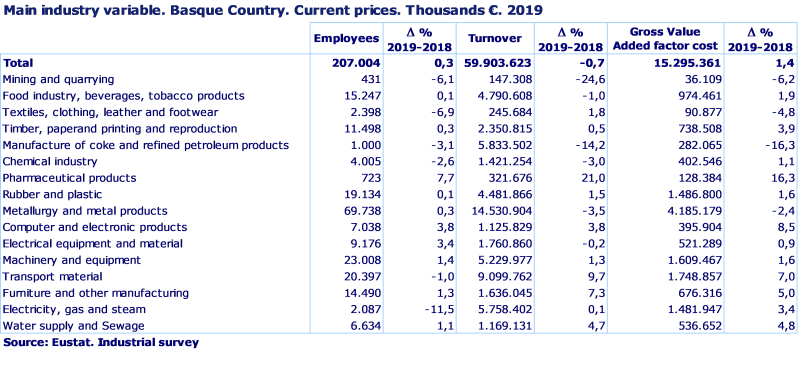
Value added reached 15,295 million euros, 1.4% more than in 2018, and the highest value since 2009. Turnover, which reached 59,904 million euros at current prices in 2019, was the second highest in the decade, following a slight drop of 0.7% compared to 2018.
In turn, the productivity of Basque industry, measured as value added provided per person in work, was 73,889 euros in 2019, 1.1% up on the year before.
The branches of Metallurgy & Metal Products, Machinery & Equipment and Transport Material made up half of Basque industry
The sector with the most weight in Basque industry was Metallurgy & Metal Products, which employed 69,738 people, 33.7% of all people working in industry. Furthermore, it took first place both in terms of sales, at 14,531 million euros, and in value added, at 4,185 million. Employment in the sector increased by 0.3% compared to 2018, but it shrank both in terms of sales and value added, by 3.5% and 2.4%, respectively.
It is followed some way behind by the Machinery & Equipment and Transport Material sectors. In 2019, the former employed 11.1% (23,008 people) of the total and the latter 9.9% (20,397 jobs). In Transport Material, turnover rose 9.7% and value added was up 7.0%. As a result of this trend, it accounted for 15.2% of sales and 11.4% of value added of all Basque industry at the year end.
The Machinery & Equipment sector made up 8.7% of sales and 10.5% of value added of Basque industry, following growth of 1.3% in sales and 1.6% in value added.
These three sectors employed more than half the number of people employed in industry, 54.7%, and also accounted for 48.2% of sales and 49.3% of the total value added in 2019.
In next place was Rubber and Plastics which, with 19,134 people, remained almost exactly the same as in 2018, accounted for 9.2% of total employment, 7.5% of turnover and 9.7% of gross value added, after the first two increased by 1.5% and the latter by 1.6% in 2019.
Another significant sector in Basque industry, in terms of value added, was Electricity, Gas & Steam. This sector, which employed only 1% of workers, generated 9.6% of sales and 9.7% of value added.
In terms of turnover, the Pharmaceutical Products saw the largest growth at 21.0%, with a 7.7% increase in employment and 16.3% in value added.
The sectors with the highest productivity were Electricity, Gas & Steam (710 thousand euros per person) and Coke Plants and Oil Refining (282 thousand euros per person), the former with growth of 16.9% and with a reduction of 13.6% in the latter. Besides these sectors, Pharmaceutical Products, with 178 thousand euros per person, and Chemical Industry, with 101 thousand euros per person, and growth of 8% and 3.8%, respectively, also stood out. At the other end of the scale are the Textile, Garments, Leather & Footwear (38 thousand euros) and Furniture & Other Manufacturing Industries sectors (47 thousand euros). The average for Industry and Energy as a whole was 73,899 euros, up 1.1% on the previous year.
Around half of sales were for export
Basque manufacturing industry companies showed a clear openness towards foreign markets. Foreign exports accounted for 44.8% of manufacturing industry sales in 2019, only three tenths down on that obtained in 2018. Out of the total sales, 29% was to the European Union while 15.8% was to the Rest of the World.
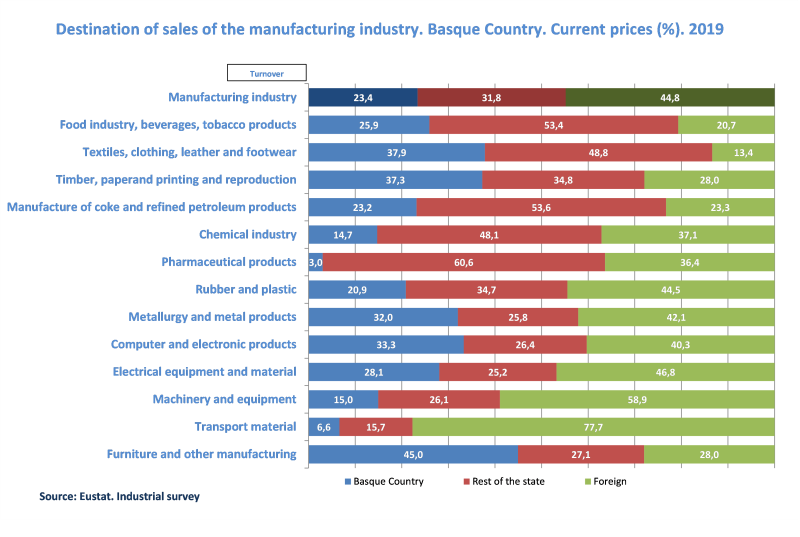
Sales to the Rest of Spain were up 0.2 percentage points on total sales compared to 2018, accounting for 31.8% of total sales in 2019. Finally, the internal market (the Basque Country) took 23.4% of the total sold, 0.5 points less than the previous year.
By sector, Transport Material, the branch with the highest percentage of exports, saw a decrease of 1.1 tenths of a percentage point in foreign sales on total sales, reaching 77.7% in 2019. Exports in the sector of Machinery & Equipment stood at 58.9% in 2019, two tenths less than that exported the previous year. On the other hand, exports in Electrical Material and Equipment, the third largest sector by volume of exports, grew by 0.4 percentage points on 2018, standing at 46.8% in 2019.
ÁLAVA
In 2019, 44% of industrial sales in Álava were of medium and high-tech products
Álava was a leader within the Basque Country in terms of the production of medium and high-tech goods, accounting for 43,6% of sales of the province’s industry as a whole, 30.3% of value added and 31.3% of people employed.
In 2019, the main indicators of industrial trends in Álava showed signs of stagnation. The number of people employed fell by 0.2% and value added dropped 0.5%. Sales, however, were up 0.2%.
19.7% of those employed were women, most of whom worked in the branches of Textile, Garments, Leather & Footwear, with 69.3%, Pharmaceutical Products (59.6%) and Electrical Material and Equipment (38.6%).
In absolute terms, sales reached a value of 14,092 million euros, barely 24 million more than in 2018, 42,909 were employed, 83 fewer than the previous year, and value added stood at 3,331.5 million euros, 16 million less than the year before.
The Metallurgy & Metal Products sector was the largest industrial employer in Álava, but Transport Material had the highest turnover
In the province, 13,451 people were employed in the Metallurgy & Metal Products sector, which was the largest as it accounted for 31.3% of total jobs in industry. Turnover in the sector was 3,017 euros, 21.4% of the province’s industry, and also came out top in terms of generating value added, with 881 million euros and 24.4% of the total.
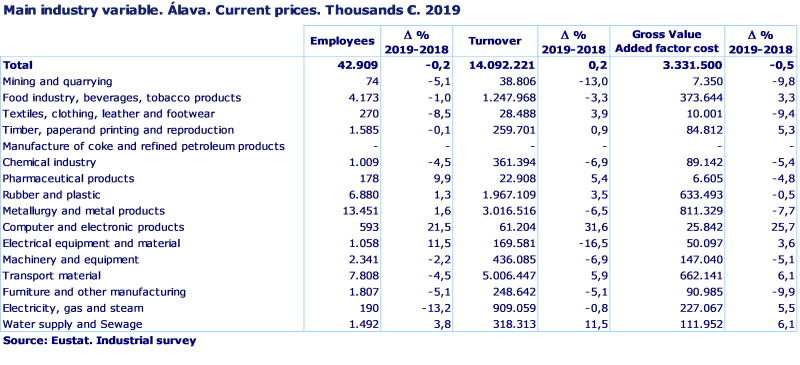
As regards turnover, however, the main sector was Transport Material, which accounted for 35.5% of turnover of the province’s industry, or one in three euros made by Álava's industrial sector. Furthermore, its sales grew by 5.9%, despite the reduction of 4.5% in the number of people employed compared to the previous year, with 7,808 people. Value added also grew by 6.1% to 662 million.
Another two sectors also stood out in this province: Rubber and Plastics, which employed 16% of the industry’s total in 2019, accounted for 14% of turnover and 19% of value added, with increases of 1.3% and 3.5% in employment and sales and a drop 0.5% in value added. The Food, Beverages & Tobacco sector came second, employing 4,173 people, with turnover of 1,248 million euros and generating 374 million euros in gross value added. In relative terms, this sector accounted for 9.7% of all jobs, 8.9% of the turnover and 11.2% of the gross value added in the province's industry.
Industry is clearly specialised in Álava’s case, as 75.3% of jobs and 79.7% of sales were in the four sectors mentioned.
In terms of turnover, the Manufacture of Computer and Electronic Products saw the largest growth at 31.6%, with a 21.5% increase in employment and 25.7% in value added.
Álava, with 55%, was the largest exporter in relative terms
Manufacturing industry companies in Álava showed a clear openness towards foreign markets. Foreign exports accounted for 55.2% of sales in the Manufacturing Industry in 2019. Out of the total sales, 39% was to the European Union while 16.2% was to the Rest of the World. For its part, sales to the Rest of Spain accounted for 26.5%, and 18.3% of the total sold went to the internal Basque Country market.
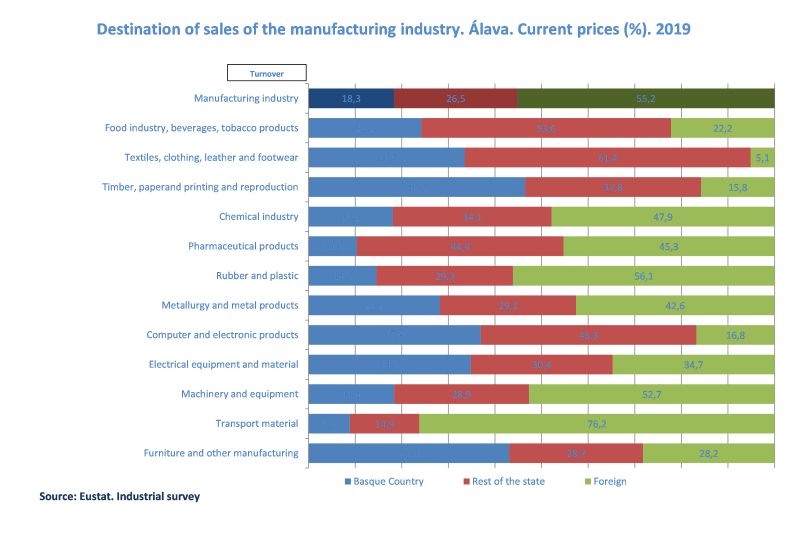
Without a doubt, the most dynamic sector in this regard was Transport Material, since 76.2% of its sales went to the foreign market. Those with figures above 50% included Rubber and Plastics, with 56.1%, and Machinery & Equipment, with 52.7%.
BIZKAIA
20.7% of people employed in Basque industry were women
In Bizkaia, medium and high-tech goods accounted for only 18.5% of total sales, although this percentage increased to 25.7% of value added and 24.3% of jobs.
Basque industry contracted both in terms of net sales and gross value added in 2019. Sales fell by 3.5% and value added dropped 1.3%. Despite this, employment increased slightly, by 0.2%.
20.7% of the total number of people employed were women, 2.3 percentage points more than 10 years previously. The branches with the highest number of female employees were Textile, Garments, Leather & Footwear, with 71.7%, Pharmaceutical Products (56.2%) and Food, Beverages & Tobacco (44.1%).
In absolute terms, sales reached a value of 26,212 million euros, 958 million less than in 2018; 81,416 were employed, 166 more than the previous year; and value added stood at 5,898.5 million euros, 77 million less than the year before.
Also in Bizkaia, the Metallurgy & Metal Products sector was, conversely, the sector with the greatest weight, accounting for 36.6% of industry and employing 29,801 people. Turnover in the sector was 6,646 euros, 25.4% of industry, and generated value added of 1,746 million euros, 29.6% of the total.
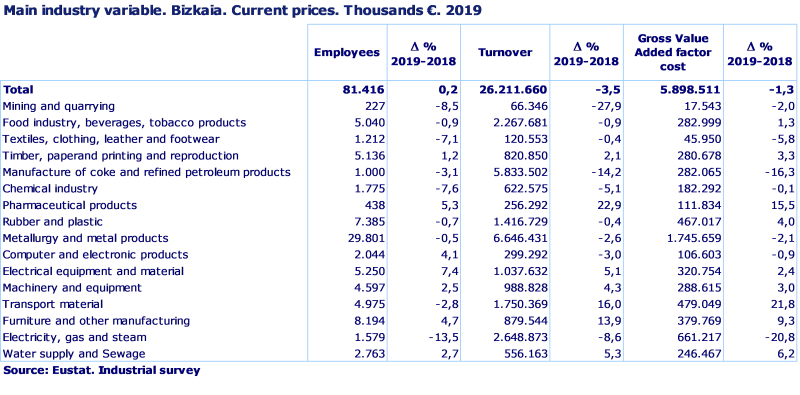
Bizkaia had the broadest diversity of sectors. As a result, none of the other sectors had a share of more than 10% of any of the main indicators, meaning that their weight varied considerably depending on the indicator used.
The 5,833.5 million euros’ turnover of Coke Plants & Oil Refining accounted for 22.3% of the province’s total, but only 1.2% of jobs (1,000 people) and 4.8% of gross value added. Compared to 2018, employment in this sector dropped by 3.1%, sales were down 14.2% and value added fell by up to 16.3%.
The Electricity, Gas & Steam was also significant in Bizkaia owing to its number of sales. It accounted for 10.1% of turnover and 11.2% of value added, despite the negative performance of 8.6% in sales and 20.8% in value added. Similarly, employment fell by 13.5%, limiting its share to 1.9% of total employment in the province's industry.
On the other hand, Furniture & Other Manufacturing accounted for 10.1% of employment, 8,194 people, but its turnover, 2,649 million, made up only 3.4% of the total and the 380 million euros in gross value added was equivalent to only 6.4%. In the last year considered, the number of people employed in this sector increased by 4.7%, sales were up by 13.9% and gross value added rose 9.3%.
Rubber and Plastics was also a key sector in Bizkaia. It provided jobs to 7,385 people, and generated 1,417 million euros in turnover and 467 million euros in gross value added. In relative terms, this sector accounted for 9.1% of total jobs, 5.4% of total turnover and 7.9% of gross value added of the province's industry.
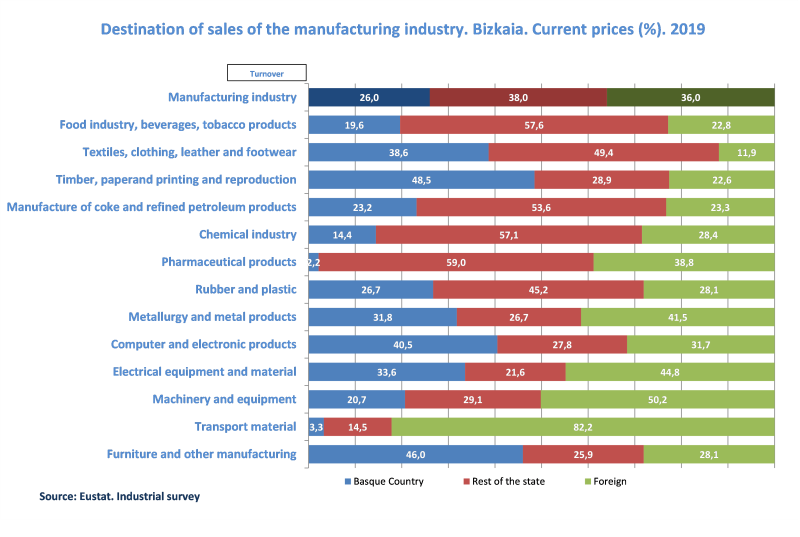
Companies in the Basque manufacturing industry made 36% of their net sales to foreign markets, less than the other two provinces in the Autonomous Community. Out of the total sales, 23.3% was to the European Union and 12.7% to the Rest of the World. Sales to the Rest of Spain, the most common destination, accounted for 38.0% of total sales in 2019 and the internal market 26.0% of the total sold.
As was the case in Álava, the most dynamic sector in terms of exports was Transport Material, since 82.2% of its sales went to the foreign market. Machinery & Equipment exported slightly more than 50% and, in third place, at just under the 50% mark, came Electrical Material & Equipment with 44.8%.
GIPUZKOA
In Gipuzkoa, medium and high-tech products accounted for around 40% of total turnover, value added and employment
In Gipuzkoa medium and high-tech goods accounted for 40.8% of total sales, 39.4% of value added and 40.1% of jobs.
Gipuzkoa was the only province in the Community in which the three main indicators showed an upward trend in 2019. Sales were up by 2.8% and gross value added, in particular, increased by 5.3%. To a lesser extent, employment experienced an upward trend, increasing by 0.7%.
The percentage of women in industry in Gipuzkoa was also the highest of the three provinces, reaching 21% in 2019. The most female-dominated sectors were again Textile, Garments, Leather & Footwear, which was 70.0% women, Pharmaceutical Products (60.7%) and Food, Beverages & Tobacco (42.3%).
Sales reached a total value of 19,600 million euros in 2019, exceeding that of 2018 by 529 million, and value added stood at 6,065 million euros, 304.5 million more than in the year before. In turn, the number of people employed in industry in Gipuzkoa increased by 572 to a total of 82,679, exceeding industrial employment in Bizkaia for the second consecutive year.
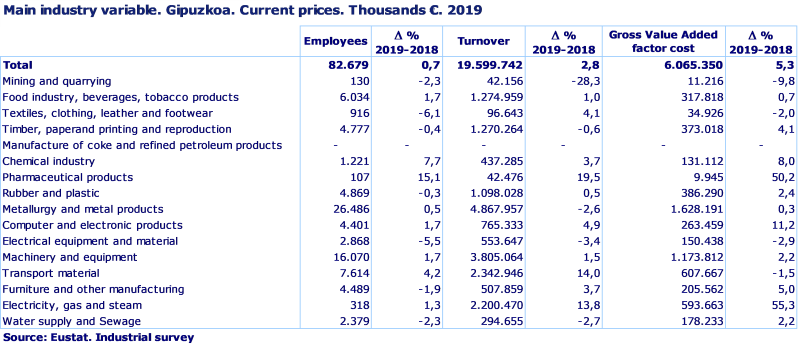
As in the other two provinces, the dominant sector in Gipuzkoa was Metallurgy & Metal Products, which employed 26,486 people, 32% of all people employed in industry in this province. Turnover in the sector was 4,868 euros, 24.8%, and it generated value added of 1,628 million euros, 26.8% of the total. Furthermore, compared to 2018, employment and value added were up by 0.5% and 0.3%, respectively, but sales were down 2.6%.
The Machinery & Equipment sector was of particular important in this province and it was the second largest in terms of employment, sales and value added. It accounted for 19.4% of employment in industry, with 16,070 people, and had a turnover higher than 3,805 million euros, also 19.4% of the total. Over the last year, employment grew by 1.7% and net sales were up 1.5%. In 2019, its gross value added reached 1,174 million euros, accounting, once again, for 19.4% of the total gross value added after increasing by 2.2% in 2019.
Transport Material came in third place. This sector provided jobs to 7,614 people, its net sales rose to 2,343 million euros and it generated 608 million euros in value added. In relation to industry in Gipuzkoa, this sector accounted for 9.2% of total employment, 12% of total sales and 10% of total gross value added. In 2019, this last indicator was down 1.5%, although employment rose by 4.2% and sales were up 14%.
As a result, the three sectors mentioned contributed 60.7% of jobs, 56.2% of sales and 56.2% – the same percentage – of gross value added, highlighting the industry’s significant presence in Gipuzkoa.
The Electricity, Gas & Steam was also significant owing to its number of sales and value added. It accounted for 11.2% of turnover and 9.8% of value added, despite only employing 0.4% of industry staff. This sector saw upward trends in sales, up 13.8% on 2018; value added, up 55.3%; and, to a lesser extent, in the number of jobs, up 1.3%.
Half of industry sales in Gipuzkoa went to foreign markets in 2019
After Álava, Gipuzkoa was the second biggest exporter in relative terms and the largest in absolute terms. 49% of its total sales were to foreign markets. Out of the total sales, 29.3% was to the European Union and 19.7% to the Rest of the World. Sales to the Rest of Spain accounted for 27.3% of total sales in 2019. Lastly, 23.7% of total sales went to the internal market of the Basque Country.
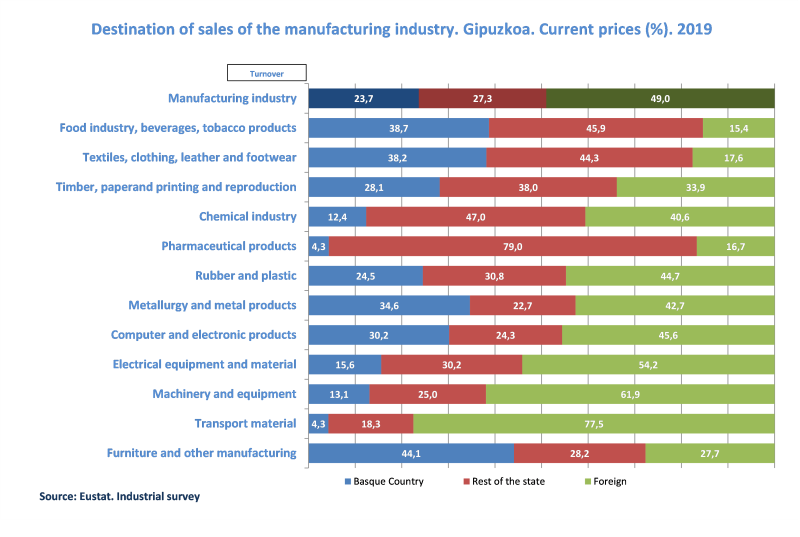
As was the case in Álava and Bizkaia, the strongest sector in terms of exports was Transport Material, since 77.5% of its sales went to the foreign market. It was very closely followed by Machinery & Equipment, a sector in which almost 62% of sales went abroad and, in third place and above the 50% mark, came Electrical Material & Equipment, with 54.2%.
For further information:
Eustat - Euskal Estatistika Erakundea / Basque Statistics Institute
C/ Donostia-San Sebastián, 1 01010 Vitoria-Gasteiz
Press Service: servicioprensa@eustat.es Tel: 945 01 75 62