Press release 19/02/2021
The Covid-19 crisis seriously affected foreign trade, but the positive trade balance was maintained in the Basque Country in 2020
In December, exports were down 10% and imports fell by 14.3%
In 2020, a year marked by the Covid-19 health crisis, exports of goods from the Basque Country reached 20,864.5 million euros, a drop of 17.8% compared to the volume of exports in 2019. Imports stood at 15,704.9 million euros, 21.9% down on the previous year, according to Eustat data.
This is the second worst record in the historical series available, surpassed only in 2009, when exports fell by 26.3% and imports were down 38.9%. In fact, the series shows negative growth only on seven occasions, with drops that do not in any case exceed 3%, except on the two dates mentioned.
In 2020, the decline in trade flows affected both exports and imports, which has kept the trade balance positive. The surplus for 2020 was in the order of 5,159.6 million, down 115.9 million, or 2.2%, on 2019.
Analysing the “non-energy” trade balance reveals that this was equally positive and reached 7,106.4 million, which represents, if we compare it with the previous year (8,661.4 million), a decrease of 18.0%. The balance for “energy products”, which was negative by 3,385.9 million in 2019, fell to -1,946.8 million, 42.5% less than the trade deficit for energy.
The Covid-19 pandemic has had an exceptional impact on import and export activity since March 2020. In that month, exports of goods fell by 21.8% and imports were down 14.9%. However, it was in April and May when its effects on foreign trade were more intensely felt. In April, exports were less than half (-53.2%) of those recorded the previous year, 2019, and in May the value of exports dropped by 36%.
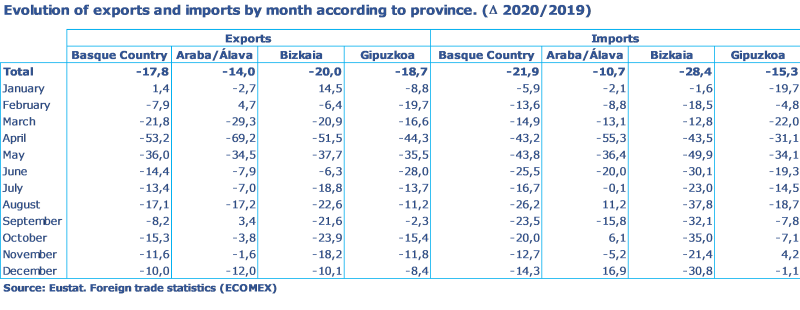
In the months immediately following, the negative trend in exports evened out significantly until September, when they reached a low of -8.2% since the start of the Covid-19 pandemic. The last quarter started with a negative spike in October, which brought the year-on-year rate, -15.3%, to mid-year levels. This quickly eased, until December closed at -10%.
Similarly, imports saw their lowest year-on-year rates in April and May, at -43.2% and -43.8%, respectively, and their monthly trends ran parallel to that of exports, albeit at higher negative values of around 20% or more, until the last two months of the year, when they fell to -12.7% in November and -14.3% in December.
In 2020, foreign trade was least affected in Álava
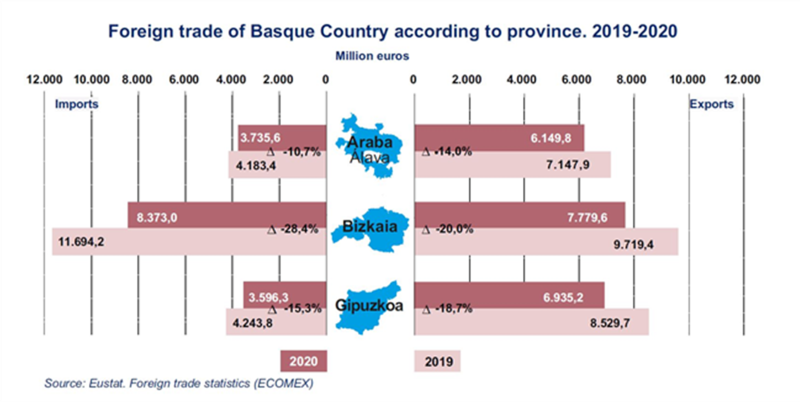
In 2020 overall, all three provinces experienced a considerable decline in foreign trade.
In this context of widespread downturns, the impact on Álava was comparatively lower. Its exports were down 14% and imports dropped 10.7%, following the slump in its exports in March (-29.3%) and especially in April (-69.2%), when it was, conversely, the worst affected province.
In 2020, Gipuzkoa, the only province that saw an increase in exports (11.6%) and imports (3.6%) at the close of 2019, lost 18.7% of exports and 15.3% of imports in 2020.
Lastly, Bizkaia, like Álava, experienced two consecutive years of declining imports and exports, with higher values for both: exports were down by 20.0% and imports by 28.4%. In its case, the highest values lasted throughout the second half of the year, whereas in Gipuzkoa and especially Araba/Álava, the effects of the crisis were somewhat alleviated.
Nevertheless, it should be noted that considering only non-energy exports, instead of 20%, the drop in exports from Bizkaia would have been limited to 11.3%, given the importance of exports of this kind in the province.
Within exports, the customs duty group with the greatest weight in the Basque Country is Passenger cars with fewer than 10 seats, which registered a year-on-year decrease of 23.3% in 2020
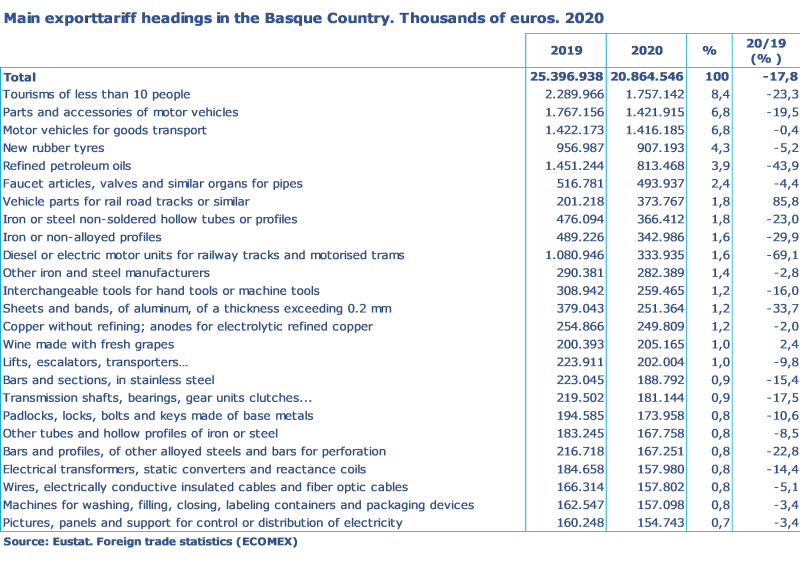
In 2020, the 25 main export duty groups accounted for more than half of the value of exports in this region (53.6%).
The two most important Basque export groups during 2020 were Passenger cars with fewer than 10 seats and Vehicle parts and accessories.
The former, with 1,757.1 million euros, accounted for 8.4% of total exports, after having dropped by 23.3% last year. For the latter, the fall was 19.5%, and the 1,421.9 million in exports accounted for 6.8% of the total. Goods Transport Vehicles accounted for the same percentage, and took third place in the ranking with 1,416.2 million euros. Exports in this group were down by only 0.4% on 2019.
On the list of most relevant groups, only two grew in year-on-year terms. These were Railway or Tramway Vehicle Parts, with exports worth 373.8 million euros, up 85.8%, and Wine of fresh grapes, up 2.4% at 205.2 million euros in 2020.
Conversely, there were significant decreases, both in absolute and relative terms, in Refined Petroleum Oils and in Diesel and Electric Motor Units for Railway Tracks and Motorised Trams. The former reached an export value of 813.5 million euros, which represented 3.9% of the total, after registering a year-on-year decrease of 43.9% for the period in question. The second fell by 69.1%, with exports down by more than seven hundred million euros in one year, at only 333.9 million euros.
Exports to the European Union (EU-27) were down 12.6% and imports were down 13.4%
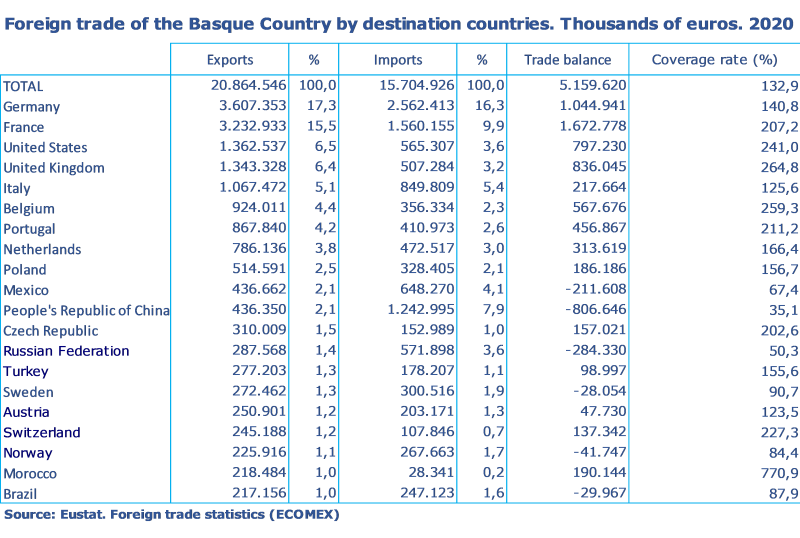
62.9% of our total exports, 13,124.9 million euros, were destined for the European Union, a 12.6% decrease compared to the previous year. For imports, the drop was 13.4% to a value of 8,605.9 million. Thus, the trade balance compared to the European Union was positive (4,519 million) but 561.7 million euros down on the previous year.
The United States, the United Kingdom and Italy made up the five countries to which the Basque Country sent half of all the goods it exported.
After Germany and France, China, Italy and Mexico were the other major sources of imports, with these five countries accounting for 43.7% of imports in 2020.
DECEMBER 2020
In December 2020, the performance of foreign trade in goods continued to be affected by the protracted crisis caused by the pandemic.
Exports of goods from the Basque Country reached 1,638.3 million euros, a decrease of 10% compared to December 2019. Imports, on the other hand, at 1,292.8 million, fell by 14.3% in year-on-year terms.
As a result, the Basque trade balance for this month was positive, at 345.5 million, and 34.6 million more than the balance recorded in December 2019.
As in previous months, the performance of energy products contributed to these year-on-year decreases to a large extent. Energy exports fell by 34.1%, while non-energy exports were down 7.9%.
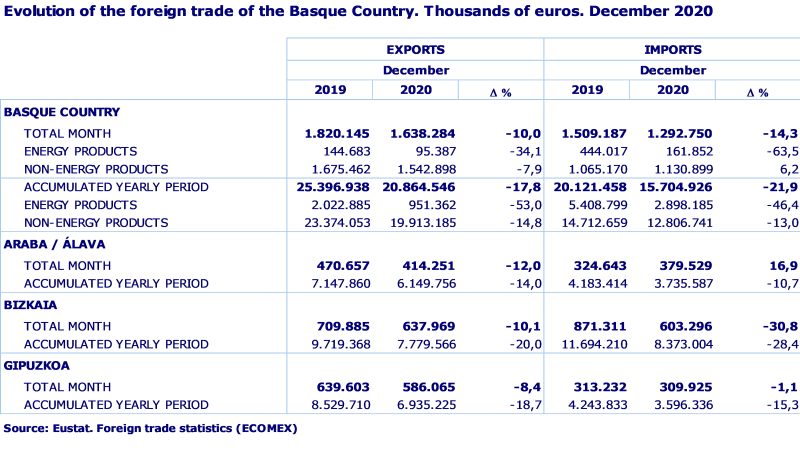
The direct nature of the relationship between imports and exports of energy products explains why energy imports were also down by 63.5% (282.2 million euros). Non-energy imports were up 6.2%.
However, overall, imports of goods to the Basque Country, with a total of 1,292.8 million euros, fell by 14.3% compared to March 2019.
At the provincial level, exports from Gipuzkoa declined by 8.4%, the biggest drop of all three provinces. The groups Vehicle parts and accessories (-20.5%), Iron or Non-Alloy Steel Sections (-55.6%) and, above all, Vehicles for transporting 10 or more people, including the driver (-78.4%) had the most significant impact on the final figure of 53.5 million euros less exported from Gipuzkoa in 2020.
The decline in exports in Bizkaia, whose value dropped by 10.1% in December 2020 compared to the same month of 2019, was mostly concentrated in Refined Petroleum Oils. It was the main export in Bizkaia, and it exported 48.9 million euros less than the same month of the previous year (-39.9%). Among the most important non-energy products, some positive trends were observed: Vehicle parts and accessories, Unrefined copper and copper anodes for electrolytic refining and New Rubber Tyres were up 12.1%, 301.5% and 27.9% more than the same month of the previous year.
Lastly, Álava was the worst performer in terms of exports in December 2020, with a 12.0% drop, essentially caused by the downturn in the Passenger cars with fewer than 10 seats and Seamless tubes and hollow profiles made of iron or steel export duty groups, of 31.3% and 47.5%, respectively.
It is also worth noting the positive performance in this province of one of its main export duty groups, New Rubber Tyres, which was up 10.7% in December 2020 compared to the same month of 2019.
For further information:
Eustat - Euskal Estatistika Erakundea / Basque Statistics Institute
C/ Donostia-San Sebastián, 1 01010 Vitoria-Gasteiz
Press Service: servicioprensa@eustat.es Tel: 945 01 75 62