Press Release 18/03/2021
SCHOOL ACTIVITY STATISTICS. 2020
In the 2019-20 academic year, Vocational Training attracted almost twice as many men as women in the Basque Country
The Department of Education awarded grants and financial aid for studying to more than 120,000 students, or one in three
In the 2019-20 academic year, almost twice as many men as women took Vocational Training at any of its three categories (Basic, Intermediate and Advanced) in the Basque Country, according to data prepared by Eustat. The pattern was repeated across all three categories, with ratios varying between 2.6 men for every woman in Basic and 1.9 in Advanced Vocational Training.
There were 419,875 students enrolled in non-university education in the Basque Country over the 2019-20 academic year, an increase of 0.3% compared to the previous year. 93% of enrolments were in General Education and the remaining 7% were in Specialised Education. There was an increase of 0.4% in General Education and a decrease of 0.2% in Specialised Education compared to the 2018-19 academic year. However, it is worth noting the rise in the number of students in Upper Secondary and Professional Training of 3.2% and 2.6%, respectively. Furthermore, there was a significant increase of 10% in Adult Education enrolments, reversing the downward trend over the last four academic years.
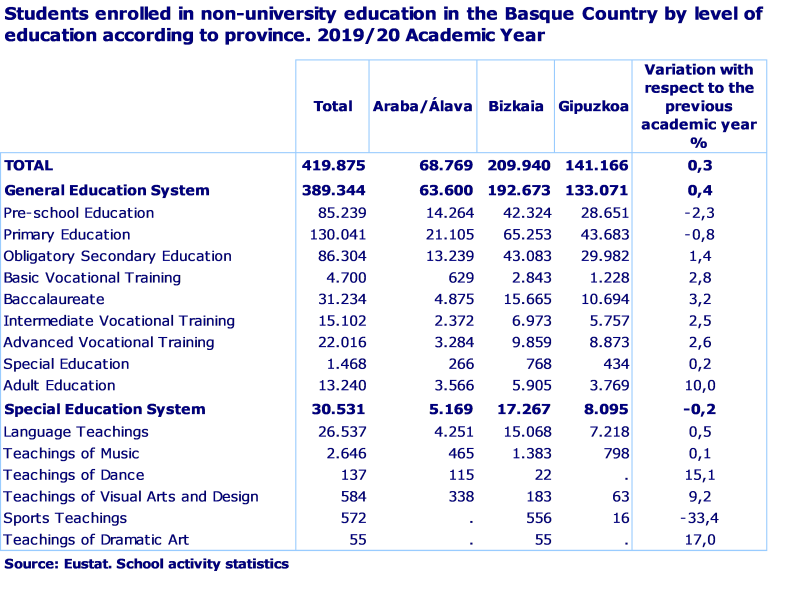
The provincial distribution of students in Specialised Education was constrained by the available supply. Although there was a plentiful supply in language and music teaching and the distribution was similar to that of General Education, for other studies students were concentrated in one of the provinces.
As regards the ownership, enrolment in General Education was slightly higher than in public centres, with 53% of students compared to 47% at private centres which, in absolute terms, was equivalent to nearly 20,000 more students in public education.
The D model was consolidated in compulsory education
The growing trend in the linguistic D model was maintained in General Education. In the 2019-20 academic year, 68% of students chose Basque as the language of instruction. However, differences arose between the levels of education: in compulsory education – infants, primary and compulsory secondary – enrolment on the D model was above 70%. On the other hand, less than a quarter of Vocational Training students received teaching according to that model.
Among the under-20s, Vocational Training as an alternative increased with age
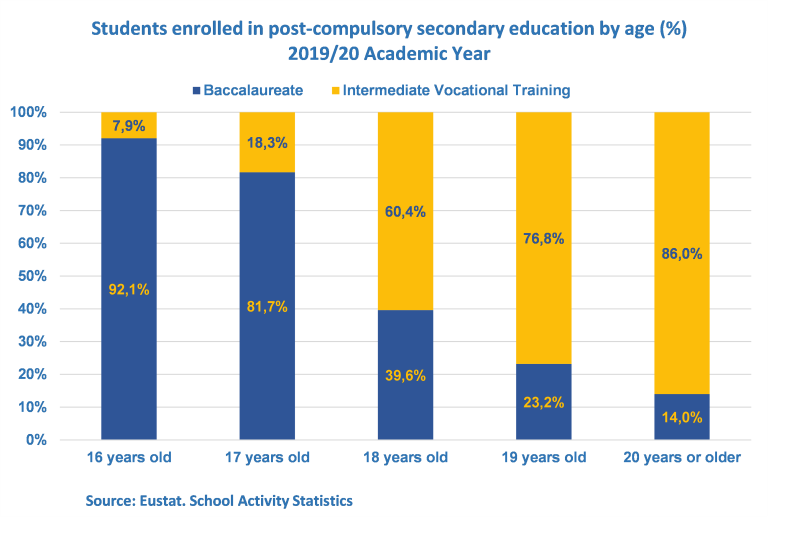
Among the under-20s studying post-compulsory secondary education in the 2019-20 academic year, 76% were enrolled in upper secondary education and the remaining 24% opted for intermediate level vocational training.
A slope was observed in the proportion of enrolments at these levels as a function of age: although a minority of students under 16 took intermediate vocational training, this option was more popular as age increased.
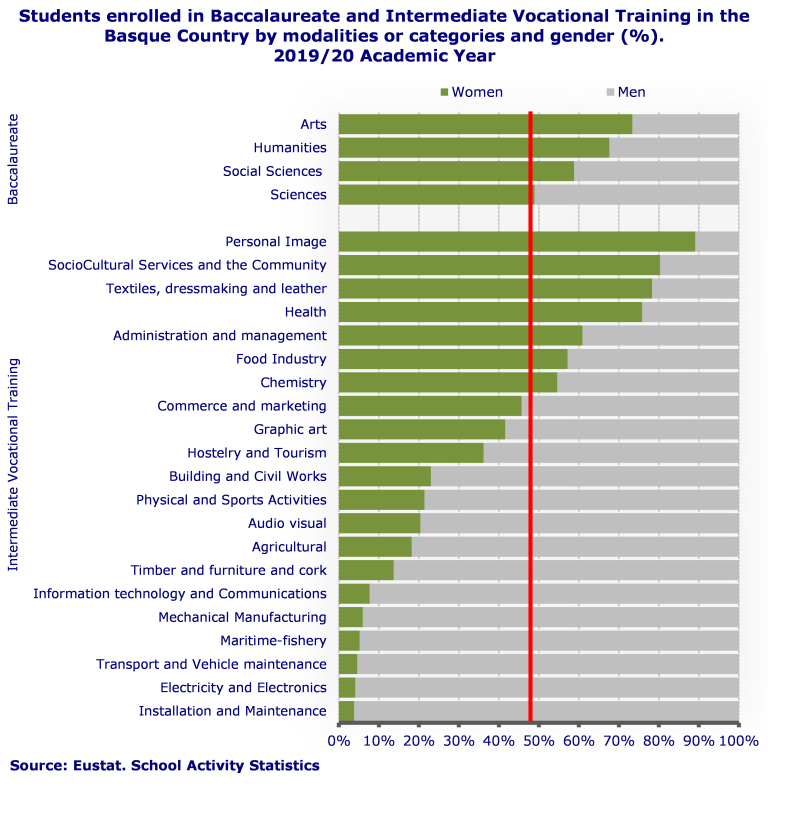
Distribution by gender at these levels was uneven. In Upper Secondary, women were the majority, at 55%, whereas in Intermediate Vocational Training there were approximately twice as many men as women. In addition, gender differences were found when choosing the category of Upper Secondary Education. Except for the scientific discipline, which was at gender parity, there was a prevalence of females, especially in Arts, in which three quarters of enrolled students were female.
Similarly, most of the professional families into which Intermediate Level Vocational Training is classified showed an unbalanced distribution of students in terms of gender. Families related to personal image and care of persons were made up of more than 75% women. On the other hand, there were six entirely male-dominated families, where the presence of women was almost inconsequential as they accounted for less than 10% of all students: Information & Communications, Mechanical Manufacturing, Maritime & Fishing, Transport & Vehicle Maintenance, Electricity & Electronics, and Installation & Maintenance.
Within non-university higher education, enrolment in Advanced Vocational Training increased by 2.6% compared to the 2018-19 academic year. The proportion of women, both in total for the level and in the various vocational families, followed the same pattern as in Intermediate Level Vocational Training.
A third of students received grants and financial aid for studying
In the 2019-20 academic year, the amount of grants and aid awarded by the Public Administration of the Basque Country in General Education increased to 51 million euros, and benefited a total of 120,489 students, 32% of the total.
Students with special education needs had the highest proportion of students with grants, 59%, followed by Basic Vocational Training, Primary Education and Compulsory Secondary Education, where two out of every five students received aid for studying.
Compulsory education took up 83% of the economic budget earmarked for this purpose. The level of education that received the most was Primary Education, which was allocated 22.3 million euros, 43% of the total. Infant and Compulsory Secondary Education received around 10 million euros apiece.
Each student with a grant received an average of €426, although this amount varied depending on the course studied, from €258 in Basic Vocational Training to €631 in Infant Education.
Public centres took approximately two thirds of the budget earmarked for grants and financial aid. Grants to students enrolled in private centres reached a total of 17.6 million euros. The proportion of students with grants was higher in public centres, with 40% compared to 24% in private centres. This gap was especially wide in Primary Education, where half of students in public centres received aid, as opposed to only a quarter of those enrolled in private centres. The ratio was reversed in Vocational Training, where the proportion of students with grants was higher in private centres, although there was less of a difference between public and private.
Half of students received school meals
Half of students enrolled in General Education ate at the school canteen. In Bizkaia, six out of ten students used this service, whereas in Gipuzkoa and Álava the proportion dropped to 43% and 34%, respectively. No major difference was observed between public and private centres.
53,966 of students, 14% of the total, used school transport. Once again, there was a higher demand for this service in Bizkaia (17%) than in Gipuzkoa (12%) and Álava (10%). This time, there were differences depending on the type of centre: the use of transport was 7 percentage points higher among students at private compared to public centres, i.e. 18% as opposed to 11%.
For further information:
Euskal Estatistika-Erakundea / Basque Statistics Institute
C/ Donostia-San Sebastián, 1 01010 Vitoria-Gasteiz
Press service:
servicioprensa@eustat.es Tel: 945 01 75 62