Press release 05/02/2021
RETAIL TRADE INDEX (ICIm). IV/2020
Retail trade sales in the Basque Country fell by 4.9% overall in 2020
In the fourth quarter of 2020, sales dropped by 1.7% compared to the same quarter of 2019
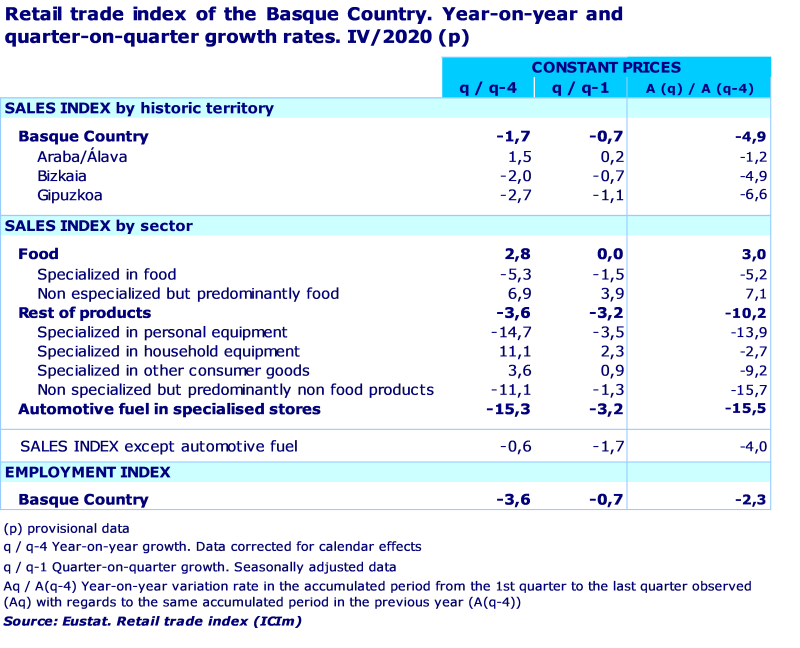
The 2020 balance for retail trade saw an overall drop of 4.9% compared to the previous year, in homogeneous terms of the working calendar and at constant prices, according to Eustat data. If service stations are excluded, accumulated sales for the year fell by 4.0%.
In 2020, a year marked by the restrictions adopted to combat the crisis caused by COVID-19, food sales were up 3.0%, while trade in other products declined by 10.2%. Furthermore, sales of automotive fuel dropped by 15.5%.
Within retail food trade, specialised trade fell throughout 2020 by 5.2%, while non-specialised retail trade predominantly in food increased by 7.1% on 2019.
In retail trade of other products, decreases of varying intensity were recorded in 2020. While specialised trade in household goods fell by 2.7% and that in other consumer goods was down 9.2%, specialised trade in personal goods and non-specialised trade with other products predominating declined by 13.9% and 15.7%, respectively.
Sales of automotive fuel dropped by 15.5% in 2020 overall, at constant prices and once corrected for calendar effects.
The decline in overall sales at constant prices in 2020 varied across the provinces. In Gipuzkoa, there was a fall of 6.6% and in Bizkaia, 4.9%, while in Álava the overall drop was 1.2%.
Lastly, the reduction in employment in the retail trade sector in 2020 compared to the average for the previous year stood at 2.3%.
FOURTH QUARTER 2020
Looking at the data from the fourth quarter of 2020 alone, the retail trade sector in the Basque Country saw a 1.7% fall in sales at constant prices in the fourth quarter of 2020, compared to the same period of the previous year. Sales in the sector, not including service stations, were down by 0.6% in year-on-year terms.
Compared to the previous quarter, the fourth quarter of 2020 on the third quarter of 2020, the sales index showed a negative quarter-on-quarter variation of 0.7%, also at constant prices and once seasonal effects had been eliminated.
By sector, food was the only sector where sales increased in year-on-year terms, by 2.8% on the fourth quarter of 2019, once the price and calendar effects had been discounted. Retail trade of other products and the sale of automotive fuel, on the other hand, decreased by 3.6% and 15.3%, respectively.
Within retail food trade, specialised trade fell in year-on-year terms by 5.3% in the last quarter of the year, while non-specialised retail trade in food increased by 6.9%.
Within retail trade of other products, while specialised trade in household goods rose by 11.1% and that in other consumer goods was up 3.6%, the performance of specialised trade in personal goods and non-specialised trade with other products predominating was negative, with decreases of 14.7% and 11.1%, respectively.
In the last quarter of the year, trends in overall retail trade sales varied by province in year-on-year terms. While in Álava, sales rose by 1.5% in real terms and once corrected for calendar effects, in Gipuzkoa and Bizkaia they fell by 2.7% and 2.0%, respectively.
The number of people employed in the retail trade sector in the Basque Country overall in the fourth quarter of 2020 was down 3.6% on the fourth quarter of 2019. Compared to the third quarter of 2020 and once corrected for seasonal effects, the drop stood at 0.7%.
NOTE:
Included as persons employed considered in this and other short-term indices, are those covered by an ERTE (Temporary Labour Force Adjustment Plan), following the definition of persons employed indicated by the Statistical Office of the European Union (Eurostat) in its manual Methodology of Short Term Business Statistics.
The models used in the correction of calendar effects and deseasonalisation of the series include the effect of COVID-19 on the variables studied, following the recommendations of the Statistical Office of the European Union (Eurostat) in its methodological note Guidance on Time Series Treatment in the context of the COVID-19 crisis.
Eustat would like to thank all the establishments that have collaborated in making this effort despite the circumstances. As a result, the index for the third quarter was calculated with 93.8% coverage of the sample – whose information was collected during January.
For further information:
Eustat - Euskal Estatistika Erakundea / Basque Statistics Institute
C/ Donostia-San Sebastián, 1 01010 Vitoria-Gasteiz
Press Service: servicioprensa@eustat.es Tel: 945 01 75 62