Press release 18/12/2020
Exports of non-energy products from the Basque Country fell by 7.2% in October 2020
Basque exports to the United Kingdom exceeded 1,100 million in the first ten months of 2020 and showed a positive balance of 700 million euros
According to Eustat data, in October 2020 exports of goods from the Basque Country (accounting for 2,001.3 million euros) were down 15.3% compared to the same month of the previous year.
The performance of exports for October 2020 is heavily conditioned by the performance of energy products, given that these registered a very sharp decrease of 89.3%, a percentage that exceeds that recorded in April (-81.1%), which was the highest to date, within the negative trend that started in January 2019. Exports of non-energy products fell by 7.2%.
The performance of imports was similar (1,406 million), which dropped by 20.0%, owing to the decrease both in energy products (-61.5%) and non-energy products (-4.8%).
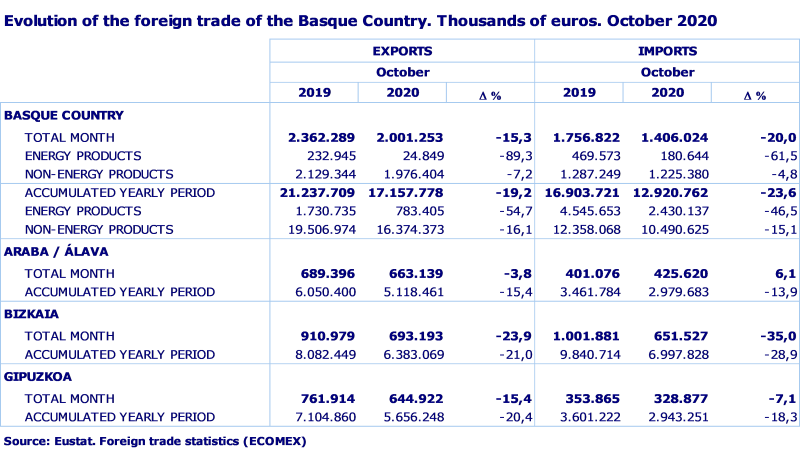
By province, Bizkaia had the worst export performance, with a 23.9% drop in exports, due to the aforementioned decrease in energy exports (-208.5 million euros, with a fall of 89.7%). This decline was mostly concentrated in products such as “Naphthalene”, “Lubricating oils”, “Bitumen”, “Unleaded petrol”, “Crude oils”, “Diesel” and “Fuel”, which reported residual exports in that month. Non-energy products fell by 1.4% in this province.
Exports from Gipuzkoa dropped by 15.4% mainly due to the decline in “Transport Material” (�19.2% and down 35.1 million) and “Electrical Material” (-22.2% with -64.8 million).
Exports from Álava fell by 3.8%, cutting short the positive trend of the previous month. This slight decrease in exports in October 2020 is (more than 2/3) due to the fall in “Metals & Manufactured” (-17.3% and down 18.7 million).
In October, five countries (Germany, France, Italy, United Kingdom and the United States) were our main customers, absorbing 53.7% (1,074.8 million) of total exports from the Basque Country. The first three belong to the EU27, which accounts for 66.1% of exports. This percentage would have been 73.0% for the former EU28.
If we consider the twelve countries that accounted for Basque exports this month, we will find that, of all of them, only three have posted positive year-on-year rates: Italy grew by 47.5%, Austria was up 19.5% and Germany, our main destination for exports, increased slightly by 0.9%. This month sales to the United States decreased by 41.1%, along with those to China (�14.2%) and Mexico (-2.7%).
Over half (61.8%) of all imports came from the EU27 and would have reached 64.0% for the erstwhile EU28. Among the largest European countries, purchases from countries such as Germany (4.7%), France (14.1%) y Poland (48.4%) have risen. However, those from Portugal (-1.7%), Italy (-12.7%) and Belgium (-19.4%) fell. For the rest of the world, imports originating in China (-13.7%) and the United States (-32.3%) were also down. Those from Mexico, on the other hand, grew (15.3%).
Products traded in October 2020
The analysis of the different areas of export activity (A86) for October 2020 revealed a collapse in Coke Plants and Oil Refining, with a fall of 86.2% compared to the same month of the previous year and with an export volume of only 24.5 million euros, a figure never before seen. The activity areas of “Iron & Steel Products” (-14.6%), “General Use Machinery” (-10.7%) and “Motor Vehicles”, with a slight decrease of 1.3%, also followed this downward trend. Conversely, there was a sharp rise in “Non-Ferrous Metals” (74.3%).
A more detailed examination reveals that, in October 2020, the ten largest customs duty groups accounted for 42.9% of exports, with a combined value of 858.7 million euros. The following groups stood out with varying increases: “Railway or Tramway Vehicle Parts” (151.0% and 33.1 million euros more than in October 2019) and “Goods Transport Vehicles“ (42.6% and 54.6 million euros more) and, in particular, “Refined copper and copper alloys, unwrought” (3,581.2% and up 50.8 million). At the other end of the scale, sharp decreases occurred in “Refined Petroleum Oils” (-90.5% and down 149.5 million euros) and in “Passenger Cars with Fewer than 10 Seats” (-22.0% and down 54.1 million euros).
This month, half of the 10 main groups are within the vehicle sector which, with a year-on-year increase of 5.4%, managed to export 34.2 million euros more than in the same month of the previous year.
The analysis of the largest areas of import activity (A86) revealed that the largest, “Manufacture of Motor Vehicles”, came in first place in terms of quantity imported, with an increase of 10.4% and 177.8 million. “Extraction & Petroleum Industries” saw a decline of 72.0%, a pattern followed by “General Use Machinery” (-13.0%) and “Iron & Steel Products” (-15.9%).
In terms of customs duty groups, the largest of these groups, “Petroleum Oils or Oils Obtained from Bituminous Minerals” (accounting for 7.5% of the total), fell by 70.1%. This trend was also observed in 10 of the 25 largest customs duty groups, notably “Petroleum gas and other hydrocarbon gases” (-84.6%). There was a notable rise in “Refined Petroleum Oils” which, with an increase of 176.4% and 58 million, was the fourth most imported product in October 2020 (third in the previous month). It seems, then, that for this product, what is not produced in the Basque Country is imported. More specifically, we can say that these mainly include “Low-sulphur diesel” and “Kerosene/jet fuel”.
BALANCE FOR THE FIRST TEN MONTHS OF 2020
Over the first ten months of 2020, the Basque Country recorded a positive balance of 4,237 million euros in terms of foreign trade in goods
During the first ten months of the year, the Basque Country’s exports fell by 19.2% compared to the same period in 2019. This translates into a decrease of 4,079.9 million euros. The total amount of exports in this period was 17,157.8 million, equivalent to a trade balance of 4,237.0 million euros, almost 97 million down on that registered in the same period of 2019. Consequently, the coverage rate stood at 132.8%, which is 7.2 percentage points higher than in 2019, despite the gross decrease in the millions of euros exported.
Over the course of this period, more than 17,100 million euros’ worth of goods were exported, led by Bizkaia with 6,383.1 million and followed by Gipuzkoa with 5,656.2 million and Álava with 5,118.5 million. Compared to the equivalent period for 2019, significant decreases were recorded by the three provinces in terms of total exports. Bizkaia headed the list with -21.0% (down 1,699.4 million euros), followed by Gipuzkoa with -20.4% (down �1,448.6 million euros) and Álava, which decreased by 15.4% (down 931.9 million euros).
The ranking for these first ten months of 2020 placed Germany as the prime recipient of goods from the Basque Country, with 17.7% (3,033.6 millions). After Germany came France (15.5% and 2,666.4 million euros), the United States (6.5%, and 1,115.0 million euros) and the United Kingdom (6.4% and 1,103.9 million euros). Between them, these four countries accounted for almost half of Basque exports for this period (46.2%).
Cumulative imports for the Basque Country as a whole during the period analysed amounted to 12,920.8 million euros. The year-on-year comparison of this figure revealed that it is almost 3,983 million euros down on the equivalent for the same period in 2019.
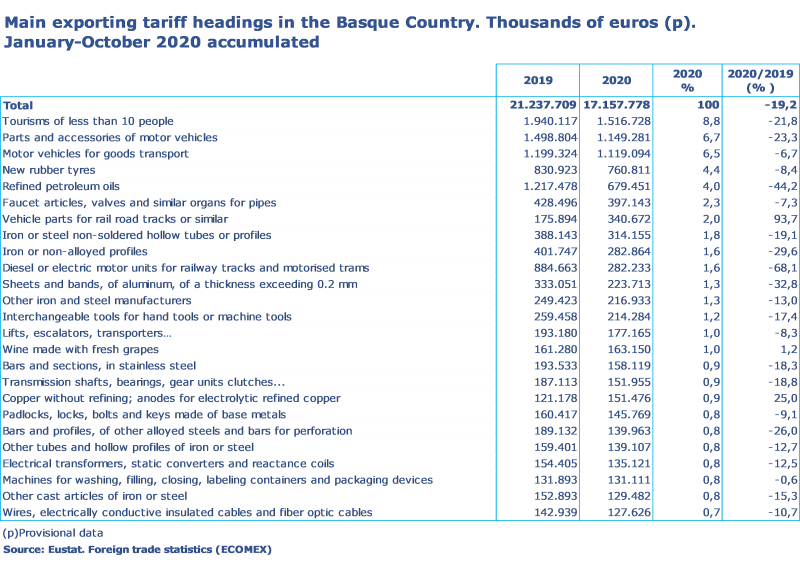
The ten most exported products (customs duty groups) during the first ten months of 2020 accounted for 39.9% of all exports, reaching a total of 6,842.4 million euros. Of these groups, only one recorded an increase: namely, Railway or Tramway Vehicle Parts, which grew by 93.7% (164.8 million euros) compared to the same period in 2019. All of the other groups recorded lower figures than the equivalent period for 2019. Most of the aforementioned decreases stood above 100 million euros, with four of them standing out with downturns in excess of 349 million; three are connected to groups in the vehicle sector. “Passenger Cars with Fewer than 10 Seats” fell by 21.8% (down 423.4 million euros), “Vehicle Parts and Accessories” fell by 23.3% (down 349.5 million euros) and “Diesel and Electric Motor Units for Railway Tracks and Motorised Trams” fell by 68.1% (down 602.4 million euros). A considerable downturn (-44.2%, down 538.0 million euros) was also registered in “Refined Petroleum Oils”.

If we broaden the focus of our analysis to the 25 main products (53.9% of the total, with 9,247.4 million euros in exports), we see that only another two, in addition to the one mentioned above, saw increases on 2019, namely “Wine made with fresh grapes” (1.2% and up 1.9 million) and “Unrefined copper and copper anodes for electrolytic refining” (25.0% and up 30.3 million).
Cumulative imports for the Basque Country as a whole during this time period amounted to 12,920.8 million euros. Comparing this figure in year-on-year terms, we see that it is almost 3,983 million euros down on the equivalent for the same period in 2019. This decrease (-23.6%) is largely due to the fact that the province of Bizkaia (with accumulated imports of 6,997.8 million) registered a downturn of 28.9%, hence exports were down by 2,842.9 million on the same period of the previous year. Imports also decreased in Gipuzkoa (-18.3%, down by 658.0 million euros) and Álava (-13.9%, down by 482.1 million euros), with the value of imports in these two provinces standing at 2,943.3 and 2,979.7 million euros, respectively.
Imports of Energy Products fell by 46.5% and those of Non-energy Products were down 15.1%.
Foreign trade in goods in the Basque Country during 2020 so far had a positive balance of 4,237.0 million euros. Although this is almost 97 million down on that registered during the same period of the previous year, it enables a positive coverage rate to be maintained, passing from 125.6 % to 132.8%.
FOREIGN TRADE WITH THE UNITED KINGDOM
Foreign trade in goods from the Basque Country with the United Kingdom had a positive balance of 701.3 million euros during the first ten months of 2020
For the first ten months of 2020 as a whole, exports to the United Kingdom continued to be significant (1,103.9 million), representing 6.4% of the total, a figure very close to the average of the last 28 years (7.0%). This percentage takes it to fourth place in the country ranking, which is topped by Germany (17.7%), France (15.5%) and the United States (6.5%). The United Kingdom has always occupied one of the top positions in the export ranking: third, fourth or fifth place.
In this same period, imports from the United Kingdom (402.6 million) accounted for 3.1% of the total, a percentage that it is below the historical series average, which began in 1990 and stands at 8.5%, with periods (1994 to 2003) in which it has been between 10.6% and 12.2%. Currently, the weight of British exports places the United Kingdom in ninth place in the import ranking, during the period considered, behind countries such as Germany (16.0%), France (9.8%), China (8.0%), Italia (5.0%), México (4.2%) and Russia (4.0%), Ireland (4.0%) and the United States (4.0%). In 1994 and 1995 the United Kingdom did in fact occupy second place. As a consequence of this double flow, export-import, there was a negative trade balance from 1990 to 2004, when it became positive. This pattern has been maintained up to the present, with the exception of 2014 and 2015. In 2020 so far, the trade balance of goods generated a surplus of 701.3 million euros, which places the coverage rate (if it is greater than 100 we export more than we import) at 274.2%, above countries such as Germany (147.1%), France (211.5%) or the United States (226.6%).
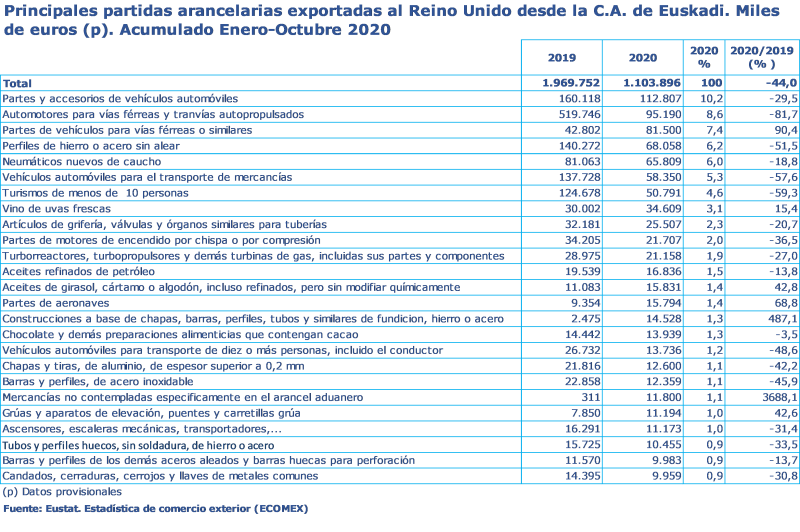
If we analyse the products that we sell to the United Kingdom, we should point out, for exports in the first ten months of 2020, that the main product (4-digit customs duty group) exported was “Vehicle Parts and Accessories” (112.8 million) with 10.2% of the total, followed, in order, by “Diesel and Electric Motor Units for Railway Tracks and Motorised Trams” (95.2 million and 8.6%), “Railway or Tramway Vehicle Parts” (81.5 million and 7.4%), “Iron or Non-Alloy Steel Sections” (68.1 million and 6.2%), “New Rubber Tyres” (65.8 million and 6.0%), “Goods Transport Vehicles” (58.4 million and 5.3%) and “Passenger Cars with Fewer than 10 Seats” (50.8 million and 4.6%). As we can see, seven of the eight first customs duty groups were related to vehicles, which had two other products among the top 25, including “Aircraft Parts” (15.8 million and 1.4%) and “Vehicles for transporting 10 or more people, including the driver” (13.7 million and 1.2%). This group accounted for 45.7% of the total exported between January and October 2020, with 504.5 million. Throughout 2019, a total of 1,338.3 million, 57.6% of the total, were exported in this group. Other noteworthy customs duty groups/sections among the main exports include “Base Metals & Manufactured” and “Machinery and Mechanical Appliances”.
The main products imported from the United Kingdom during the period considered were, by order of significance: “Petroleum oils or oils obtained from bituminous minerals” (88.7 million and 24.3% of the total), “Remelting scrap ingots of iron or steel” (22.3 million and 6.1%), “Flat, hot-rolled iron or non-alloy steel products of a width exceeding 599mm” (18.2 million and 5.0%), “Fresh or Refrigerated Fish” (15.0 million and 4.1%), “Railway or Tramway Vehicle Parts” (13.8 million and 3.8%) and “Refined Petroleum Oils” (13.1 million and 3.6%). These products have also been the most important over recent years (2000 to 2018), alternating in the top positions, with the exception of 2011, 2012 and 2013, when there were no imports of petroleum oils. Attention should also be drawn to another two products that, albeit with a more irregular trajectory and since 2004, have always been in the top ten: “Turbo-reactors, turbo-propellers and other gas turbines, and their parts and components” and “Stainless steel in ingots or other primary forms”. To conclude the analysis of imports, we can say that ten products account for 58% of imports, that the classification of “Mineral fuels, oils and products of their distillation” comprised a quarter of total imports in the period in question (102.4 million and 25.4%) and that, together with “Iron and Steel” (78.1 million and 19.4%), they set the trend for imports to the Basque Country from the United Kingdom.
For further information:
Eustat - Euskal Estatistika Erakundea / Basque Statistics Institute
C/ Donostia-San Sebastián, 1 01010 Vitoria-Gasteiz
Press Service: servicioprensa@eustat.es Tel: 945 01 75 62