Press Release 30/11/2020
ENVIRONMENTAL ACCOUNTS. ENVIRONMENTAL GOODS AND SERVICES ACCOUNT. 2017
The environmental economy in the Basque Country generated added value of 1,207 million euros in 2017
In terms of employment, it generated 18,000 jobs, 1.92% of the total economy
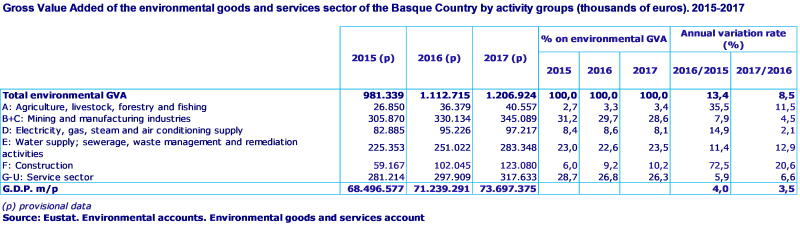
According to data from the Environmental Goods and Services Account prepared by Eustat for the first time, the Gross Value Added (GVA) of the environmental economy stood at 1,207 million euros in 2017, equivalent to 1.64% of GDP for that year. Compared to the previous year, environmental GVA increased by 8.5%, five percentage points higher than growth in Gross Domestic Product of the economy as a whole in the same period.
The Environmental Goods and Services Account is part of the system of environmental accounts and is prepared according to Eurostat's methodology. These accounts allow for a coherent integration of economic and environmental aspects within the National Accounts system. The environmental goods and services (environmental economy) sub-sector is composed of the segment of the economy dedicated to the production of goods and services for environmental protection and activities related to the management of natural resources to reduce or eliminate environmental pressures.
By economic sector, and in relation to GVA, it is worth highlighting the contribution of Extraction and Manufacturing Industries, with 28.6% of the environmental total, followed by the Services sector with 26.3% and Water Supply and Waste Cleanup and Management activities, with 23.5%. In 2017, the sectors with the largest environmental contribution were Construction (10.2%), Supply of Electricity, Gas and Air Conditioning (8.1%) and, lastly, the Primary sector, with 3.4%.
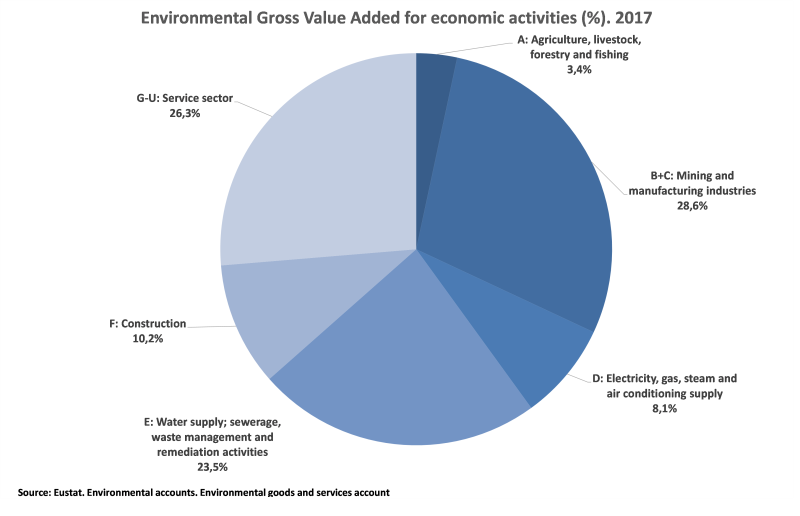
Turning to variation over the three years studied, 2015-2017, the environmental GVA increased in all sectors, but the Construction sector is of particular note, which saw an increase of just over 4 percentage points in its share of the total environmental GVA, to which legislation on the certification of new buildings has contributed. The percentage of the total of the Primary sector (1.7 percentage points) and the Water Supply, Purification and Waste & Decontamination Management sector (0.5 points) have also increased.
Employment generated by environmental activities, measured as full-time equivalent (FTE) jobs, accounted for 1.92% of total employment recorded in 2017.
If we look at environmental employment by economic sector, the Services sector comes out top with 32.3% of total environmental employment, followed by Extraction and Manufacturing Industries with 29.7%, and Water Supply and Waste Cleanup and Management activities, with 22.8%. Conversely, the sectors with the lowest contribution to environmental employment were Construction (11.4%) and, some way behind, the Primary and the Supply of Electricity, Gas and Air Conditioning sectors, with 3.5% and 0.3%, respectively.
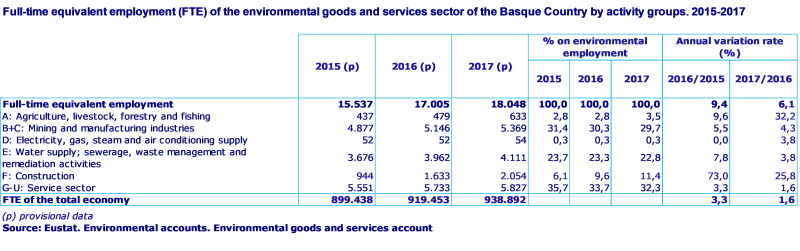
In year-on-year terms, the sectors that stand out in terms of the trend in environmental employment in 2017 were the Primary and Constructions sectors, with a respective 32.2% and 25.8% growth in employment.
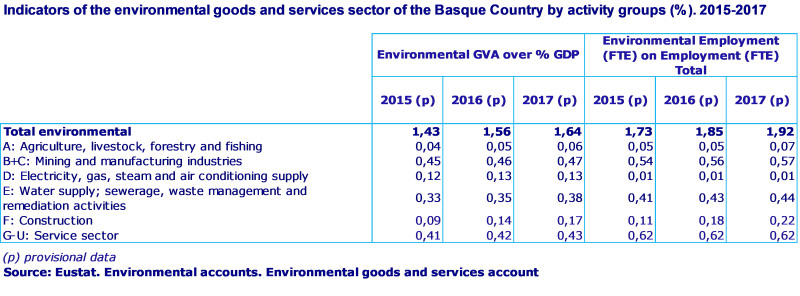
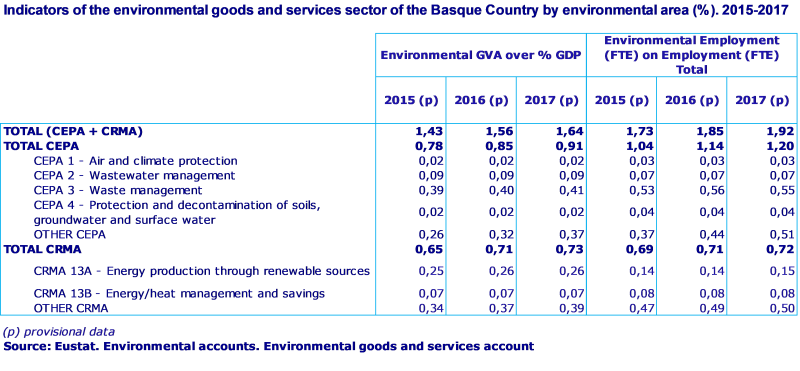
Taking into account the main indicators that relate the environmental sub-sector with the economy as a whole, environmental GVA accounted for 1.64% of GDP in 2017, 0.08 of a percentage point more than the previous year, and Full-time Employment accounted 1.92% of employment as a whole, 0.07 of a percentage point more than in 2016. Look at the period 2015-2017, a sustained upward trend can be observed.
Compared with Spain, environmental activities in the Basque Country accounted for a higher percentage of employment in relation to the economy as a whole: 1.92% in the Basque Country as opposed to 1.73% for the rest of Spain. On the other hand, in relation to GDP, the value is higher for Spain, 2.15%, than for the Autonomous Region, 1.64%.
Following the European Regulation, two major domains stand out in terms of their environmental goals: environmental protection activities and resource management activities, both categorised into two mutually exclusive classifications. On the one hand, environmental protection activities are described in the Classification of Environmental Protection Activities (CEPA) and, on the other, resource management activities for environmental protection are described in the Classification of Resource Management Activities (CRMA).
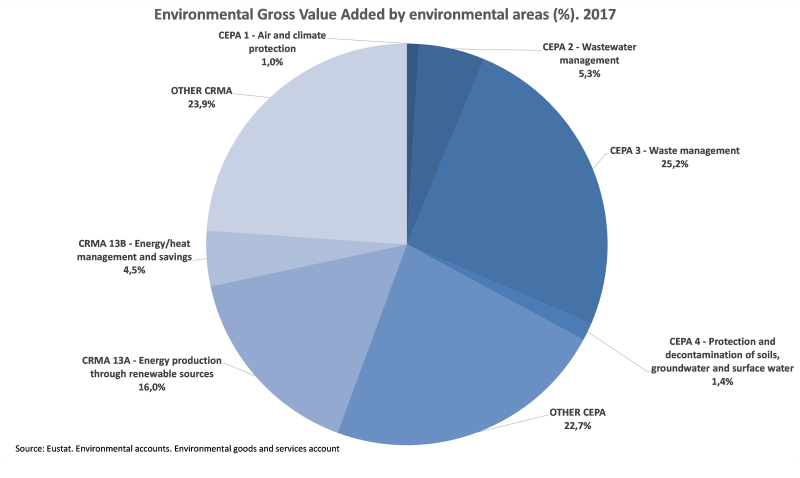
The domain with the largest proportion of total environmental GVA generated in 2017 was Waste Management, contributing 25.2% of the total. Energy Production from renewable sources also stood out, with 16%. The category of CRMA, which comprises activities such as the management of water, forest resources and wild flora and fauna, among others, contributed 23.9%, while activities that fall under the Other CEPA heading, activities related to noise reduction, preservation of biodiversity, protection against radiation and environmental R&D, among others, contribute 22.7%.
In terms of GDP, environmental protection activities (CEPA) contribute 0.91% of GDP in 2017, higher than the 0.73% contribution from resource management activities.
In terms of employment, activities associated with environmental protection also accounted for a large proportion of the total, 1.20% compared to 0.72% of resource management. More specifically, the environmental domain that contributed most to employment as a whole was Waste Management (0.55 points) and Energy Production from renewable sources (0.15 points).
For further information:
Eustat - Euskal Estatistika Erakundea / Basque Statistics Institute
C/ Donostia-San Sebastián, 1 01010 Vitoria-Gasteiz
Press Service: servicioprensa@eustat.es Tel: 945 01 75 62