Press Release 27/11/2020
HOSPITAL MORBIDITY STATISTICS. 2019
Hospital admissions fell slightly in the Basque Country in 2019, the main cause of which were digestive diseases
Outpatient surgery saw a 4.1% increase in admissions, of which eye diseases were the main cause
A total of 234,674 people were admitted to acute care hospitals in the Basque Country (not including medium and long-stay hospitals and psychiatric hospitals) in 2019, which was a decrease of 0.4% compared to the previous year, according to Eustat data. 84% of admissions were to public hospitals, and January was the month that saw the highest number of admissions. More than half were of persons aged 65 and over and digestive diseases were the main cause of hospitalisation. In addition, 82,490 people were treated as outpatients (+4.1%), in this case the main reason for treatment was the cataract surgery.
Diseases of the digestive system (13.5%) and circulatory system (12.8%), together with respiratory diseases (11.9%), were the main causes of hospital admission. They were followed, with similar rates, by tumours (9.4%), trauma and injuries (9.1%) and diseases of the musculoskeletal system (8.8%). In comparison with 2018, admissions owing to respiratory diseases and care for pregnancy, childbirth, and postnatal issues were down 7.6% and 3.5%, respectively.
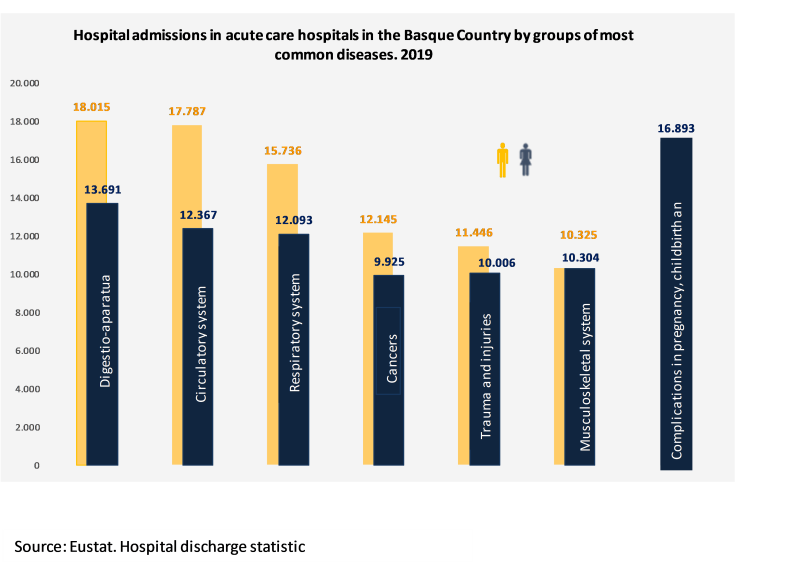
Despite a decrease in recent years, pregnancy, birth and puerperium incidents continued to be the most common reason for hospital care among women (14.6%), followed by digestive diseases (11.9%) and circulatory and respiratory diseases, which accounted for around 11%.
The main causes of hospitalisation among men, who accounted for 51% of admissions, were the same as for women, but with a higher prevalence: diseases of the digestive system (15.1%), circulatory system (14.9%) and respiratory system (13.2%).
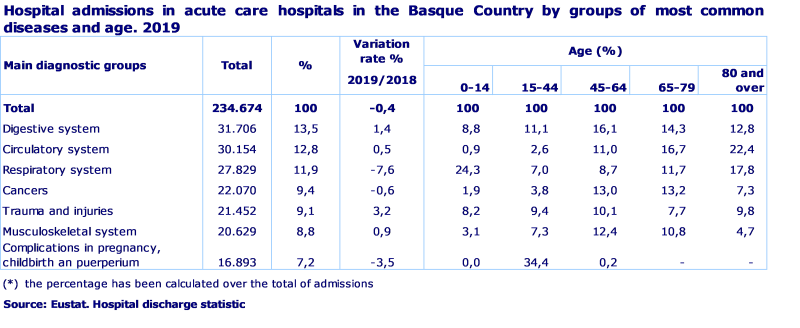
The health problems treated in hospital are closely related to age: in the 0 to 14 age group respiratory and perinatal diseases were the most common, in the 15 to 44 age group it was pregnancy, birth and puerperium, in the 45 to 64 age group it was digestive diseases and tumours, and among those aged 65 and over it was circulatory diseases, followed digestive diseases in the 65-79 age group, and respiratory diseases among people aged 80 and over. It should be noted that the 65 and over age group accounted for 50% of hospital admissions.
In January, admissions were 50% higher than in August
January was the month with the largest number of hospital admissions, around 23,000, of which the main cause was respiratory diseases (21%), owing to its markedly seasonal component, while August saw the fewest (15,011 admissions).
The treatment pattern varied depending on the ownership of the hospital. In public hospitals, which recorded 84% of total admissions, the most common illnesses were diseases of the digestive and circulatory systems, both with 13.6%, while private hospitals mostly treated diseases of the musculoskeletal system and connective tissue disorders (18.6%).
The average length of hospital stays was 5.6 days (5.7 in 2018); the longest stays were for mental disorders (14 days), followed by perinatal diseases (10.5 days), and infectious diseases (8.6 days).
Cataracts and eye diseases accounted for 36% of outpatient surgery
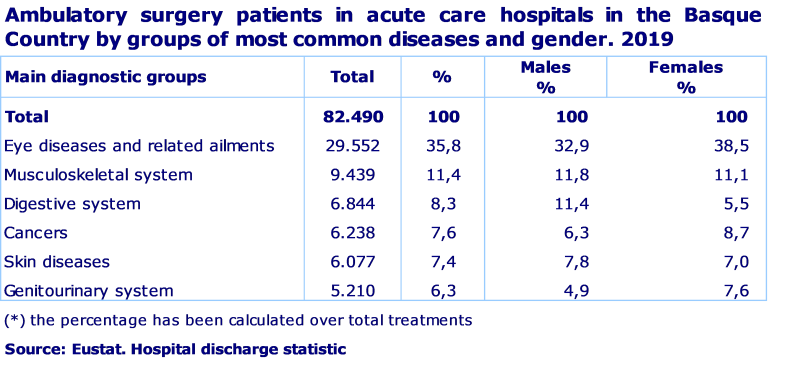
Outpatient surgery, where patients are admitted, treated and discharged on the same day, recorded 82,490 admissions (4.1% more than in 2018). The group of eye diseases was the most common, accounting for 35.8% of cases treated, of which 88% were carried out in public hospitals and 12% in private hospitals, with cataracts being the most treated pathology.
In second place were diseases of the musculoskeletal system (11.4%), where 61% of procedures were carried out in private hospitals, with the most frequent being knee disorders in men, and acquired deformities of fingers and toes in women.
Methodological note
For reasons of comparability with Spanish and international statistics, the hospital admissions mode only takes into account admissions with a stay equal to or greater than 1 day, that is, admissions with 0 days are not counted. The length of stay is calculated as the number of days between the date of admission and the date of discharge, without taking into account the time of admission or discharge.
For further information:
Eustat - Euskal Estatistika Erakundea / Basque Statistics Institute
C/ Donostia-San Sebastián, 1 01010 Vitoria-Gasteiz
Press Service: servicioprensa@eustat.es Tel: 945 01 75 62