Press Release 20/11/2020
STATISTICS ON SCIENTIFIC RESEARCH AND TECHNOLOGICAL DEVELOPMENT ACTIVITIES - R&D - 2019
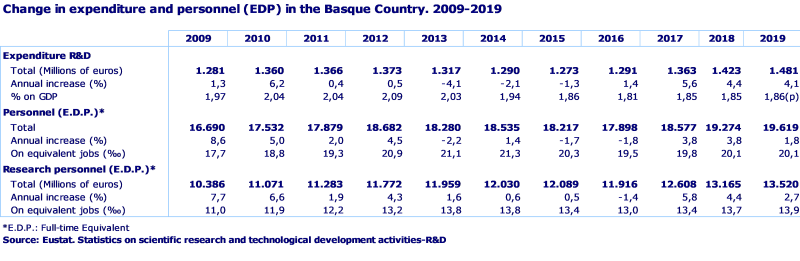
Expenditure on R&D increased by 4.1% and reached 1,481.4 million euros in the Basque Country, or 1.86% of GDP, in 2019
Almost 20,000 people were in full-time employment in R&D in 2019, up 1.8% on the previous year
Expenditure on internal R&D (Technological Research and Development) in 2019 reached a total of 1,481.4 million euros in the Basque Country, according to EUSTAT data. This figure is up by 58 million euros on the previous year, a 4.1% increase, securing for the fourth consecutive year a phase of growth that started in 2016 and paving the way towards a historic new high in terms of expenditure in 2019.
19,619 people held full-time equivalent positions in internal R&D in 2019, following growth of 1.8% compared to the previous year. The number of research staff, 13,520 people in full-time equivalent positions, increased by 2.7%. As with expenditure, both total employed personnel and research staff in R&D reached historic highs in 2019.
In relation to GDP, expenditure on internal R&D in the Basque Country reached 1.86% in 2019, one hundredth of a percentage point more than 1.85% in the previous year. The most recent comparative data with the European Union 28 (EU-28) are for 2018, when it accounted for 2.11% of its GDP, compared to 1.24% for Spain.
On a provincial level, 46.2% of total expenditure on internal R&D in the Basque Country in 2019 was carried out in Bizkaia, 43.3% in Gipuzkoa and 10.5% in Álava. It should be pointed out that this expenditure represented 2.40% of GDP in Gipuzkoa, 1.71% in the case of Bizkaia and 1.23% in that of Álava.
76.3% of expenditure on internal R&D in the Basque Country was implemented by the business sector
In terms of the sector that carried out internal R&D expenditure, the majority, 76.3% (1,129.6 million euros) was implemented by businesses, whereas 17.1% (253.8 million) corresponded to Higher Education and the remaining 6.6% (98.0 million) was carried out by various bodies dependent on the Administration. This sectorial distribution of implementation of R&D expenditure has remained relatively stable in recent years.
Compared to the previous year, all three sectors, Businesses, Public Administration and Higher Education, increased their expenditure on internal R&D by 4.6%, 1.6% and 2.7%, respectively.
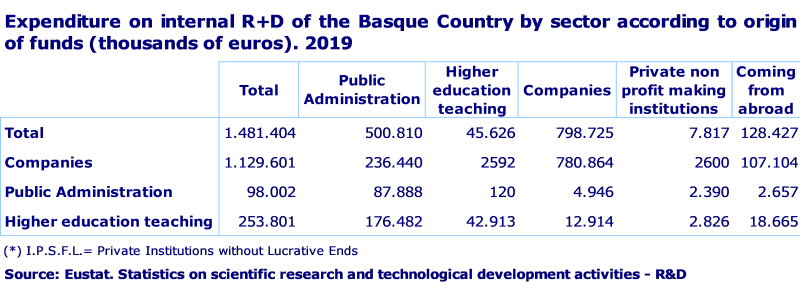
From the point of view of funding internal R&D expenditure, public funding saw the largest increase, 6.3% more than the previous year, and the 500.8 million allocated now accounts for 33.8% of total R&D expenditure. The contribution of the Autonomous Administration (408.0 million) is the largest in this sector, which increased by 8.2% on the previous year and accounts for 81.5% of the total funding from the public administration in 2019. In 2010, it was 62.9%. For its part, the central administration (69.1 million) cut its funding by 0.3% in 2019 and limited its share to 13.8% of total funding. Lastly, the share of local administrations and provincial councils (23.7 million) was 4.7%, and their contribution also fell, by 3.4% compared to the previous year.
Businesses, which spent 799 million euros on research, 3.5% more than in 2018 and 53.9% of total funding, remained the primary source of funding.
The rest of the funding came from abroad, with 128.4 million – a similar figure to the previous year (+0.5%), from higher education – 45.6 million (-0.3%), and from private non-profit institutions – 7.8 million, an increase of 15.1%.
There were 19,619 people in full-time employment in the following implementation sectors: 13,916 people corresponded to the Business Sector (70.9% of the total), 4,400 to Higher Education (22.4%) and 1,303 to Public Administration (6.7%). Of particular note is the increase in research staff, 13,520 people, up 2.7% compared to 1.8% for total staff.
36.6% of R&D personnel were women in 2019, 3.2 percentage points more than in 2010
36.6% of R&D personnel in full-time employment were women; the variation compared to the previous year was up by 0.7 percentage points on total personnel, however the increase in relation to 2010 was 3.2 percentage points and up to 4.9 points on 2005.
Considering the sector that carried out R&D, it can be observed that there are higher numbers of women in the Business and Higher Education sectors, 4,316 and 2,152 women, respectively, compared to 715 women in the Public Administration. However, in relative terms, woman accounted for 54.9% of the Public Administration, compared to 48.9% in Higher Education and 31.0% in the Business sector.
Note: Eustat would like to thank all the businesses and institutions that have collaborated in preparing these statistics and for their effort in spite of the circumstances. It would not have been possible without their cooperation.
For further information:
Eustat - Euskal Estatistika Erakundea / Basque Statistics Institute
C/ Donostia-San Sebastián, 1 01010 Vitoria-Gasteiz
Press service: servicioprensa@eustat.es Tel: 945 01 75 62