Press Release 18/09/2020
QUARTERLY ACCOUNTS. II/2020
The GDP of the Basque Country registered a 16.4% quarter-on-quarter decline in the second quarter of 2020
In year-on-year terms, there was a 19.5% decrease in GDP and 17.2% in employment, compared to the second quarter of 2019
The Gross Domestic Product (GDP) of the Basque Country fell by 16.4% in the second quarter of 2020, compared to the previous quarter, according to Eustat data. With regards to the same quarter of the previous year, there was year-on-year drop of 19.5%.
GDP and Employment estimates for the second quarter of 2020 slightly lessened the scale of the contraction in economic activity and employment estimated in the Advance Quarterly Accounts of 24 July, after incorporating the relevant information that was not available when these Accounts were prepared. Thus, the drop in GDP, which was estimated at 16.9% in quarter-on-quarter terms and 20.1% in year-on-year terms, was reduced by 0.5 and 0.6 of a percentage point respectively, using the relevant information now available. The estimate for employment was revised to a larger extent, going from a year-on-year variation of -19.8% in the advance accounts to -17.2% at present.
The year-on-year decrease in the GDP of the Basque Country was lower than the estimate for the Spanish economy, which saw a year-on-year decline in the second quarter of 22.1%. On the other hand, the Eurozone (-14.7%) and the European Union as a whole (-13.9%) performed better.
The state of alarm declared in Royal Decree 463/2020 of 14 March in order to manage the health crisis caused by COVID-19 was in effect until 21 June. The effect on economic activity during the second quarter of the year has been extraordinary, as suggested by the estimates given. The sudden paralysis of economic activity, following by a staggered return to normality, has posed a challenge to statistical offices in terms of collecting and processing information from economic agents. The estimation and prediction procedures on which the quarter-on-quarter accounts are based have seen an extraordinarily intense shock, which have resulted in adjustments and harmonised updates. For example, a specific variable to highlight the effect of COVID-19 has been included in the models used in the correction of calendar effects and deseasonalisation of the series, following the recommendations of the Statistical Office of the European Union (Eurostat) in its methodological note Guidance on Time Series Treatment in the context of the COVID-19 crisis.
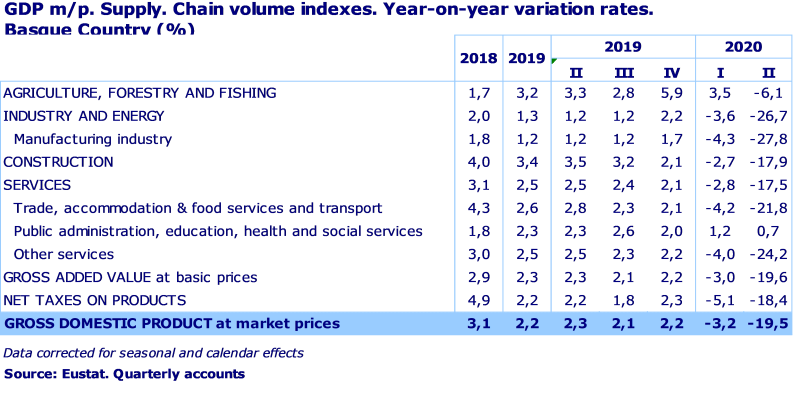
From the point of view of supply, the sudden decrease in added value, both in year-on-year terms and in quarter-on-quarter terms, observed in the first quarter of the year, has accelerated in all sectors in this second quarter, with the exception of the Public Administration, Education, Health and Social Services branch.
The Primary sector has recorded a decline in added value of 6.1% compared to the same quarter of the previous year and 4.4% compared to the first quarter of 2020.
The Industry sector has experienced a downturn in year-on-year terms of 26.7%, with an even greater decrease in added value in the case of the manufacturing industry (27.8%). Compared to the first quarter of 2020, the decline in industry as a whole stood at 23.4%, reaching 24% in the case of the manufacturing industry.
The Construction sector also saw a larger decrease than in the previous quarter, with a fall in added value of 17.9% in year-on-year terms and 15% compared to the first quarter of the year.
Global activity within the Services sector in the second quarter of 2020 also saw an accelerated decline, with a year-on-year decrease of 17.5% and a drop of 14.9% compared to the activity observed in the first quarter of the year.
The performance of the Services sector varied by branches. The branch of Trade, Hotel Management & Catering and Transport posted a decrease in added value of 21.8% compared to the second quarter of the previous year, which represents a contraction of 18.1% compared to the previous quarter. There was a sharper drop in the Other Services branch – which includes professional, financial and insurance activities – with a year-on-year variation rate of -21.8% and a quarter-on-quarter rate of -21.0%.
Conversely, the Public Administration, Education, Health and Social Services branch retained its value near that observed in previous quarters, with an estimated year-on-year growth of 0.7%, standing at the same level as in the previous quarter (quarter-on-quarter variation of 0.0%).
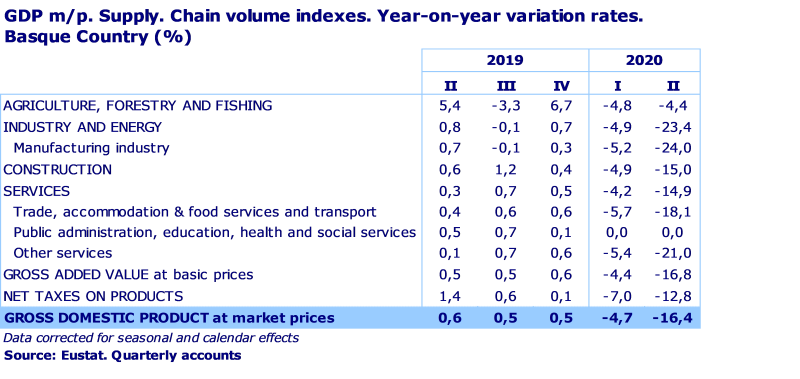
The negative aggregated performance of almost all sectors accelerated the decrease in the Gross Value Added of the Basque Country, which stood at 19.6% in comparison with the second quarter of the previous year and 16.8% compared to the first quarter of 2020.
From the point of view of Demand, all aggregated sectors saw steep declines both in year-on-year terms and in quarter-on-quarter terms, with the exception of the Final Consumption Expenditure of the Public Administrations.
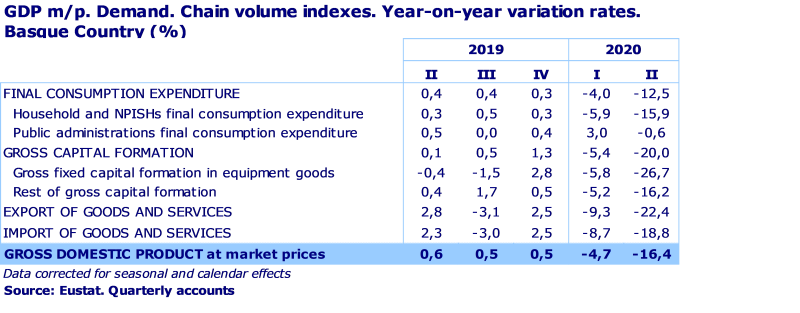
The Final Consumption Expenditure of Households (Private Consumption) fell more sharply, with an estimated decrease of 20.3% in year-on-year terms and 15.9% in quarter-on-quarter terms.
Public Consumption (Final Consumption Expenditure of Public Administrations) was the only aggregated sector that posted a higher value than that observed in the second quarter of the previous year (year-on-year variation of 3.0%), although there was a decrease of 0.6% on the first quarter of the year.
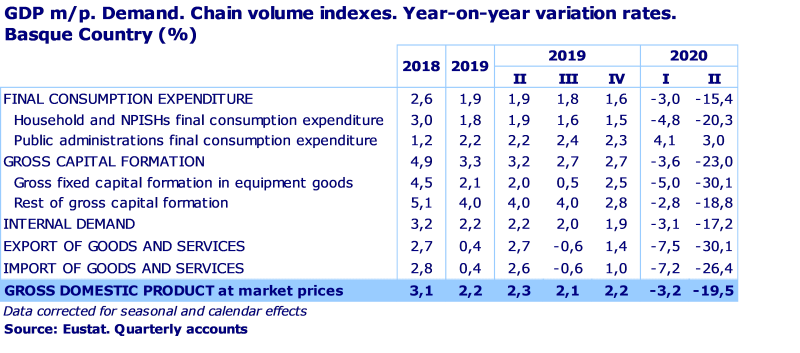
Gross Capital Formation (Investment) also saw a steep decline in year-on-year terms, with a variation rate of -23.0%. Compared to the first quarter of the year, the decrease was estimated at 20.0%. There was a particularly sharp drop in investment in Capital Goods, which recorded a 30.1% decline compared to the second quarter of 2019 and 26.7% compared to the first quarter of 2020.
In Other Gross Capital Formation, which is more closely linked to the performance of the construction sector, the year-on-year decrease was 18.8%, following an estimated 16.2% contraction compared to the first quarter of the year.
Internal Demand, composed of Final Consumption Expenditure and Gross Capital Formation, fell by 17.2% in year-on-year terms in the second quarter of the year. This decrease was below that estimated for GDP as a whole (-19.5%), for which the contribution of the Foreign Sector was also negative in the second quarter of the year. Exports of goods and services were down 30.1% compared to the second quarter of the previous year, whilst Imports decreased to a lesser extent (-26.4%). There was therefore a fall in the foreign balance.
In relation to the level of employment (measured in Full-Time Equivalent Jobs), employment as a whole was down 17.2% compared to the second quarter of the previous year, following a 14.3% drop compared to the first quarter of the year.
In this regard, it should be remembered that the definition of a job, according to the European System of Accounts (ESA), excludes persons temporarily not at work but who have a formal attachment to their job, for example, an assurance of return to work or an agreement as to the date of return, as is the case with ERTEs (Temporary Labour Force Adjustment Plans).
The accelerated downturn in employment observed in the first quarter of the year was common to all activity branches, both in year-on-year terms and in quarter-on-quarter terms.
The primary sector saw a 3.3% drop in employment in relation to the second quarter of 2019 and was down 1.5% compared to the previous quarter. The year-on-year drop is measured at 20.1% in the Industry sector, following a quarter-on-quarter fall of 16.9%. In Construction, the performance of employment signified a decrease of 14.3% in year-on-year terms and of 10.2% in quarter-on-quarter terms. Lastly, in the Services sector, the decline in Full-Time Equivalent Jobs has also accelerated, after posting a 16.8% drop in year-on-year terms and a 14.1% fall in quarter-on-quarter terms.
In terms of GDP performance by Province, Álava posted a year-on-year variation rate of -20.2%; Bizkaia of -19.5%, and Gipuzkoa of -19.3%.
Methodological note: Definitive data from 2018 and advance data from 2019 from the Economic Accounts of the Basque Country have been incorporated into the Quarterly Accounts by Eustat, which has meant re-estimating the corresponding quarterly series.
For further information:
Eustat - Euskal Estatistika Erakundea / Basque Statistics Institute
C/ Donostia-San Sebastián, 1 01010 Vitoria-Gasteiz
Press Service: servicioprensa@eustat.es Tel: 945 01 75 62