Press release 29/10/2020
HEALTH ACCOUNT. 2019
Health expenditure in the Basque Country registered 4.7% growth in 2019
The indicator of contributions from the Public Administrations for health placed the Basque Country above Spain and the OECD average
Current health expenditure in the Basque Country was 7,042 million euros in 2019, which was 4.7% more than in 2018 according to Eustat data. This and other data of the Health Account are calculated in accordance with the OECD methodology published in the System of Health Accounts-SHA 2011.
Healthcare expenditure measures the final consumption of goods and services for health, that is, current expenditure by any financing agent. The financing of this expenditure includes, as a whole, the public administrations, compulsory health insurance, voluntary health insurance and direct payment by households.
In the period 2010-2019, the total current expenditure in absolute values grew at an average annual rate of 2.5%, with the last three years standing out with growth rates over 4%; specifically, it grew 4.0% in 2017, 4.8% in 2018 and 4.7% in 2019.
This expenditure of 7,042 million accounted for 8.9% of the GDP in 2019, one tenth of a percentage point more than the previous year. The ratio per inhabitant also registered a greater advance than in previous years: expenditure per inhabitant was 3,216 euros, 4.4% more than in 2018.
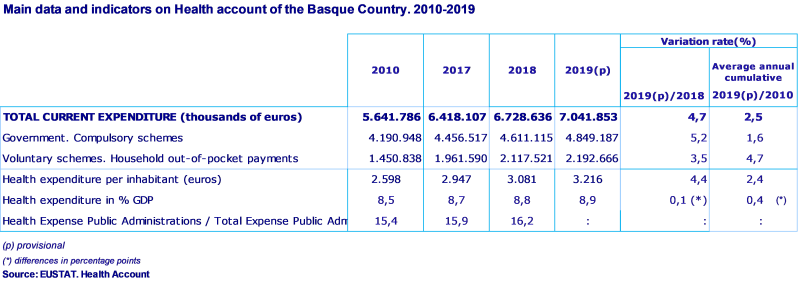
With respect to the type of financing, of the 7,042 million euros of current expenditure in 2019, 4,849 million euros corresponded to the public administrations and compulsory health insurance together, 5.2% more than in 2018; and voluntary health insurance and direct payment by households together accounted for 2,193 million euros, 3.5% more than in the previous year. Since 2010 the growth in the amount corresponding to the combination of households and voluntary health insurance has been greater than that corresponding to the combination of public administrations and compulsory insurance; consequently, the contribution of the latter fell from 74.3% in 2010 to 68.9% in 2019, whereas the contribution of households and voluntary health insurance increased from 25.7% in 2010 to 31.1% in 2019.
The variation in healthcare expenditure in the Basque Country has followed a similar evolution to the OECD average. Until 2015, the variation rate of current expenditure per capita, in real terms, showed greater fluctuations in the Basque Country that in the OECD average; since that year the rates have been more similar. In the last two years, 2018 and 2019, this variation rate was only 3.0% in the Basque Country, 0.4 points above that registered as the OECD average, with a growth rate of 2.6%.
The indicator of contributions from the public administrations, in other words, public expenditure on healthcare compared to the total expenditure by public administrations in the Basque Country, was 16.2% in 2018. The last available data to make an international comparison in relation to this indicator corresponds to 2017; in this year the OECD average was 15.1% and the figure for Spain was 15.3%, in both cases below the 15.9% obtained in the Basque Country.
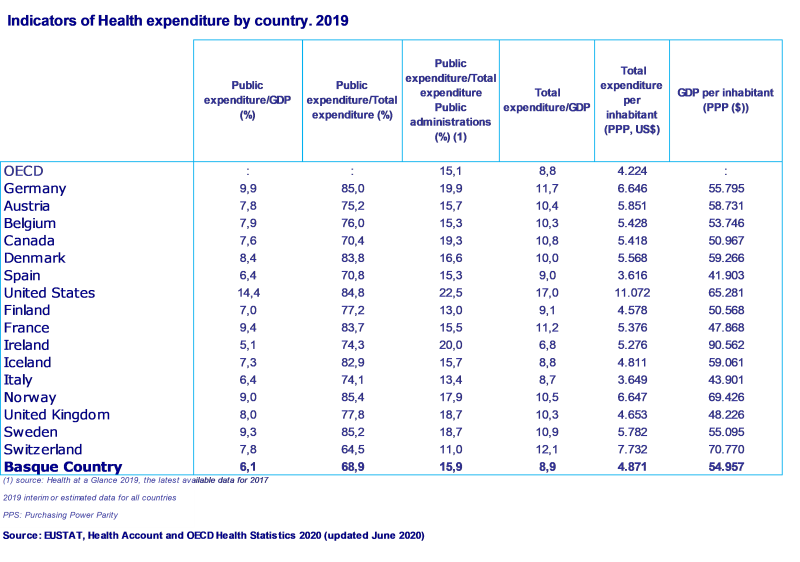
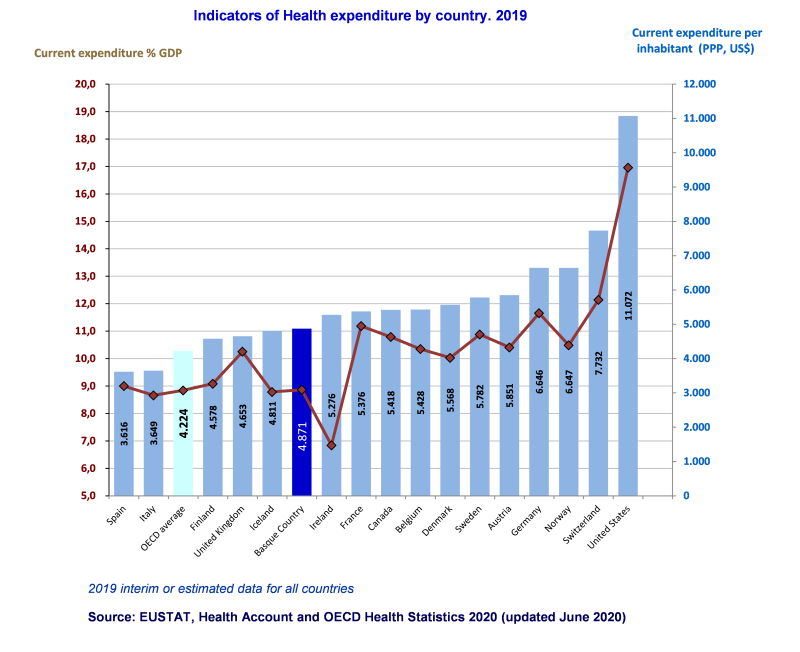
Other OECD indicators for international comparison are expenditure as a share of GDP and health expenditure per capita in PPS ($). In 2019, the Basque Country was above the OECD average for both indicators. Current health expenditure in the Basque Country was 8.9% of GDP, 0.1 points above the OECD average (8.8%), although slightly below Spain (9.0%. A better position was obtained by the health expenditure per capita in PPS ($), which was 4,871 in the Basque Country, which placed it above the OECD average of 15%, with 4,224, Spain (3,616) and countries such as Finland (4,578); at the other extreme, this was well below countries such as Switzerland, with 7,732, Norway, with 6,647, and Germany, with 6,646, all of these being at the very top of the table.
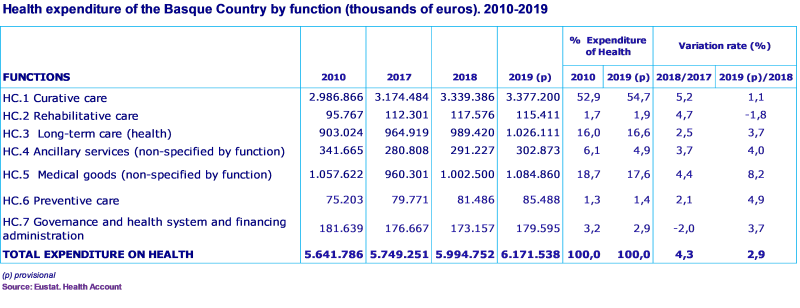
A more detailed analysis of the data on the Health Accounts of the Basque Country for 2019, shows that in the distribution of expenditure by functions, the largest section continues to be Curative Healthcare, which in 2019 accounted for 56.5% of current expenditure and was up 6.9% compared to 2018. The second most important function corresponds to Medical Products (pharmaceutical products, prostheses etc.), which accounted for 16.5% of current expenditure and a more moderate increase compared to 2018 of 1.1%. In third place, expenditure on long-stay healthcare provision (which includes expenditure on the healthcare of dependants) accounted for 16.1% of current expenditure and was up 1.9% compared to 2018.
The breakdown of the type of healthcare (inpatient, outpatient and in the home) indicates that, from 2010 to 2019, spending on outpatient care (external appointments and day patients) increased by a cumulative average annual rate of 4.2%, more than that destined for inpatient care, with a rate of 2.2%, and healthcare in the home, spending on which increased at an average annual rate of 1.5%.
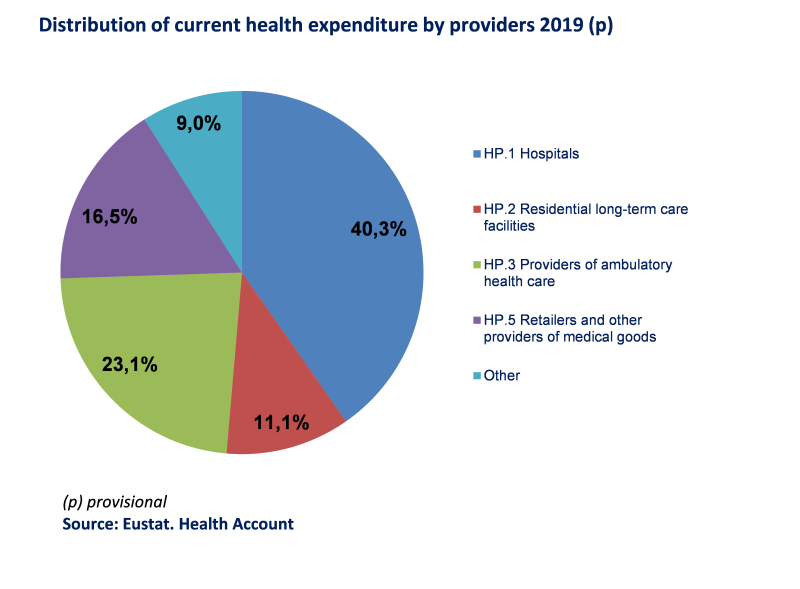
The structure of expenditure by provider was similar to that of previous periods; the greater part of spending was on hospitals (40.3%), which was, moreover, the item that experienced the greatest growth, 6.8%. In second place were providers of outpatient care, who managed 23.1% of spending. Retailers and providers of medical products accounted for more modest percentages, 16.5% of current expenditure, as did long-stay residential establishments, which accounted for 11.1%. The remaining 9.0% of expenditure corresponded to providers of auxiliary services (healthcare transport, laboratories), preventive service providers, administration of the healthcare system and the rest of the economy, which includes households as home healthcare providers.
For further information:
Eustat - Euskal Estatistika Erakundea / Basque Statistics Institute
C/ Donostia-San Sebastián, 1 01010 Vitoria-Gasteiz
Press service: servicioprensa@eustat.es Tel: 945 01 75 62