Press release 30/09/2020
INFORMATION SOCIETY SURVEY. FAMILIES. 2020
82.6% of the population of the Basque Country are internet users in 2020, although occupation and age determine significant differences
The gender gap in internet use has narrowed but it remains unchanged in online services and purchases
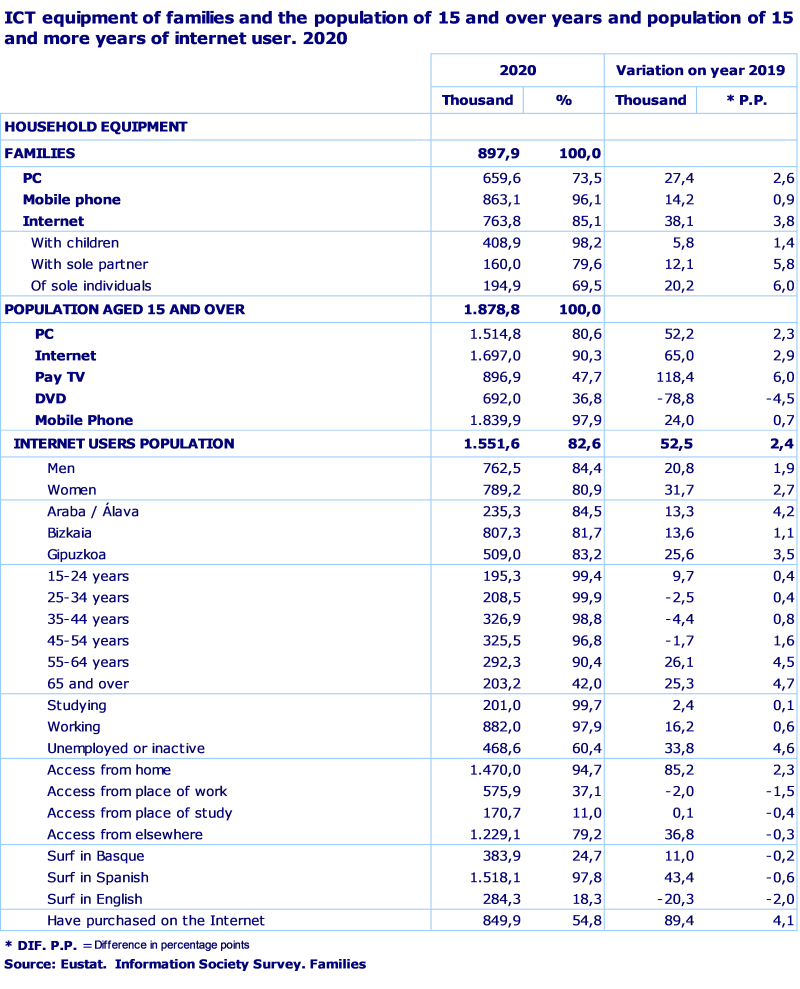
The number of internet users aged 15 and over in the Basque Country stood at 1,551,600 in the first quarter of 2020, accounting for 82.6% of the overall Basque population in this age group, according to Eustat data. This percentage was up 2.4 percentage points compared to the same period last year.
By occupation, practically the entire student population (99.7%) are internet users, followed by people in work (97.9%) and, finally, the inactive and unemployed population (60.4%) which, despite being the group that displays the greatest increase (4.6 points) compared to the previous period, stands far removed from the others with differences of more than 37 percentage points.
In terms of age, the increases in internet users aged 65 and over (+4.7 percentage points) and those between 55 and 64 (+4.5 points) are worthy of note; despite this, these are the only age groups with user figures below 95% and, in the case of the former, considerably removed from this threshold. The biggest difference between age brackets is between people aged 25 to 34, who are all users (99.9%), and those aged 65 and over, who stand at 42%.
Álava was the province where the percentage of internet users grew the most, after seeing an increase of 4.2 points compared with the same period of the previous year, and recovered first place in the Basque Country with 84.5% of users; 83.2% (+3.5 points) of the population of Gipuzkoa are internet users and Bizkaia was next with 81.7%, following a slight increase compared to the previous year (+1.1 points).
As regards the Basque provincial capitals, Vitoria-Gasteiz remained the capital with the highest proportion of internet user population (84.5%), followed by Donostia/San Sebastián (82.4%) and Bilbao (81.0%). The greatest differences can be identified at the regional level, around 5 percentage points, in the percentage of users between the highest value of Estribaciones del Gorbea (85.4%) and the lowest of Montaña Alavesa (80.8%).
The preferred language for web browsing is Spanish (97.8%), followed by Basque (24.7%) and English (18.3%). The usual location continued to be the private home, with 94.7% of users connecting from their houses.
The most frequently used services are associated with communication and access to information
45.2% of the Basque population has bought goods and services online in the last twelve months, 4.1 percentage points higher than in 2019; this represents 54.8% of the internet user population.
The services used most are those associated with communication and access to information. The most common include: receiving or sending email (81.4%), reading news stories, newspapers or current affairs magazines (77.5%) and searching for information on goods and services (67.1%).
WhatsApp and other similar mobile apps are the most used, regardless of internet users’ age, sex and occupation, always over 93%. The people who use these apps the least are 65 and over (93.5% of users), which accounts for 39.3% of the total population of this age group, 5.4 percentage points more than the previous year.
The gender gap in the internet user population has decreased but there were differences in the online services used
The gender gap narrowed to 3.5 percentage points, almost one point less than in the same period in 2019. Men using the internet represent 84.4% of the male population, while women users account for 80.9% of the female population.
As regards computer use, the gender gap stood at 7.9 percentage points, 0.3 percentage points higher than in 2019. Men using computers represent 71.6% of the male population, compared to 63.7% of women.
There are also differences by gender in the services used online. Women use more health services, such as searching for information or making a medical appointment (+10.5 percentage points), take more online courses (+3.9 points) and communicate more with monitors and students using educational portals and websites (+3.2 points) than men. Men, meanwhile, use information more than women -they read more news stories, newspapers or current affairs magazines- (+6.7), watch more online programmes (+5.5) and play or download more games (+4.7).
In e-commerce, women buy more sports equipment and clothing (+6.1 percentage points), household goods (+5.7) and travel services -public transport tickets, car hire- (+4.4 points) than men. Men, for their part, purchase more electronic equipment (+17.9 points), computer equipment (+13.1 points) and computer/console games and their updates (+7.2 points) than women.
Family characteristics determine the ICT equipment of Basque households
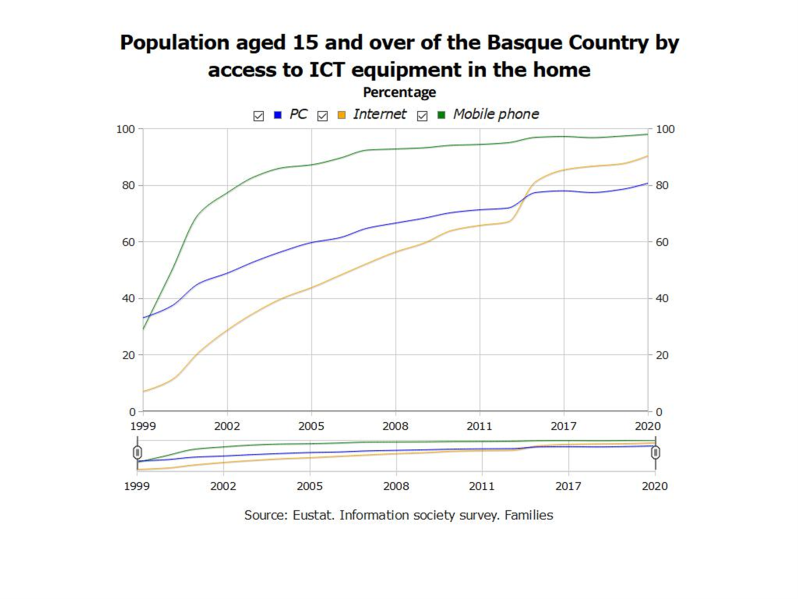
In the first quarter of 2020, 85.1% of families (763,800) had an internet connection at home, an increase of 38,100 families (+3.8 points) compared to the same period of the previous year. In population terms, 90.3% of people aged 15 and over (1,697,000) have home access to the web.
Moreover, 73.5% of households in the Basque Country have computers, signifying that 80.6% of the population have a computer in their home. Mobile phones are present in 96.1% of households; 97.9% of the population aged 15 and over have access to one.
As regards households with audiovisual equipment, it should be noted that 42.5% have pay-TV, 5.1 points and 48,000 families more than the previous year; this means that 47.7% of the population (118,400 more people) have this service at home.
The presence of ICT equipment among Basque households varies according to the type of family. Its presence increased in all cases compared to the previous year, but with an unequal rate between different types of families and according to the ICT equipment; the greatest increases stood at around 6 percentage points and occurred in the availability of internet access in households without children, as well as in access to some type of computer in households made up of couples (+6.0 points).
Despite a reduction in the differences between the various types of family, they continued to be significant. The greatest differences were seen between families with children and others, especially compared to families made up of single individuals: 98.2% of families with children have Internet access in the dwelling, almost 30 points more than families in single member households (69.5%); 92.3% of families with children have some type of computer in their dwelling, a difference of just more than 40 points compared to single member households (50.7%); finally, mobile phones had a more widespread presence and presented minor differences; they are present in almost all families with children (99.9%), followed by 97.3% of those made up of couples and 89.7% of single-member families.
For further information:
Eustat - Euskal Estatistika Erakundea / Basque Statistics Institute
C/ Donostia-San Sebastián, 1 01010 Vitoria-Gasteiz
Press Service: servicioprensa@eustat.es Tel: 945 01 75 62