Press Release 01/10/2020
STATISTICAL OVERVIEW OF OLDER PERSONS. 2020
112,531 people aged 65 and over live alone in the Basque Country
Eustat is including a new section dedicated to statistics on Older Persons grouped into five thematic areas
Eustat is launching a new section on its website, called the Statistical overview of older persons, to coincide with the International Day of Older Persons. The section contains a series of indicators contained in more than 170 tables, graphs and documents with more than 40 statistical operations. The aim is to reflect numerous aspects of the economic, personal and social situation of persons aged 65 and over in the Basque Country from a gender perspective.
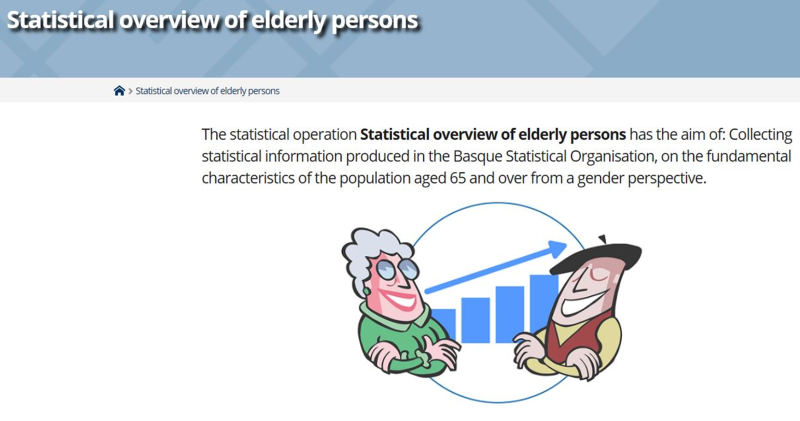
The main objectives of the section include obtaining information on the fundamental characteristics of the population aged 65 and over or closely related topics. It uses the direct sources of Eustat and departmental statistical bodies, especially the Department of Health.
The Statistical overview of older persons covers five thematic areas, which are: Demographics, Economic life and financial situation, Health, Daily life and Social protection. Below, we take a look at some of the statistical information available in each of the five thematic areas of the new statistical overview.
Demographics: there were 486,738 (22.2%) persons aged 65 and over in the Basque Country – 280,132 women and 206,606 men – in 2019
The Demographics area covers Population, Families, Migration, Mortality and Marriages and separations.
Population: the figures as of 01/01/2019 show that 486,738 people aged 65 and over lived in the Basque Country, of whom 280,132 were women and 206,606 were men. The 65 and over age group of the Basque Country saw an upward trend in the 2008-2019 period. Thus, it reached a percentage of 18.6% in 2008, 20.2% in 2013, and 22.2% in 2019. With 22.2% of its population 65 and over, it stood in the year in question above the EU28 average of 20%. In the ranking of all the countries in the Union, the Basque Country was exceeded only by Italy (22.8%).
2041 and 2061 scenarios: according to demographic assumptions, it is expected that, in the Basque Country, there will be 729,000 persons aged 65 and over in 2041 and 735,500 in 2061.
The evolution of each age group is, evidently, the result of the size of the generations that come to be incorporated therein, as well as the differential effect of mortality, migration and birth rate in each one. The progression of older people is also explained by the increase in life expectancy.
Families: around 263,000 people lived alone in the Basque Country in 2019, of whom 112,531 were aged 65 and over – 26% were men and the remaining 74% were women.
Life expectancy at birth: this has always been higher for women than for men. Compared to European Union countries, the Basque Country tops the list, with 86.4 years for women and 80.6 years for men, while the EU average is 83.6 and 78.3 years, respectively.
Mortality: the leading cause of death among men is tumours, and among women it is cardiovascular diseases. However, there has been a gradual increase in neurodegenerative diseases – such as Alzheimer's and dementia – as the main cause of death among the elderly.
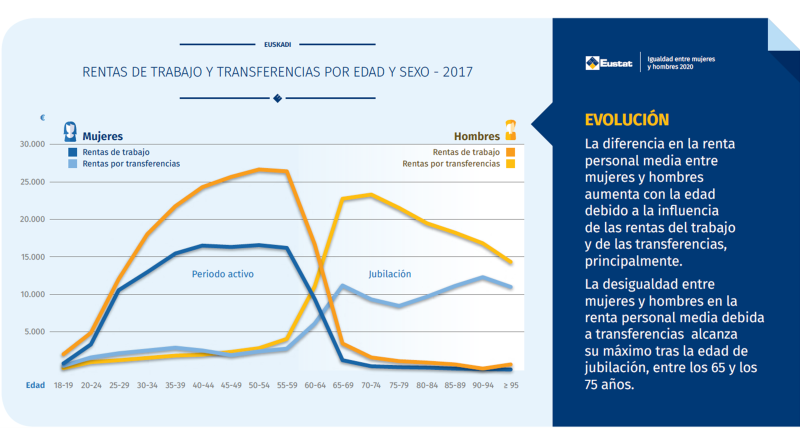
Economic life and financial situation: gender inequality in average personal income increases after retirement age
The Economic life and financial situation area covers Personal and family income, Poverty, Rural environment and Work activity.
Personal and family income: the population aged 18 and over in the Basque Country had an average personal income of €21,083 in 2017. Men obtained an average income of €26,519 compared to the €16,074 obtained by women. The greatest difference was recorded in the 65 to 69 age group, in which the average income of men exceeded that of women by €17,309.
Health: people aged 65 and over accounted for half of all hospital admissions
The Health area covers State of health, Life habits or behaviour, Preventive practices, Treatment of health problems and Road safety.
State of health: in 2018, the age group with the highest prevalence of anxiety and depression symptoms, i.e. the proportion of people with this health problem, were people aged 75 and over, 27.5% of whom were women and 14.9% were men.
Life habits or behaviour: as regards alcohol consumption, 24.4% of men and 9.6% of women between 65 and 74 years of age had a high-risk intake.
Preventive practices: in 2018, 80.3% of women aged 65 to 69 in the Basque Country had had a mammogram in the past two years.
Treatment of health problems: people aged 65 and over accounted for half of all the 248,580 hospital admissions in the Basque Country in 2018.
Daily life: the population aged 65 and over scored 7.26 for life satisfaction
The area of Daily life area covers Personal and social life, Education, Basque language, Culture, Attitudes and social habits concerning the environment and Digital skills.
Personal and social life: the retired population spent an average of 2:00 hours a day on active leisure and sports and 4:06 on passive leisure, compared to the working population, which spent around 3 hours a day less on leisure. The population aged 65 and over scored an average of 7.26 out of 10 on life satisfaction and 7.54 on leisure time satisfaction in 2019.
Education: illiteracy rates among the population aged 75 and over was 1.6% – 0.8% for men and 2% for women, and 0.5% in the 70 to 74 age group and 0.3% in the 65 to 69 age group. Illiteracy is progressively becoming a residual problem in the Basque Country.
Basque language: the bilingual population aged 65 and over in the period 1991-2016 used Basque more than Spanish, specifically 78.1% in 2016, compared with 41.3% of the bilingual population aged 16 to 24 in 2016.
Social protection: 20,654 places at elderly care homes
The area of Social protection covers Social services and social action, Economic accounts for social protection, Directory of related economic activities and Violence against women.
Social services and social action: this section offers information on centres, places, users, staff and expenditure of the centres. Specifically, in 2018, there were 445 centres for older persons with a total of 20,654 places, of which 7,504 were public and the remaining 13,150 were private.
The information is continually updated throughout the year
The information is continually updated throughout the year depending on the availability of the statistical operations for the section of the website.
For further information:
Eustat - Euskal Estatistika Erakundea / Basque Statistics Institute
C/ Donostia-San Sebastián, 1 01010 Vitoria-Gasteiz
Press Service: servicioprensa@eustat.es Tel: 945 01 75 62