Press release 27/10/2020
LARGE STORES AND FOOD CHAINS TRADE INDEX OF THE BASQUE COUNTRY. SEPTEMBER 2020
Sales in large stores and food chains in the Basque Country rose by 5.5% in September 2020
The accumulated total for the first nine months of the year closed with 1.7% growth
Sales at large stores and food chains in the Basque Country in September 2020 experienced a year-on-year increase at constant prices of 5.5% in homogenous terms of the working calendar, according to Eustat data; the fourth consecutive month with positive rates. Compared to August 2020, sales were up 0.5% in deseasonalised terms.
Sales of food products at large stores and food chains reflected a year-on-year rise of 6.8%, whereas sales corresponding to other items experienced an increase of 2.9%, with respect to the same month of the previous year, once corrected for calendar effects.
In relation to August 2020, and once corrected for seasonal effects, sales of food products at constant prices rose by 1.6%, while those corresponding to other products were down 1.7%.
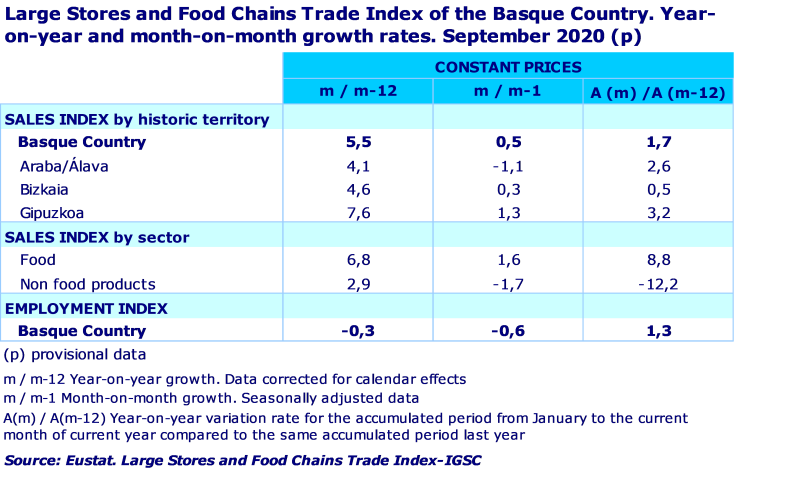
By province, in September 2020 all three registered a year-on-year increase in sales at constant prices, with a rise, once corrected for calendar effects, of 4.1% in Álava; 4.6% in Bizkaia; and 7.6% in Gipuzkoa.
In the accumulated total for January to September 2020, the Sales index in large stores and food chains was up 1.7%, due to the 8.8% increase in sales of food products, and the decrease of 12.2% in sales of other products.
Sales increased in all provinces in the year-to-date: Bizkaia by 0.5%, Álava by 2.6%, and Gipuzkoa by 3.2%, all at constant prices and in homogeneous terms of the working calendar.
The number of people employed in large stores and food chains in the Basque Country in September 2020 fell by 0.3% compared to the same month of the previous year and was down 0.6% on the previous month, in deseasonalised terms.
In the accumulated total for the first nine months of 2020 the number of people employed was up 1.3% on the same period of 2019.
NOTE:
Included as persons employed considered in this and other short-term indices, are those covered by an ERTE (Temporary Labour Force Adjustment Plan), following the definition of persons employed indicated by the Statistical Office of the European Union (Eurostat) in its manual Methodology of Short Term Business Statistics.
The models used in the correction of calendar effects and deseasonalisation of the series include the effect of COVID-19 on the variables studied, following the recommendations of the Statistical Office of the European Union (Eurostat) (Eurostat) in its methodological note Guidance on Time Series Treatment in the context of the COVID-19 crisis.
Eustat would like to thank all the establishments that have collaborated in making this effort despite the extraordinary current circumstances. As a result, the September index was calculated with 88.10% coverage of the sample - whose information was collected during October.
For further information:
Eustat - Euskal Estatistika Erakundea / Basque Statistics Institute
C/ Donostia-San Sebastián, 1 01010 Vitoria-Gasteiz
Press Service: servicioprensa@eustat.es Tel: 945 01 75 62