Press Release 29/09/2020
MUNICIPAL EDUCATION STATISTICS. 2019
In 2019 33% of the population aged 16 and over in the Basque Country had higher qualifications
The percentage of employed people increased the higher the level of education
A third of the population aged 16 and over residing in the Basque Country held a higher education qualification (615,877 people) in 2019, according to Eustat data. 22.4% corresponded to university qualifications (417,540) and 10.6% to higher level training courses (198,337 people).
One out of three residents aged 16 and over, 606,733, have a primary school qualification (32.5%); 401,245 (21.5%) hold a secondary school qualification and 156,358 people (8.4%) have a basic or intermediate vocational training qualification. Finally, 85,124 (4.6%) have no official qualification.
In relation to 2018, an increase was registered in the number of people with vocational training qualifications (1.1 percentage points) and university qualifications (half a percentage point) Meanwhile, there was a fall in the percentage of residents with primary school qualifications, which went from 33.7% in 2018 to 32.5% in 2019. To a lesser extent, there was also a fall in the percentage of people with secondary school qualifications (down 0.1 percentage points).
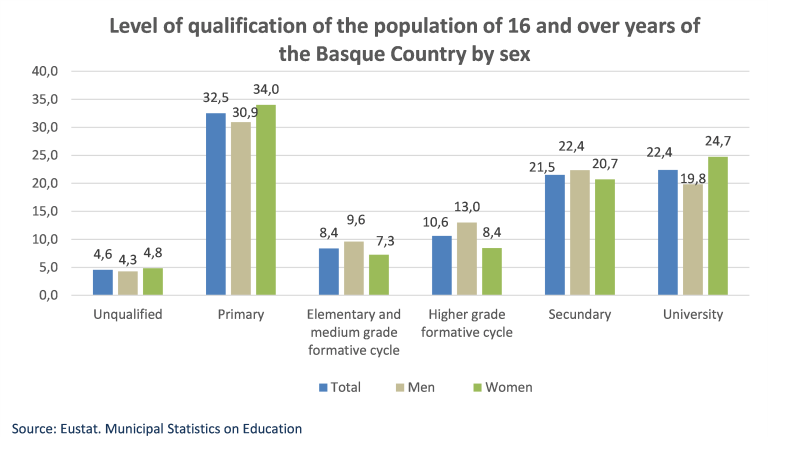
Taking into account the gender variable, women stood out in university qualifications, 24.7% compared to 19.8% for men, and similarly, in primary school or lower qualifications: 34% of women compared to 30.9% of men. However, the most notable differences were found in vocational training qualifications, the level in which there was a greater proportion of men (22.6%) than women (15.7%). The same occurred in secondary school qualifications, which were more common among men (22.4%) than women (20.7%)
At a provincial level, Álava presented a greater proportion of people with primary school qualifications, with a proportion of 33.6%. This province, with 22.2%, was also slightly above (by 0.7 percentage points) the Basque Country average in secondary school qualifications. However, the percentage of the population with university qualifications (20.3%) stood below the Basque Country average. Finally, 19.4% of those residing in Álava aged 16 and over had a professional qualification, 0.4 percentage points above the Basque Country average.
Bizkaia was the province where the greatest proportion of the population had a university qualification, with 23.4%, 1 point above the average. In contrast, it was the province with the fewest people with a professional qualification, 18.2%. Primary education stood at the average level, with 32.5% of the population having primary school qualifications.
Finally, Gipuzkoa was of note as the province with the greatest proportion of people holding a professional qualification (20.2%). The proportion of people with primary education stood at 32%, slightly below the average, and those with university qualifications accounted for 21.6%.
The differences are more pronounced on a regional level. In the case of higher qualifications (university qualifications and higher level vocational training qualifications), standing out were the regions of Plentzia-Mungia (42%), Estribaciones del Gorbea (35.5%), Donostialdea (35%) and Gran Bilbao (33.7%). In basic and intermediate vocational training, of particular note were the regions of Encartaciones (11.4%), Añana (10.3%) and Alto Deba and Arratia-Nervión (both with 10.2%). For secondary school qualifications, attention should be drawn to the regions of Plentzia-Mungia (24.2%), Bajo Bidasoa (23.9%) and Estribaciones del Gorbea (22%). Finally, the highest percentages in primary school qualifications were concentrated in Montaña Alavesa (44.9%), Rioja Alavesa (44.5%) and Añana (40.3%), all pertaining to Álava.
Almost half of the employed population had higher qualifications
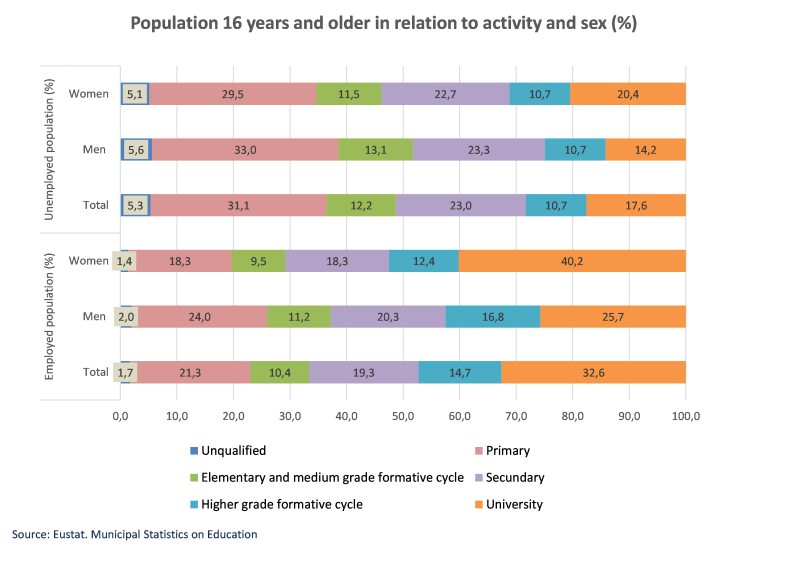
As for the relationship with activity, almost half of the employed population, 47.3%, had a higher qualification whereas this educational level represented 28.3% of the unemployed population. Inversely, 36.4% of the unemployed population had only primary education or did not have a qualification; when among the employed population the percentage is much lower (23%).
Gender differences, in both employment and unemployment, were more pronounced in the case of women with higher qualifications. 52.6%, more than half of the female employed population had higher qualifications, whereas the weight of these qualifications was 42.5% among employed men. Likewise, among the unemployed population the proportion of women with higher education, 31.1%, is higher than that of men, 24.9%.
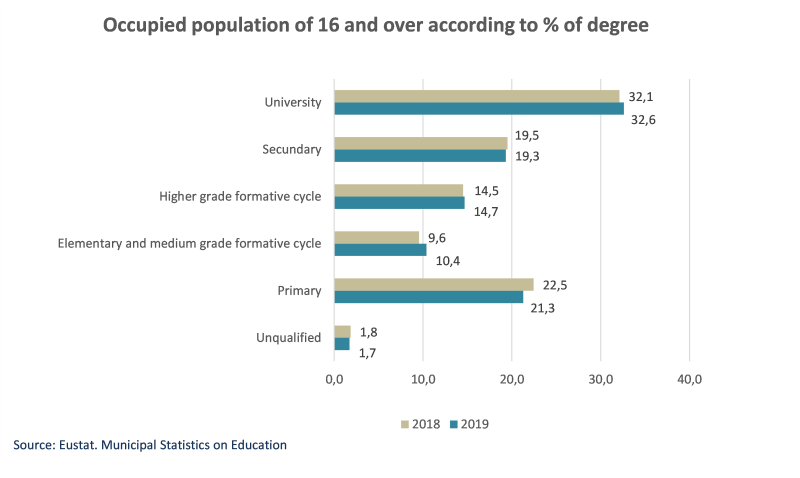
The differences in the relationship with activity in respect of the previous year are reduced. Among employed people university qualifications increased half a percentage point in 2019 compared to 2018, while the proportion of primary education was down 1.2 percentage points.
Methodological note: In this 2019 edition, with the aim of completing information relating to vocational training qualifications, information from the administrative register on certificates of professional qualifications issued by LANBIDE, the Basque Employment Service has been included. These Certificates of Professional Qualifications are organised by blocks, called training modules, which enable a personal itinerary of qualifications to be established and allows the educational administration to validate the units of competence that coincide with the Vocational Training qualifications, in order to facilitate the achievement of a regulated Vocational Training qualification.
For further information:
Eustat - Euskal Estatistika Erakundea / Basque Statistics Institute
C/ Donostia-San Sebastián, 1 01010 Vitoria-Gasteiz
Press service: servicioprensa@eustat.es Tel: 945 01 75 62