Press release 16/09/2020
MIGRATORY MOVEMENTS STATISTICS. 2019
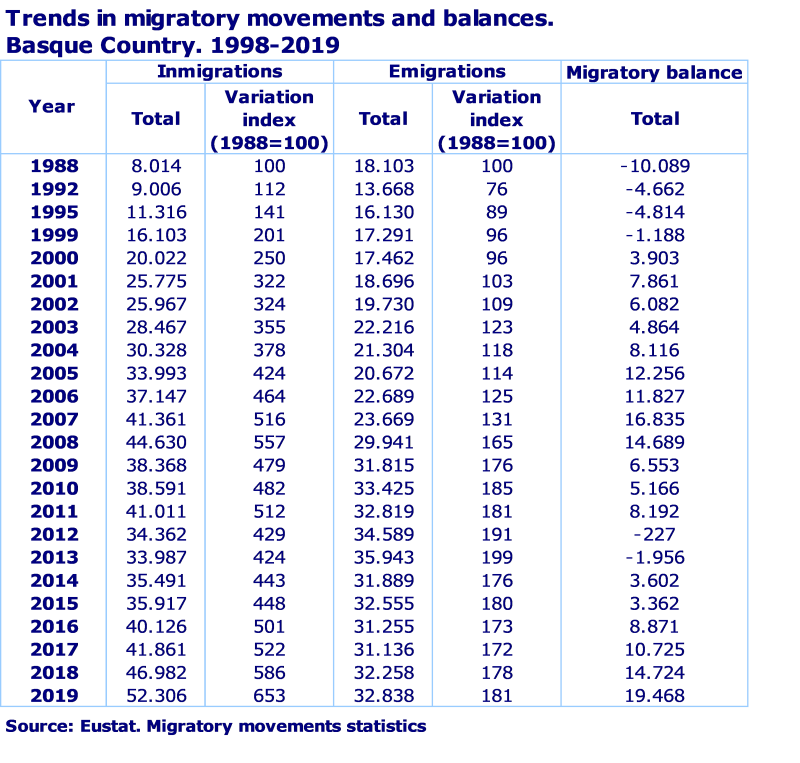
In 2019 the migratory balance of the Basque Country was positive, contributing 19,468 people to the population
The 2019 migratory balance is the highest in the last 20 years
In 2019 a positive migratory balance was posted in the Basque Country, contributing 19,468 more people to the population, a higher figure than the 14,724 in 2018, according to Eustat data.
By province, Bizkaia, which gained 11,217 people, recorded the highest migratory balance in absolute figures; Gipuzkoa had a positive balance of 5,389 people and Álava gained 2,862 people. The highest percentage rise in the migratory balance corresponded to the province of Bizkaia, with an increase of almost 60% compared to the previous year. The migratory balance saw growth of 11.5% in Gipuzkoa and in Álava it remained constant in respect of the previous year. Regarding the capitals, the municipality of Bilbao had a migratory balance of 4,856 people, Vitoria-Gasteiz of 2,345 and San Sebastián of 1,494 people.
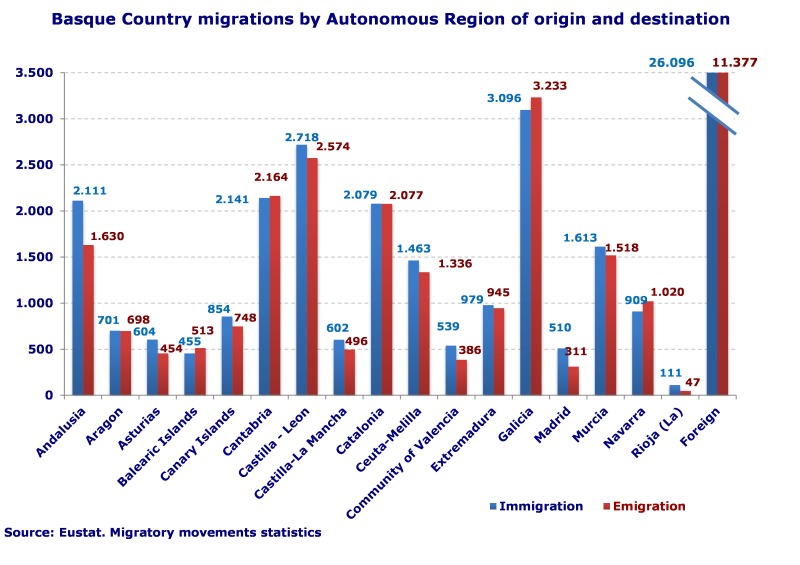
In relation to the movements that occur between the Basque Country and the other Autonomous Regions, there was a positive balance of 1,335 people in 2019, substantially higher than that of the previous year (82). On the other hand, the balance with foreign countries was positive by 18,133 people.
Since 2000, when the migratory movements of the Basque Country became positive, there have only been negative migratory balances in 2012 and 2013. The 2019 migratory balance is the highest in the last 20 years
Emigration rates continued to be relatively low
In 2019 external or extra-community geographical mobility involved almost 39 per thousand inhabitants of the Basque Country, and was 6 points below the other Spanish Autonomous Regions, where on average 45 inhabitants per thousand moved. By provinces, Álava reached 42.9‰, Bizkaia 38.2‰ and Gipuzkoa also stood at 38.2‰.
If we take into account the migratory movements with the different Autonomous Regions we see that the Basque Country maintained a positive migratory balance overall and there was only a negative balance with four of them.
The Autonomous Regions that contributed the most immigrants were, in descending order, Madrid, Castilla y León, Cantabria, Andalusia and Catalonia. Andalusia is the Autonomous Region that maintained the highest positive balance, with 481 people.
The Autonomous Regions that attracted the emigrants from the Basque Country were as follows, in order: Madrid, Castilla y León, Cantabria, Catalonia and Andalusia, that is, the same and in almost the same order. Between the five of them they received 60% of the people who left the Basque Country for other Autonomous Regions, although the negative balances were never more than 150 people.
The average age of the emigrants (36.3 years old) was higher than that of the immigrants (32.8 years old). 50% of immigrations and 46% of emigrations were by people in the 21-39 age group.
There were moderate differences in relation to gender: men represented 51% of immigrants and women 49%, similarly 53% of emigrants were men and 47% were women.
Almost 66% of immigrants and 44% of emigrants were foreign nationals
Immigrations of foreign nationals stood at 34,687 in 2019, representing almost two thirds of the total. Of these 7,239 came from other Autonomous Regions, primarily from Madrid, Catalonia, and Andalusia, and another 27,448 came directly from abroad.
Emigrations of foreign nationals rose to 14,558, accounting for 44% of the total. The destination for over half of them (61%) was abroad and therefore the balance of foreign nationals was positive by 20,129.
65% of the changes of residence among the Basque population occurred within the Autonomous Region of the Basque Country itself
11% of the Basque population changed their place of residence in 2019, with the mobility on 65% of the occasions being within the Basque Country, whilst in the other cases the mobility was extra-community. These figures are almost identical to those from 2018.
In total, 240,324 changes of normal places of residence were recorded in the Basque Country. Of these, 101,925 were changes of address within the same municipality. Intra-community mobility, in other words, where the origin and destination are different municipalities of the Basque Country, increased to 53,255 movements.
There were also 52,306 cases of extra-community or external immigration, which are those that have their origin outside the Autonomous Region and where the destination is the Basque Country. Of these cases, 30,821 came from abroad.
Finally, there were 32,838 cases of external or extra-community emigration, in other words, residential variations originating in a municipality of the Autonomous Region and with the destination outside it, 12,688 of which were to destinations abroad; an increase of 10.7% with respect to the 2018 figures.
For further information:
Eustat - Euskal Estatistika Erakundea / Basque Statistics Institute
C/ Donostia-San Sebastián, 1 01010 Vitoria-Gasteiz
Press Service: servicioprensa@eustat.es Tel: 945 01 75 62