Press Release 20/07/2020
UNIVERSITY STATISTICS 2019
The number of students in Basque universities in the 2018/19 academic year increased for the second consecutive year
12,993 young people finished their studies in 2019: 9,316 received an undergraduate degree qualification, 3,219 completed an official masters degree qualification and 458 obtained a doctorate.
In the 2018/19 academic year, universities with centres located in the Basque Country took in 67,374 students, which was 0.9% down on the previous year, according to Eustat data. This was the second consecutive year in which the number of enrolments increased.
Undergraduate students represented 84% of the total and saw an increase of 0.5% in respect of the previous academic year. The remaining 16% enrolled in postgraduate studies: official masters degrees and doctorates, with increases of 1% and 6.5%, respectively.
72% of students attended public universities, which have seen a drop of 7 percentage points over the last eight years. For undergraduate studies the percentage is the same (72%), whereas it reduces to 62% for masters degrees and rises to 87% for doctorates undertaken in the Basque Country.
In terms of where students studied, 59% attended universities in Bizkaia, 29% in Gipuzkoa and 12% in Álava.
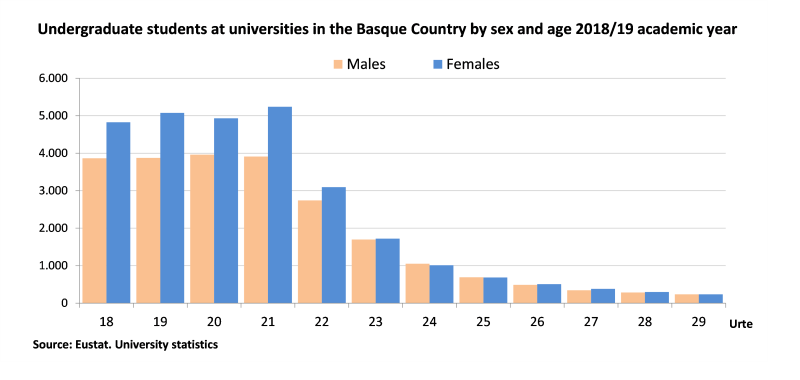
The proportion of women undergraduate students stood at 54%
There were higher numbers of women undergraduate students, exceeding men by 9 percentage points. There was a notable difference at the ages of 18-21, between 11 and 14 percentage points in favour of women, although the proportion of both sexes subsequently evens out.
With regards to doctorates, the gap in favour of women was less (3 points) and there is parity between both sexes in masters degrees.
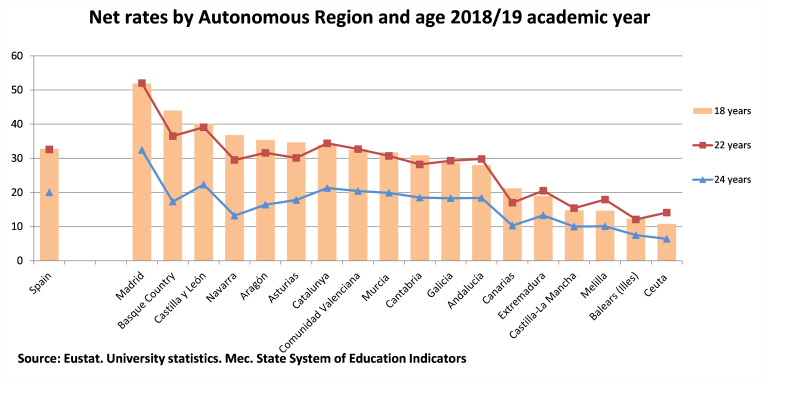
In the Basque Country 44% of the population aged 18 studied at university
For 18-year-olds, the schooling rate in university studies was 44% in the Basque Country, occupying second position in the list of Autonomous Regions, only behind Madrid (52%) and with a difference of 11 percentage points compared to the Spanish average.
For 22-year-olds the proportion was 36%, making it the Autonomous Region with the third highest schooling rate, behind Madrid (52%) and Castilla-León (39%). In contrast, the proportion of 24-year-olds was 17%, placing the Basque Country slightly below the Spanish average.
Gender determines choice of university degree
Of the 56,845 young people enrolled in undergraduate studies at a Basque University, half of them enrolled in one of the following: Business Management and Administration (5,683), Primary Education (4,007), Law (3,508), Psychology (2,766), Early Childhood Education (2,140), Mechanical Engineering (2,138), Medicine (1,840), Nursing (1,492), Social Education (1,489), Industrial and Technological Engineering (1,431), Social Work(1,338) and Industrial Electronics and Automation Engineering (1,256).
Gender continues to be decisive when choosing university studies; in fact, there was a majority of women in 36% of degrees and in another 39% there is a majority of men; only 25% of degrees have an equal proportion of men and women.
Of particular note is a group of degrees with a percentage of women higher than 80%, such as: Early Childhood Education, Pedagogy, Nursing, Modern Languages and Management, Translation and Interpreting and Preservation and Restoration of Cultural Assets.
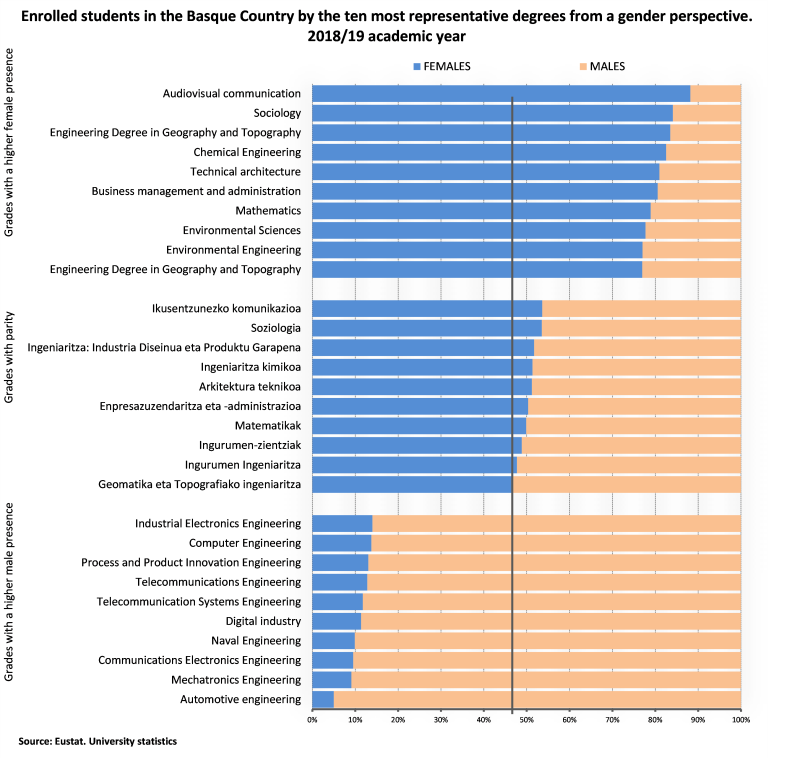
In contrast, all degrees with less than a quarter of women students belong to the branch of engineering. Furthermore, there are four degrees in which the proportion of men exceeds 90%: Marine Engineering, Electronic Communications, Mechatronics and Automotive Engineering.
Finally, the degrees with a more equal proportion of men and women were: Mathematics, Business Management and Administration, Environmental Sciences, Technical Architecture and Chemical Engineering.
In the 2018/19 academic year, a total of 12,993 young people completed their studies. 56% of them were women.
Of the 12,993 young people who finished their studies in 2019, 9,316 received an undergraduate degree qualification, 3,219 completed an official masters degree qualification and 458 obtained a doctorate. While the variation in respect of the previous year is insignificant in undergraduate degrees and masters, there was a 25% increase in the number of doctorates completed.
The branch of Social & Legal Sciences accounted for half of graduates, whereas degrees in the branch of Sciences and Health Sciences were less common, 6% and 7%, respectively.
The distribution of graduates by branches is different according to sex, as was the case with enrolments. In the branch of engineering and architecture the distribution by sex was more favourable towards men than women, with a difference of 24 percentage points, whereas the proportion of women in Health Sciences exceeded that of men by 13 points.
For further information:
Euskal Estatistika-Erakundea / Basque Statistics Institute
C/ Donostia-San Sebastián, 1 01010 Vitoria-Gasteiz
Press Service: servicioprensa@eustat.es Tel: 945 01 75 62